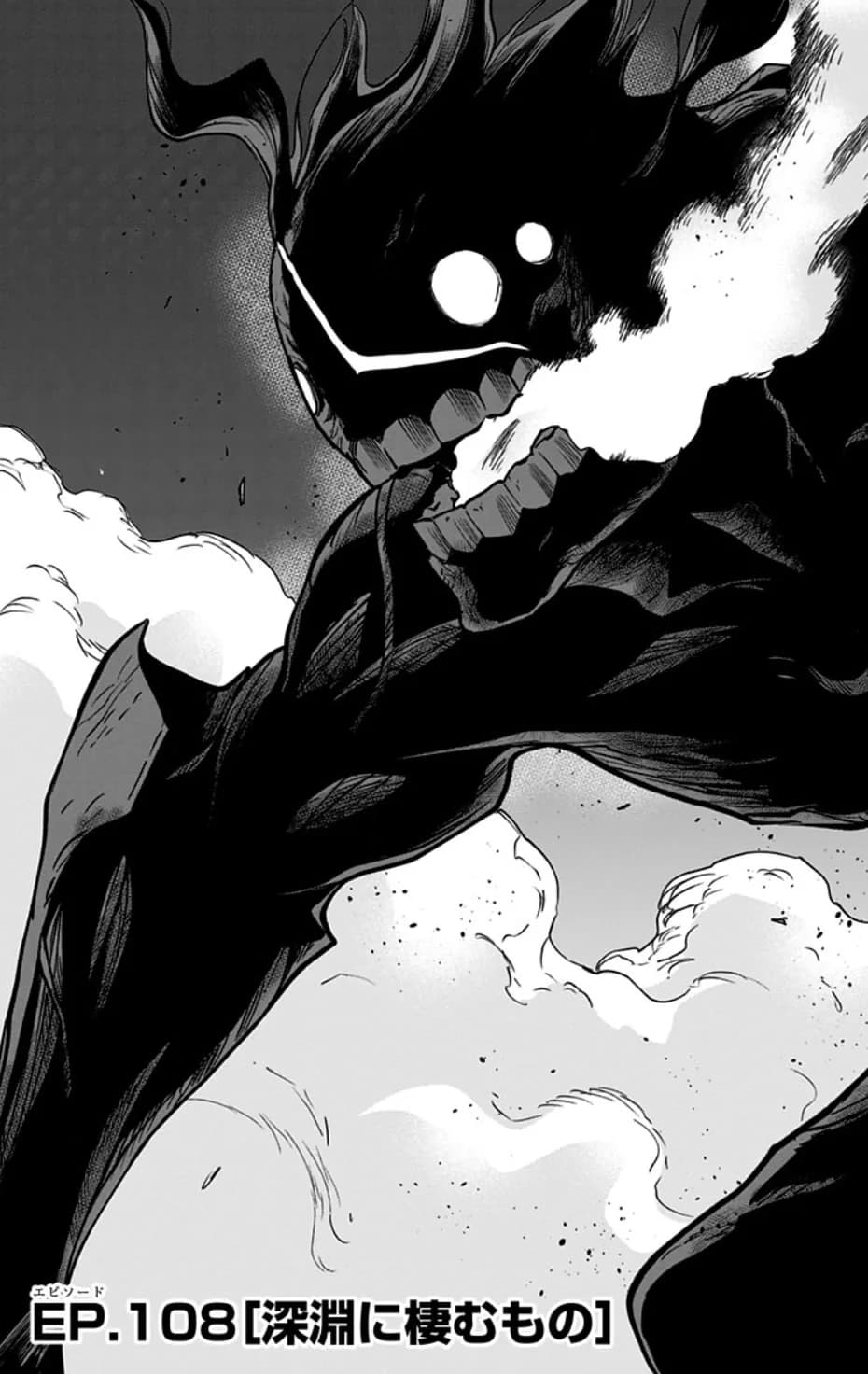
Vigilantes chapter 108 unleashes the Hi-Crawler, a body rebuilt to live inside Overclock permanently. Koichi survives it on instinct alone, having spent years as a vigilante learning to take the first hit and answer it without thinking.
Main Characters (4)
Summary
Koichi Haimawari recoils from the beast Number 6 has become, a shape the villain claims was built to endure his real speed. Calling it the Hi-Crawler, he tears across the distance and rakes at Koichi's legs with claws that Koichi barely avoids.
Koichi reasons that the villain has to slow down to strike with his hands, so distance is the answer, and gets a headbutt for it, then a body slam, then a stream of slashes exploiting every hesitation. Worse, he realizes the slowdown never happened at all: Number 6 has been carving at his weak points the entire time, and on this trajectory he dies soon.
The O'Clock illusion argues against the current approach even so. Normally the acceleration state of Overclock crushes the body under its own pressure, but the modifications have changed that, and a remodeled muscular structure plus additional eyes now let Number 6 hold the accelerated state indefinitely, an apex predator without a shutoff.
Then the illusion names the problem: the opponent is The Crawler. Heroes and police strike first, but years of vigilante work put Koichi permanently on the receiving end, absorbing the opening blow again and again. That history built a fight-or-flight response into him without his noticing, producing a variant fighter conditioned to answer any attack, which is exactly what carries him through this assault. Exhausted and startled by his own survival, Koichi holds on, while O'Clock tells Number 6 that overwhelming him with speed is not the way and points toward another strategy, the real purpose behind Phase 6.

Key Events
Number 6's beast form, the Hi-Crawler, is revealed to bypass every physical limitation Overclock would impose on his ordinary body, letting him remain accelerated permanently.
Koichi counters the onslaught almost perfectly, his years as a vigilante having drilled unconscious defensive reflexes into him.
With raw speed failing, the O'Clock illusion redirects Number 6 toward the true objective of Phase 6.
Related Reading
See all
Naruto vs Luffy: Does the Fight Change if Luffy Tickles Hinata?
Naruto vs Luffy with the twist nobody asked for: Luffy tickled Hinata on date night, and she kind of liked it. We break down the whole fight and commit to a winner....
Namek Has No Women, and Piccolo Pulls Anyway
There are no women on Namek. That isn't an oversight, it's the biology. Why we handed Piccolo the one thing his own species rules out, and why it had to be trap soul....


Notes
The nineteen-page chapter by Hideyuki Furuhashi and Betten Court ran on August 28, 2021 in the Naruhata Lockdown arc and opens volume 14, with Number 6 on the cover.
Magazine readers saw it as The Variant (Igyō no Mono) before the volume renamed it Dweller of the Depths.
Only three figures appear: Number 6, Koichi, and the O'Clock illusion projected by All For One.
Frequently Asked Questions
What happens in My Hero Academia: Vigilantes Chapter 108?
Chapter 108, Dweller of the Depths, has Number 6 unveil his Hi-Crawler beast form, which lets him hold Overclock's accelerated state permanently, while Koichi Haimawari barely survives the assault on pure instinct.
What is the Hi-Crawler in My Hero Academia: Vigilantes?
The Hi-Crawler is the monstrous beast form Number 6 takes in Chapter 108, remodeled with extra eyes and muscle so he can stay in Overclock's accelerated state indefinitely instead of being crushed by it.
How does Koichi Haimawari survive the Hi-Crawler's attack?
Koichi Haimawari survives because years of taking the first hit as a vigilante trained an unconscious fight-or-flight response into him, letting him answer Number 6's onslaught almost perfectly without thinking it through.
What does the O'Clock illusion tell Number 6 in Chapter 108?
The O'Clock illusion tells Number 6 that overwhelming Koichi Haimawari with raw speed will not work and redirects him toward the true objective behind Phase 6 of Operation Anonymous.
Who are the only characters to appear in Chapter 108?
Only three figures appear in Chapter 108: Number 6, Koichi Haimawari, and the O'Clock illusion projected by All For One.
Sources & Information
Looking for more on Chapter 108 (Vigilantes)? The My Hero Academia Wiki on Fandom has a dedicated page with community notes.
View on FandomThis content is original writing by Daddy Jim Headquarters based on the My Hero Academia anime series, manga, and official materials. My Hero Academia was created by Kohei Horikoshi, published by Shueisha, and animated by Bones. All rights to My Hero Academia and its characters belong to their respective owners. Episode and chapter references are cited where applicable.
Rights holders
All rights belong to their respective owners.
Character and scene imagery on this site is original artwork by Daddy Jim Headquarters, not screenshots or licensed imagery. Official cover art is used on three types of pages for editorial commentary:
- Movie pages: theatrical posters and key visuals, credited to Bones and Shueisha.
- Game pages: official box art, credited to the game's respective publishers.
- Manga chapter pages: volume covers, credited to Shueisha and Kohei Horikoshi.
Official resources:
Help Us Keep This Wiki Accurate
Daddy Jim Headquarters maintains this encyclopedia. If you spot an error, a translation issue, or something that doesn't look right, let us know.