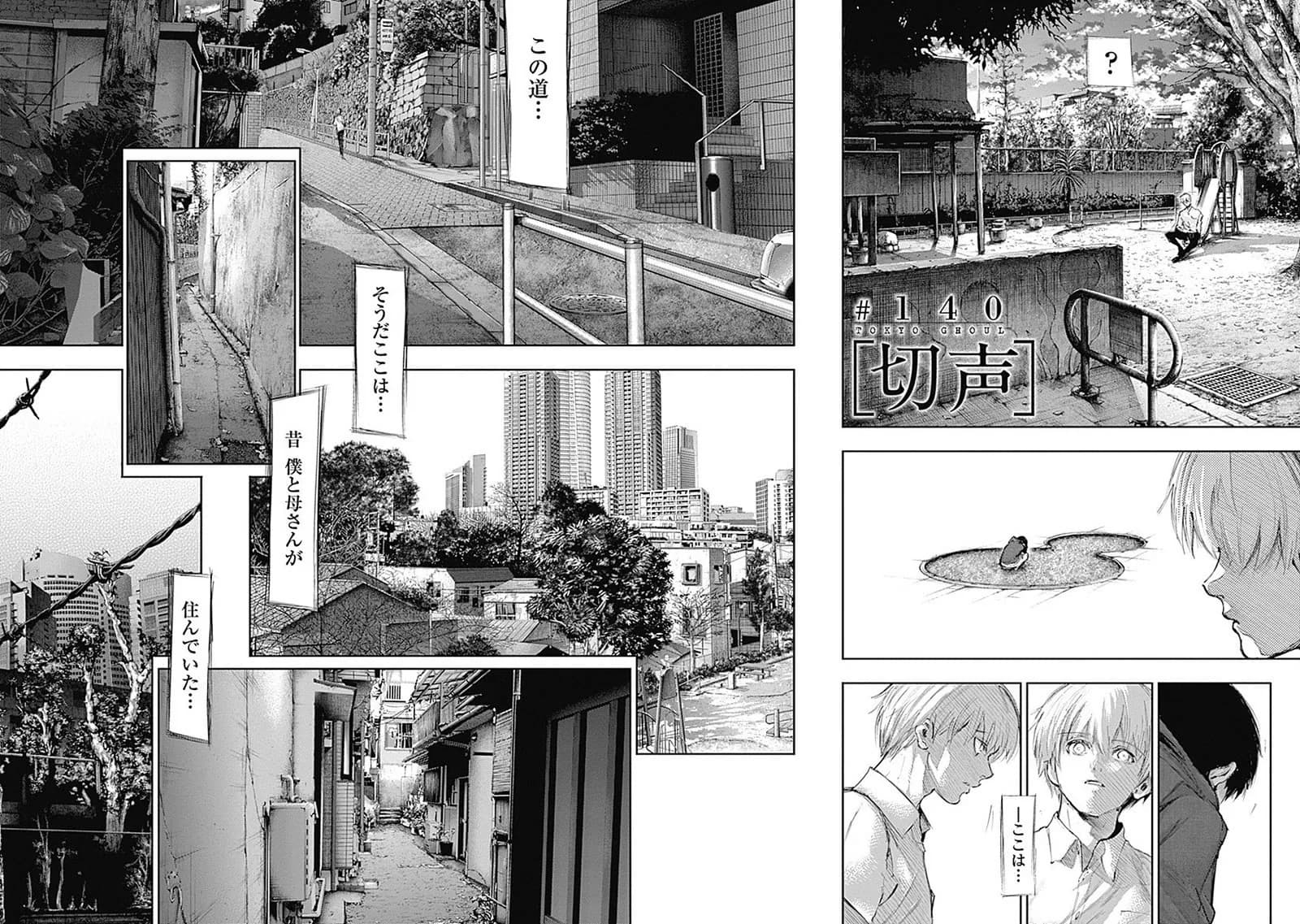
The one hundred fortieth chapter of Tokyo Ghoul retreats entirely into Kaneki's mind as he lies broken before Arima. Reliving his mother and his lonely childhood, he confronts his own selfishness, makes peace with his younger self, and finally recalls the night that made him a ghoul.
Summary
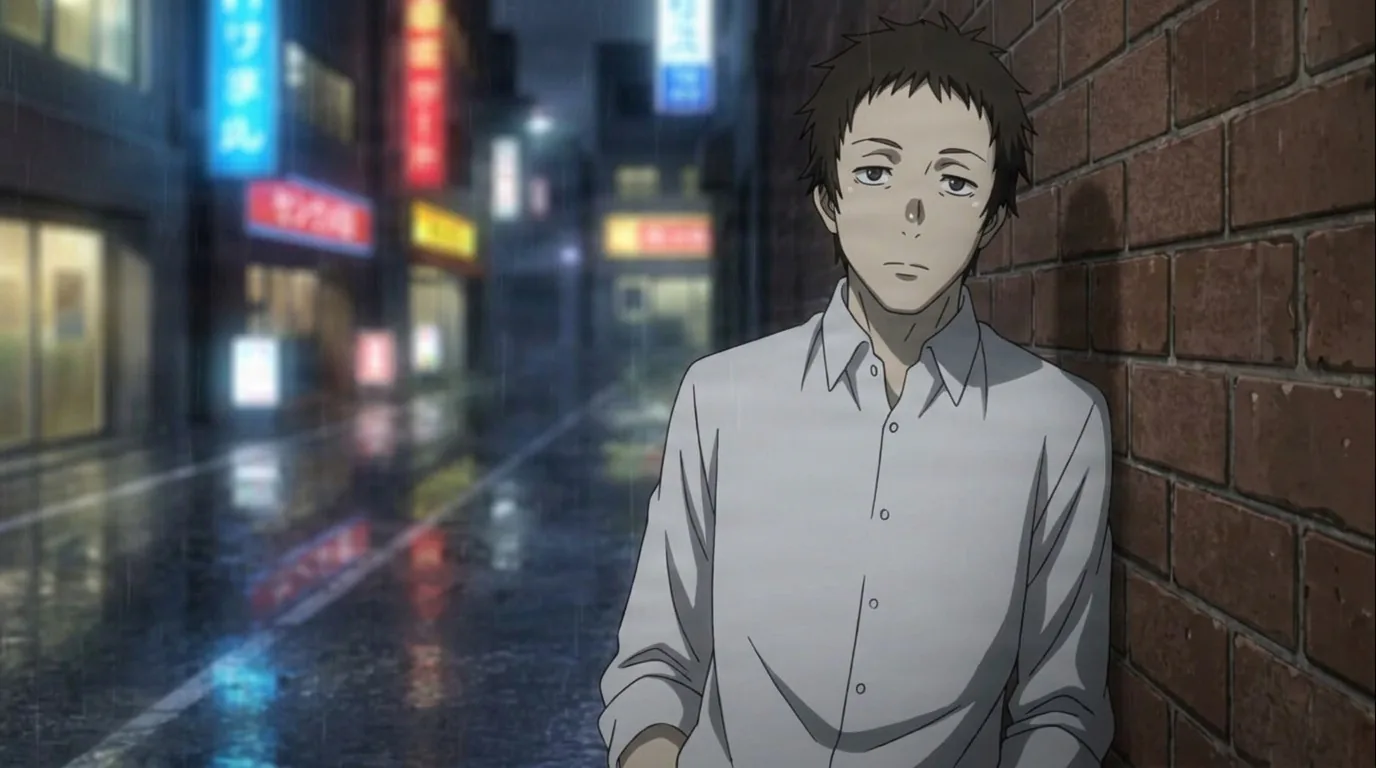
Beaten and sinking into his own defeat, Kaneki drifts into a memory of the street where he lived with his mother as a boy. She greets him home, worn out yet still toiling, and he pleads with her to ease off the overwork he never dared question as a child. Looking back, he sees how her drive to give everything to those she loved slowly cornered her, and he weighs that pattern against the choices his friends offered him: to simply live, to be rescued, to return to Anteiku, or to stay put. From this he draws a harsh conclusion, that he and his mother were alike in only pretending to care for others while really serving themselves.
He grasps at last why she labored so hard for her sister, tracing it back to his father's death and her terror of losing anyone dear to her. She was no gentle soul, he decides, but a coward afraid of being alone, and he admits he is the same, never truly wanting to shield everyone, only himself. Recalling a childhood of reading alone in his father's room and playing alone in the sandbox, he concedes that Touka was right to call him a selfish coward.

Key Events
Kaneki spots his younger self sitting in a sandbox and walks over, inviting the boy to come home. Taking his own small hand to fill the hollow places in his memory, he wanders with no destination and asks the child whether he loved their mother. The boy answers that he dreams of growing up to be just like her, someone who worked tirelessly for others into the night. Realizing how far his life bent away from that promise once he became a ghoul, Kaneki breaks down in tears and apologizes for the man he became. His younger self comforts and thanks him for fighting in place of his weaker half, then suggests they rest, and both figures crumble away into ash.


Notes
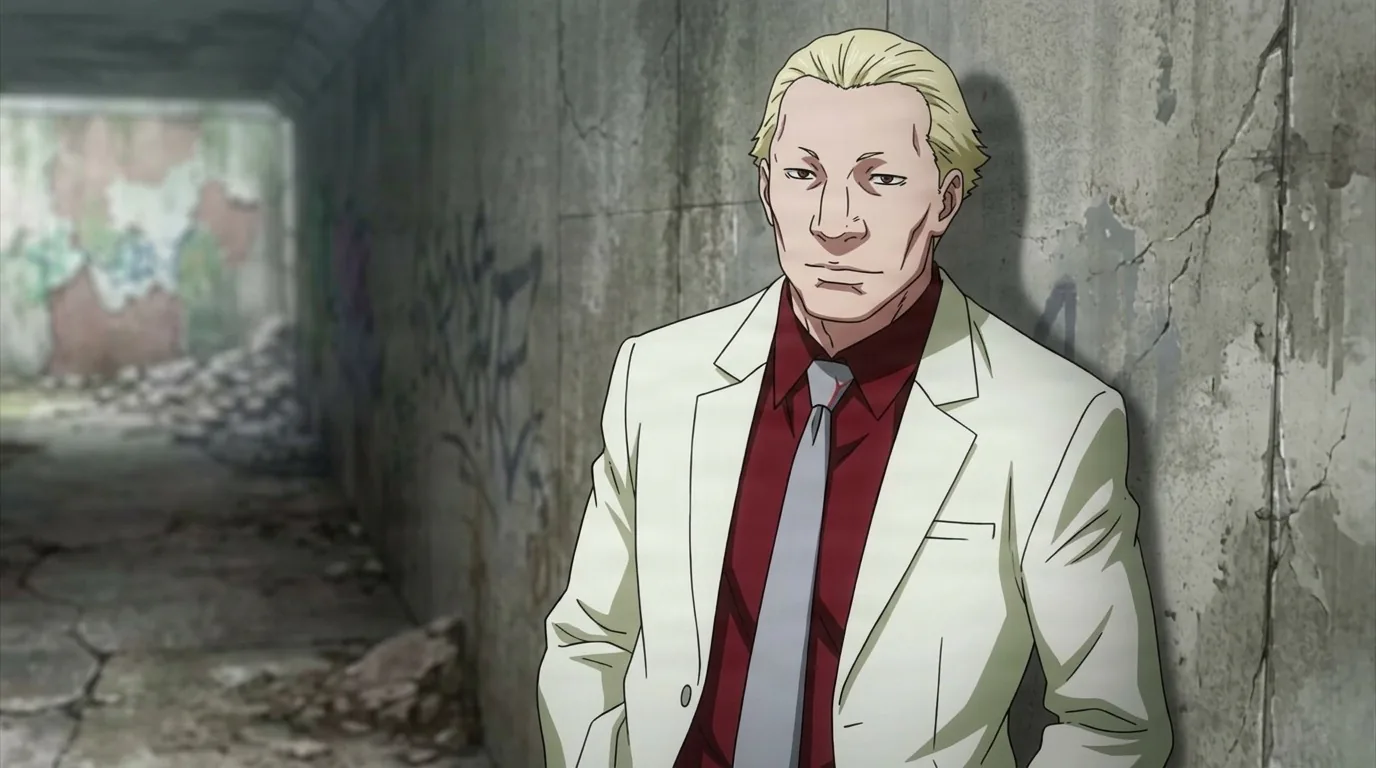
As his awareness slips, Kaneki finally recalls the night he and Rize Kamishiro were crushed in the Steel Beam Incident. Behind Rize's stare stood a laughing clown counting backward in steps of seven, a meaning he knows he will never learn, since he was already blacking out limp at Arima's feet.
Frequently Asked Questions
What does Kaneki relive while lying defeated before Arima in Chapter 140?
In Chapter 140, a beaten Kaneki drifts into a memory of the street where he lived with his overworked mother, pleading with her in his mind to ease off the labor he never questioned as a child.
What conclusion does Kaneki reach about himself and his mother in Chapter 140?
Kaneki concludes that he and his mother were alike in only pretending to care for others while really serving themselves, tracing her exhausting devotion to her sister back to his father's death and her fear of losing anyone dear to her.
What happens when Kaneki meets his younger self in Chapter 140?
Kaneki finds his younger self sitting in a sandbox, invites him home, and asks whether he loved their mother. The boy answers that he dreams of growing up to be just like her, which leaves Kaneki in tears apologizing for the man he became.
How does Kaneki's memory sequence end in Chapter 140?
Kaneki's younger self comforts him and thanks him for fighting in his place, and after the two suggest resting together, both figures crumble away into ash.
What does Kaneki finally recall about the Steel Beam Incident in Chapter 140?
As his awareness fades, Kaneki finally recalls the night he and Rize Kamishiro were crushed in the Steel Beam Incident, remembering a laughing clown behind Rize's stare counting backward in steps of seven before he blacks out at Arima's feet.

Sources & Information
Looking for more on Moderation? The Tokyo Ghoul Wiki on Fandom has a dedicated page with community notes.
View on FandomThis content is original writing by Daddy Jim Anime based on the Tokyo Ghoul anime series, manga, and official materials. Tokyo Ghoul was created by Sui Ishida, published by Shueisha, and animated by Studio Pierrot. All rights to Tokyo Ghoul and its characters belong to their respective owners. Episode and chapter references are cited where applicable.
Rights holders
- Created bySui Ishida
- Published byShueisha
- Animated byStudio Pierrot
All rights belong to their respective owners.
Character and scene imagery on this site is original artwork by Daddy Jim Anime, not screenshots or licensed imagery. Official cover art is used on three types of pages for editorial commentary:
- Movie pages: theatrical posters and key visuals, credited to Studio Pierrot and Shueisha.
- Game pages: official box art, credited to the game's respective publishers.
- Manga chapter pages: volume covers, credited to Shueisha and Sui Ishida.
- Licensed imagery: Photographs of real people, including creators, voice actors and production staff, are used under licence from the rights holder or the applicable stock provider, or under the terms of a public licence permitting editorial use. Each such image is reproduced in its licensed form and remains the property of its owner.
- Exceptions: Limited exceptions to the practices described above may apply to individual entries. Where an exception applies, it is noted on the entry itself alongside the applicable attribution. Rights holders may contact us regarding any attribution and it will be reviewed promptly.
Official resources:
Help Us Keep This Wiki Accurate
Daddy Jim Anime maintains this encyclopedia. If you spot an error, a translation issue, or something that doesn't look right, let us know.