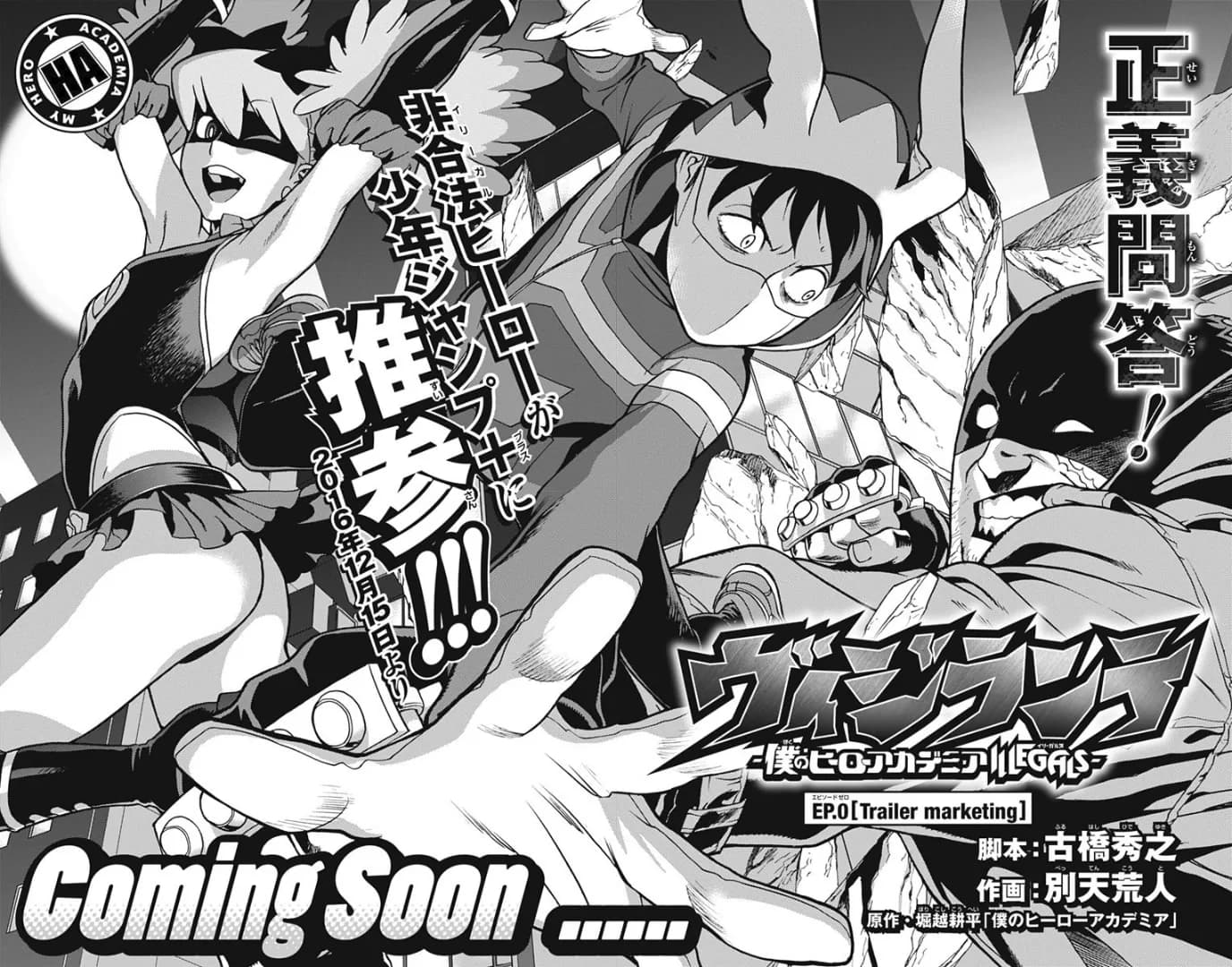
A non-canon preview built to promote My Hero Academia: Vigilantes, framed as a lecture. All Might and Shota Aizawa walk Class 1-A through what a vigilante is and why the law treats them as villains, while the series' three leads demonstrate the point in the field.
Main Characters (6)
Summary
Izuku Midoriya, at U.A. High School, puzzles over the word vigilante until All Might arrives with an explanation: someone who takes public action for the sake of public safety with no regard for legality. The roots of heroism itself trace back to them, All Might notes, and Izuku works out the implication. During the early Quirk phenomenon no body existed to license or organize Pro Heroes, meaning the very first Pros were vigilantes by definition. Shota Aizawa adds that today's Hero Regulations criminalize handing out punishment without credentials, so modern law draws no distinction between a vigilante and a villain, though he considers them relics who have mostly died out.
In an alley, a criminal with a blade for an arm corners a girl and demands her bag. A muscular figure in bandages drops from above with a kick, catches the blade arm to render it useless, and puts him down with a punch. Furious at the intent behind even a petty crime, he declares every offender a villain worth punishing. He is Knuckleduster. Elsewhere a teenage girl flies on her Quirk, irritated that the regulations bar public Quirk use and force her to walk like everyone else, a rule she finds childish; she is Pop☆Step, and she perches on a rooftop with no interest in rules. A third figure, a boy in a hooded jacket modeled on All Might, sprints along the ground with his own Quirk, recovering a lost phone, guiding a stranger through town, finding a missing child, and helping elderly women cross streets. Nice Guy finds these small acts wonderful.
Back in the classroom, Shota labels the three heinous criminals and forbids imitation, which bewilders Nice Guy. Shota cites his public Quirk use, while All Might zeroes in on the parka and wonders aloud whether it happens to be the Official Online-Exclusive Limited Edition model, leaving Nice Guy stunned to meet him. Shota then dresses him down for wearing misleading clothes and doing misleading deeds without a proper costume or qualifications, and Nice Guy defends himself as someone helping people. Knuckleduster turns up to scold him for behaving like a criminal and Pop☆Step calls him stupid, and all three scatter when Shota reaches for the Police Force. He was bluffing. Guiding how ordinary people live is not a hero's work, he says, and as long as vigilantes do not turn their Quirks toward evil they can be left alone. He goes further: plain fan admiration can produce someone like Nice Guy, so heroes should keep fan interaction within reason, a thought All Might finds frightening. Class 1-A promises not to associate with vigilantes, and Shota closes on the paradox. Inwardly they are heroes, but measured objectively they are villains, and whatever else happens these illegal heroes must never be copied.

Key Events
All Might defines vigilantism for Class 1-A and establishes that the first Pro Heroes were themselves vigilantes, since no regulatory body existed when Quirks first appeared.
Knuckleduster, Pop☆Step, and Nice Guy are each introduced through short field vignettes that illustrate their approaches, and all three end up in the classroom before fleeing a fake police call.
Shota articulates the series' central tension, calling vigilantes heroes on the inside and villains by any objective measure, and warns the class against imitating them.
Related Reading
See all
Naruto vs Luffy: Does the Fight Change if Luffy Tickles Hinata?
Naruto vs Luffy with the twist nobody asked for: Luffy tickled Hinata on date night, and she kind of liked it. We break down the whole fight and commit to a winner....
Namek Has No Women, and Piccolo Pulls Anyway
There are no women on Namek. That isn't an oversight, it's the biology. Why we handed Piccolo the one thing his own species rules out, and why it had to be trap soul....
Notes
The chapter is non-canon and runs fifteen pages, collected in Volume 4 and followed by Chapter 1 of Vigilantes. Its Japanese title is given as Trailer marketing, matching its purpose as promotional material.
Knuckleduster, Pop☆Step, and Nice Guy appear on the cover under their vigilante identities.
A VOMIC adaptation of the chapter was produced to promote the debut season of the Vigilantes anime.
Frequently Asked Questions
What is Episode Zero about?
Episode Zero is a non-canon preview chapter that promotes My Hero Academia: Vigilantes, framed as a classroom lecture. All Might and Shota Aizawa explain what a vigilante is to Class 1-A while the series' three leads, Knuckleduster, Pop Step, and Nice Guy, are shown in action out in the field.
Is Episode Zero canon?
No, Episode Zero is explicitly labeled non-canon. It was created as fifteen-page promotional material to introduce My Hero Academia: Vigilantes and is collected in Volume 4.
Who are the three vigilantes introduced in Episode Zero?
Episode Zero introduces Knuckleduster, Pop Step, and Nice Guy, the three central vigilantes of the spin-off series. Each is shown through a short field vignette demonstrating their approach before crossing paths in Class 1-A's classroom.
What does All Might tell Class 1-A about vigilantes in Episode Zero?
All Might explains that a vigilante is someone who takes public action for public safety without regard for legality, and that the earliest Pro Heroes were technically vigilantes since no licensing body existed when Quirks first appeared. Shota Aizawa adds that modern Hero Regulations draw no legal distinction between a vigilante and a villain.
How does Shota Aizawa describe vigilantes in Episode Zero?
Shota Aizawa calls vigilantes heroes on the inside but villains by any objective legal measure, warning Class 1-A never to imitate them despite their good intentions. He reaches this conclusion after Knuckleduster, Pop Step, and Nice Guy flee his classroom when he bluffs about calling the police.
Sources & Information
Looking for more on Episode Zero? The My Hero Academia Wiki on Fandom has a dedicated page with community notes.
View on FandomThis content is original writing by Daddy Jim Headquarters based on the My Hero Academia anime series, manga, and official materials. My Hero Academia was created by Kohei Horikoshi, published by Shueisha, and animated by Bones. All rights to My Hero Academia and its characters belong to their respective owners. Episode and chapter references are cited where applicable.
Rights holders
All rights belong to their respective owners.
Character and scene imagery on this site is original artwork by Daddy Jim Headquarters, not screenshots or licensed imagery. Official cover art is used on three types of pages for editorial commentary:
- Movie pages: theatrical posters and key visuals, credited to Bones and Shueisha.
- Game pages: official box art, credited to the game's respective publishers.
- Manga chapter pages: volume covers, credited to Shueisha and Kohei Horikoshi.
Official resources:
Help Us Keep This Wiki Accurate
Daddy Jim Headquarters maintains this encyclopedia. If you spot an error, a translation issue, or something that doesn't look right, let us know.
