Capsule
ItemRevolutionary storage devices invented by Dr. Brief that can shrink and contain virtually any object, from motorcycles to entire houses, inside a tiny pill-shaped container.
Invention and Mechanics
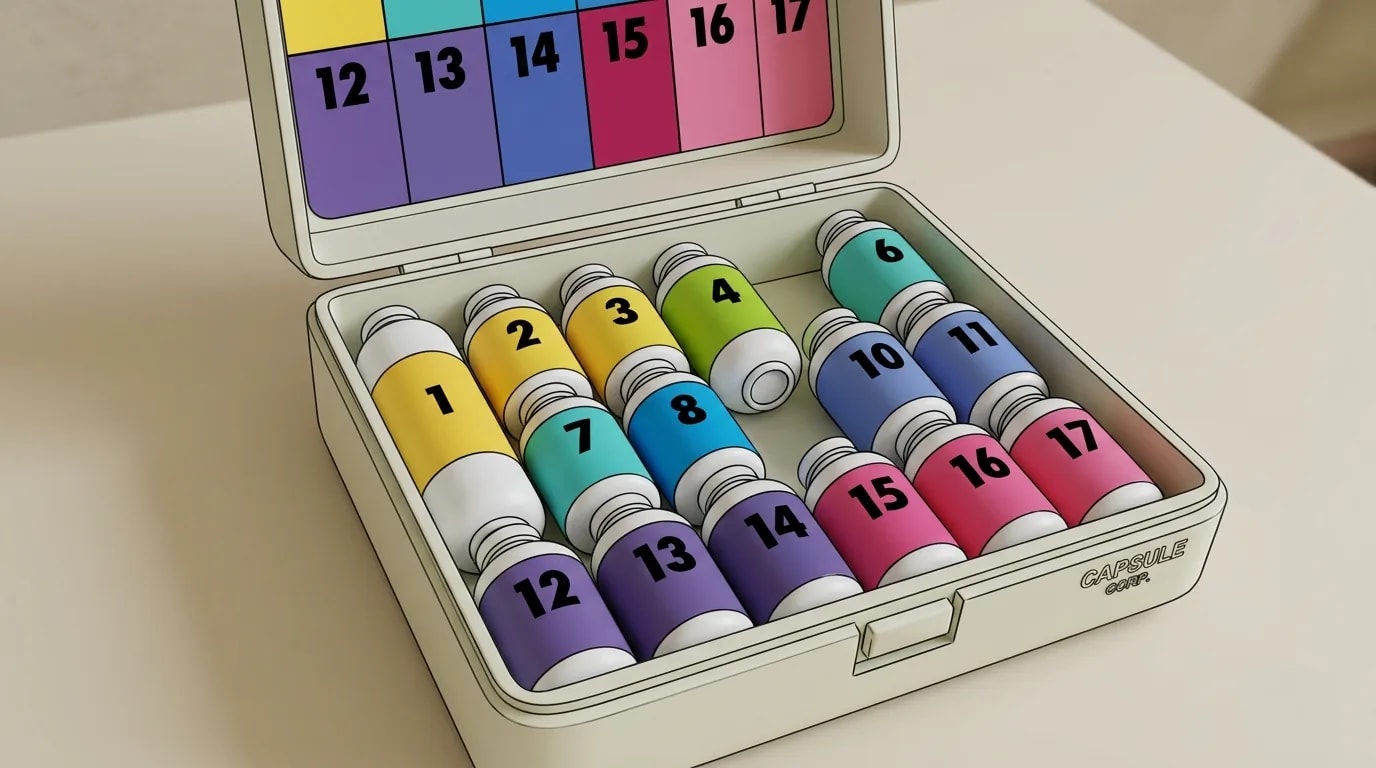
Capsules, commonly known as Hoi-Poi Capsules or DynoCaps, are among the most transformative inventions in the Dragon Ball world. Created by Dr. Brief, the founder of Capsule Corporation, these small pill-shaped devices use a proprietary technology to compress and store objects of virtually any size. A single capsule can contain anything from a motorcycle to a fully furnished house, released instantly with a click of the top button and a toss.
The technology operates on a principle of matter compression, shrinking objects down to fit within the capsule's compact shell. To deploy an item, the user presses the button on top and throws the capsule; upon impact, the stored object materializes at full size in a puff of smoke. To store an item, the process is reversed, collapsing the object back into capsule form. Each capsule is numbered and color-coded for easy identification.
Impact on Society
Capsule technology revolutionized daily life across the entire planet. Transportation, housing, and logistics were all fundamentally altered by the ability to carry enormous objects in a pocket. Capsule Corporation grew into the wealthiest and most influential company on Earth, largely on the strength of this single invention. The technology is so ubiquitous that characters throughout the series casually produce vehicles, shelters, and supplies from capsules at a moment's notice.
Bulma, Dr. Brief's daughter, is the character most frequently seen using capsules throughout the franchise. She introduced Goku to the technology at the very beginning of the original Dragon Ball series and continued to rely on it throughout Dragon Ball Z, Dragon Ball Super, and Dragon Ball GT.



Frequently Asked Questions
What are the capsules in Dragon Ball called?
Revolutionary storage devices invented by Dr. Brief that can shrink and contain virtually any object, from motorcycles to entire houses, inside a tiny pill-shaped container. Capsules, commonly known as Hoi-Poi Capsules or DynoCaps, are among the most transformative inventions in the Dragon Ball world.
Did Bulma invent capsules?
Created by Dr. Brief, the founder of Capsule Corporation, these small pill-shaped devices use a proprietary technology to compress and store objects of virtually any size. A single capsule can contain anything from a motorcycle to a fully furnished house, released instantly with a click of the top button and a toss. The technology operates on a principle of matter compression, shrinking objects down to fit within the capsule's compact shell.
Why is Capsule Corp Goku called Capsule Corp?
The Capsule was created by Dr. Brief. Created by Dr. Brief, the founder of Capsule Corporation, these small pill-shaped devices use a proprietary technology to compress and store objects of virtually any size.
What is the Capsule in Dragon Ball?
A single capsule can contain anything from a motorcycle to a fully furnished house, released instantly with a click of the top button and a toss. The technology operates on a principle of matter compression, shrinking objects down to fit within the capsule's compact shell. To deploy an item, the user presses the button on top and throws the capsule; upon impact, the stored object materializes at full size in a puff of smoke.
What does the Capsule do in Dragon Ball?
The technology operates on a principle of matter compression, shrinking objects down to fit within the capsule's compact shell. To deploy an item, the user presses the button on top and throws the capsule; upon impact, the stored object materializes at full size in a puff of smoke. To store an item, the process is reversed, collapsing the object back into capsule form.

Sources & Information
Looking for more on Capsule? The Dragon Ball Wiki on Fandom has a dedicated page with community notes.
View on FandomThis content is original writing by Daddy Jim Headquarters based on the Dragon Ball anime series, manga, and official materials. Episode and chapter references are cited where applicable.
Character and scene imagery on this site is original artwork by Daddy Jim Headquarters, not screenshots or licensed imagery. Official cover art is used on three types of pages for editorial commentary:
- Movie pages: theatrical posters and key visuals, credited to Toei Animation and Shueisha.
- Game pages: official box art, credited to Bandai Namco, Atari, and other publishers.
- Manga chapter pages: Jump Comics volume covers, credited to Shueisha and Akira Toriyama.
Browse our episode guides:
Official resources:
Help Us Keep This Wiki Accurate
Daddy Jim Headquarters maintains this encyclopedia. If you spot an error, a translation issue, or something that doesn't look right, let us know.