Daima Saga
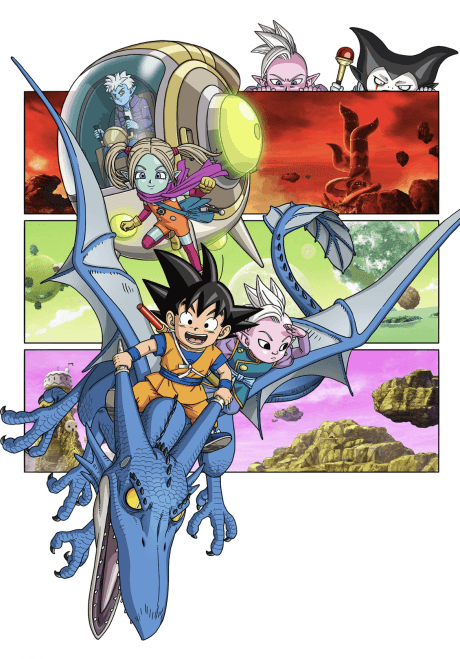
SagaDragon Ball Daima follows Goku and his allies after a Demon Realm conspiracy transforms them into children. Traveling to the mysterious Third Stellar Region alongside the enigmatic Glorio, mini Goku must recover the Demon Realm Dragon Balls, confront the scheming King Gomah, and uncover secrets that reshape the lore of the entire franchise.
A Wish That Shrinks the World
In the shadows of the Demon Realm, newly crowned King Gomah and his advisor Degesu hatch a desperate plot. Having witnessed the defeat of Majin Buu through a magical monitor, Gomah fears that Earth's warriors could easily overrun his domain. His solution is deviously simple: use Earth's Dragon Balls to transform every fighter involved in Buu's defeat into helpless children. With the aging Namekian sorcerer Neva at his side, Gomah travels to the Lookout, overpowers Dende, summons Shenron, and makes his wish. In an instant, Goku, Vegeta, Piccolo, and all their allies are reduced to miniature versions of themselves.
Into the Demon Realm
The shock of transformation gives way to urgency when the group learns that Dende has been kidnapped and taken back to the Demon Realm, rendering Earth's Dragon Balls useless. A mysterious demon named Glorio arrives at the Lookout with a proposition: he needs Goku's strength to overthrow Gomah. With Supreme Kai Shin joining the expedition, the trio boards Glorio's small ship and departs for the Demon Realm, leaving Vegeta behind to wait for Bulma to repair a second vessel. Their journey takes them through a Sir Warp transit point on Planet Batapi, and for the first time, Goku steps foot into an entirely new dimension of the Dragon Ball universe.
The Third Demon World
The Third Demon World greets the travelers with heavy air that slows movement, floating islands, and a massive statue of the late Dabura looming over the landscape. Goku struggles to adapt to his shrunken body and the oppressive atmosphere. Along the way, the group encounters bandits, hostile bar patrons who despise outsiders, and the tyrannical Gendarmerie, a military police force that terrorizes civilians under Gomah's rule. It is here that they meet Panzy, a spirited young rebel princess who joins their quest after Goku rescues her from the Gendarmerie. When the group reaches King Kadan's castle, Goku proves his worth by effortlessly defeating an entire garrison of soldiers, earning the king's trust and a plane for the long journey ahead.
Dragon Balls of the Demon Realm
The quest shifts to collecting the three Demon Realm Dragon Balls, each guarded by a fearsome Tamagami created by Neva himself. These ancient guardians are far more dangerous than anything Goku has faced in his diminished form, forcing him to push his abilities to their limits. Meanwhile, Vegeta, Piccolo, and the others finally arrive in the Demon Realm aboard the repaired ship, adding their strength to the campaign. As the group battles through the Second and First Demon Worlds, they discover that Glorio's loyalties are more complicated than they appeared. He has been reporting to Dr. Arinsu, sister of Degesu, whose true ambitions involve the legendary Evil Third Eye, an artifact of absolute power lost during an ancient reign.
The Truth Behind the Conspiracy
The final act peels back layers of deception. Dr. Arinsu's plan was never simply to support Gomah; she manipulated everyone, including her own brother, to position herself to claim the Evil Third Eye. The climactic battles take place across the First Demon World and the Demon King's Palace itself, where Goku must fight not only Gomah's forces but the consequences of Arinsu's scheming. In the end, Goku's determination and the bonds forged during this strange journey prove decisive. The Demon Realm Dragon Balls are gathered, the wish to restore everyone to their proper forms is made, and the Demon Realm's political landscape is forever altered. Dende is rescued, and the heroes return home carrying knowledge of an entire civilization that had existed beyond their awareness for all of Dragon Ball history.



Battles Across Three Worlds
Daima reimagines combat through the lens of Goku's child-sized body. His reduced reach and the Demon Realm's heavy atmosphere force him to rely on the Power Pole and creative tactics rather than raw power. Early encounters with bandits and bar brawlers establish the tone: this is a Goku who must think and adapt rather than simply overpower. The fights against King Kadan's soldiers showcase his speed and technique even in diminished form, and the crowd's stunned silence speaks louder than any power level readout.
The Tamagami Trials
Each Tamagami battle serves as a major set piece. These ancient guardians possess abilities unlike any previous Dragon Ball villain, drawing on Demon Realm magic rather than ki-based combat. Goku discovers that brute force alone cannot overcome creatures designed by Neva to be unbeatable, leading to some of the most inventive fight choreography in the franchise. The battles push the animation quality to breathtaking heights, with fluid movement and dynamic camera work that honors Toriyama's original vision for kinetic action.
Glorio's True Colors
One of Daima's most compelling confrontations is not physical but emotional. The revelation that Glorio has been working for Dr. Arinsu creates a moment of genuine betrayal that the series earns through episodes of trust-building. When Glorio must choose between his employer and the companions who have fought beside him, the tension surpasses many of the saga's actual battles. His eventual decision to stand with Goku becomes one of the arc's defining character moments.
The Final Showdown
The climax delivers on the promise of the entire journey. With all parties converging on the First Demon World, the battles escalate in both scale and emotional stakes. Vegeta's arrival provides the rival dynamic fans crave, while Piccolo's tactical mind proves essential against enemies who fight with unfamiliar magic. The final confrontation forces Goku to tap into reserves of strength that his child body was never meant to contain, creating a visually stunning and narratively satisfying conclusion to the saga's central conflict.
Toriyama's Final Gift
Dragon Ball Daima carries enormous significance as the last project personally conceived by Akira Toriyama before his passing in March 2024. Every new character, every expansion of the Demon Realm mythology, and every plot twist represents the creator's final creative vision for the world he built over four decades. The series premiered in October 2024 and ran through early 2025, serving as both a celebration of Dragon Ball's roots and a bold expansion of its lore.
Recapturing the Spirit of Adventure
By transforming the cast into children, Daima deliberately echoes the tone of the original Dragon Ball series. The emphasis on exploration, humor, and discovery over pure power escalation gives the saga a warmth that distinguishes it from the spectacle-driven approach of Dragon Ball Super. Goku's interactions with Panzy and the citizens of the Demon Realm recall his early adventures with Bulma, complete with the sense of wonder that comes from encountering a world full of surprises. The decision to give Goku his Power Pole back is a deliberate callback that longtime fans immediately recognized as a love letter to the franchise's beginnings.
Expanding the Universe
Daima's greatest contribution to Dragon Ball lore is the full realization of the Demon Realm as a living, breathing civilization with its own politics, cultures, and history. The three Demon Worlds each possess distinct characteristics and social structures, transforming what had previously been a vague background element into a richly detailed setting. The introduction of characters like Glorio, Panzy, Gomah, and Dr. Arinsu adds depth to the franchise's mythology, while the revelation that Namekians have ancestral ties to the Demon Realm recontextualizes decades of established lore.
A Fitting Farewell
For fans who grew up with Dragon Ball, Daima represents something rare: a story that respects the past while genuinely adding to the franchise's world. Toriyama's fingerprints are visible in every design choice, every comedic beat, and every moment where the story chooses character over spectacle. The saga stands as a testament to the idea that Dragon Ball, at its best, has always been about the joy of adventure, and the bonds formed along the way.
Related Reading
See all
Krillin's on the Tinder: How the Ultimate Short King Survived the Height Filter
Tinder built a height filter. Dragon Ball built a five foot legend. What happened when we sent the ultimate short king into the modern dating hellscape....
Infinite Zeni Glitch: When Yamcha Never Pays and Mr. Popo Always Does
The internet found an infinite money glitch. So did Yamcha. A smooth R&B track about the easiest money in the Dragon Ball world and the one man who keeps paying for it....
Frequently Asked Questions
Is Dragon Ball Daima only 20 episodes?
The Daima Saga spans episodes 1-20. Dragon Ball Daima follows Goku and his allies after a Demon Realm conspiracy transforms them into children.
What is the Daima Saga in Dragon Ball?
Dragon Ball Daima follows Goku and his allies after a Demon Realm conspiracy transforms them into children. Traveling to the mysterious Third Stellar Region alongside the enigmatic Glorio, mini Goku must recover the Demon Realm Dragon Balls, confront the scheming King Gomah, and uncover secrets that reshape the lore of the entire franchise.
What happens in the Daima Saga?
After the events of the Buu Saga but before the end of Dragon Ball Z, a conspiracy in the Demon Realm sets the plot in motion. Gomah, a low-ranking demon who has seized control of the Demon Realm, wishes on Earth's Dragon Balls to turn Goku and his allies into children, hoping to eliminate them as threats to his rule. Goku, now a child again (along with Vegeta, Piccolo, and others who were affected), must travel to the Demon Realm, a vast, layered world beneath the mortal realm, to find the Demon Realm's own set of Dragon Balls and reverse the wish.
Who is the main villain of the Daima Saga?
The main villain of the Daima Saga is Gomah / Degesu. Dragon Ball Daima follows Goku and his allies after a Demon Realm conspiracy transforms them into children.
What series is the Daima Saga from?
The Daima Saga appears in Dragon Ball Daima. Dragon Ball Daima follows Goku and his allies after a Demon Realm conspiracy transforms them into children.
Sources & Information
Looking for more on Daima Saga? The Dragon Ball Wiki on Fandom has a dedicated page with community notes.
View on FandomThis content is original writing by Daddy Jim Headquarters based on the Dragon Ball anime series, manga, and official materials. Episode and chapter references are cited where applicable.
Character and scene imagery on this site is original artwork by Daddy Jim Headquarters, not screenshots or licensed imagery. Official cover art is used on three types of pages for editorial commentary:
- Movie pages: theatrical posters and key visuals, credited to Toei Animation and Shueisha.
- Game pages: official box art, credited to Bandai Namco, Atari, and other publishers.
- Manga chapter pages: Jump Comics volume covers, credited to Shueisha and Akira Toriyama.
Browse our episode guides:
Official resources:
Help Us Keep This Wiki Accurate
Daddy Jim Headquarters maintains this encyclopedia. If you spot an error, a translation issue, or something that doesn't look right, let us know.