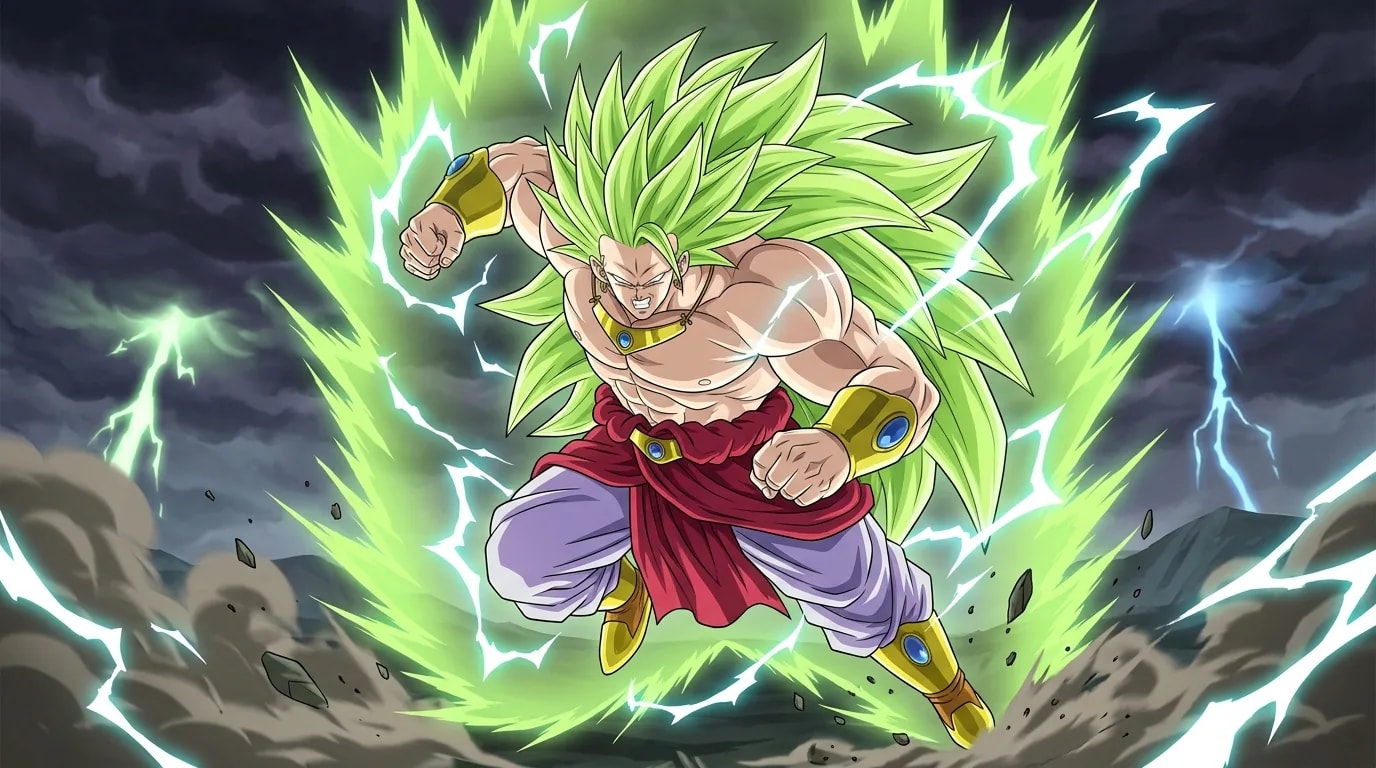
Legendary Super Saiyan 3
TransformationThe theoretical apex of the numbered Legendary Super Saiyan line, combining the continuously escalating power of the Legendary mutation with the extreme amplification of Super Saiyan 3. This form exists exclusively in Dragon Ball Heroes and related game media, where it represents one of the most powerful Saiyan transformations ever depicted.
Origins and Design
Legendary Super Saiyan 3 pushes the concept of the Legendary mutation to its logical extreme within the numbered Super Saiyan framework. If standard Super Saiyan 3 quadruples the output of Super Saiyan 2, then LSS3 applies that same multiplier to the already enormous power of LSS2. The result is a transformation whose raw output defies meaningful measurement.
Introduced in Dragon Ball Heroes, LSS3 is primarily associated with Broly and serves as one of his ultimate forms within that game's continuity. The visual design combines the signature elements of both parent forms: the waist-length hair and pronounced brow ridge of SS3, rendered in the Legendary form's distinctive green palette.
Visual Identity
The form is immediately recognizable by its combination of extreme hair length and green coloration. Where standard SS3 features golden hair that reaches past the waist, LSS3 replaces that gold with the Legendary Super Saiyan's green-tinged palette. The eyebrows vanish as they do in standard SS3, and the brow ridge becomes heavily pronounced. Combined with the Legendary form's already massive musculature, the result is an imposing figure that radiates raw destructive intent.
Frequently Asked Questions
What is Legendary Super Saiyan 3?
Legendary Super Saiyan 3 is the apex of Broly's Legendary Super Saiyan lineage, combining the bulk and green palette of his original Legendary form with the long flowing hair and lost eyebrows of Super Saiyan 3. The state is featured in Dragon Ball Heroes and crossover material as one of Broly's strongest tiers.
How does Legendary Super Saiyan 3 differ from Legendary Super Saiyan 2?
Hair grows to extreme length reaching below the waist, similar to standard Super Saiyan 3 but with the Legendary green tint. Brow ridge becomes more pronounced with eyebrows vanishing. Muscle mass reaches its peak. A colossal green aura with electrical discharge engulfs the user.
How strong is Legendary Super Saiyan 3?
Legendary Super Saiyan 3 is positioned at roughly four times the output of Legendary Super Saiyan 2, again mirroring the relationship between standard Super Saiyan 2 and Super Saiyan 3. The multiplier is approximate, with the form treated as the strongest tier in the Legendary line.
Who can use Legendary Super Saiyan 3?
Must have achieved Legendary Super Saiyan 2. Requires an enormous reserve of energy to sustain the transformation.
Is Legendary Super Saiyan 3 canon?
Legendary Super Saiyan 3 is not part of the canonical Dragon Ball Super manga or anime. It originates in Dragon Ball Heroes and tie-in media as an extension of the Legendary Super Saiyan branch.
Sources & Information
Looking for more on Legendary Super Saiyan 3? The Dragon Ball Wiki on Fandom has a dedicated page with community notes.
View on FandomThis content is original writing by Daddy Jim Headquarters based on the Dragon Ball anime series, manga, and official materials. Episode and chapter references are cited where applicable.
Character and scene imagery on this site is original artwork by Daddy Jim Headquarters, not screenshots or licensed imagery. Official cover art is used on three types of pages for editorial commentary:
- Movie pages: theatrical posters and key visuals, credited to Toei Animation and Shueisha.
- Game pages: official box art, credited to Bandai Namco, Atari, and other publishers.
- Manga chapter pages: Jump Comics volume covers, credited to Shueisha and Akira Toriyama.
Browse our episode guides:
Official resources:
Help Us Keep This Wiki Accurate
Daddy Jim Headquarters maintains this encyclopedia. If you spot an error, a translation issue, or something that doesn't look right, let us know.