Super Saiyan
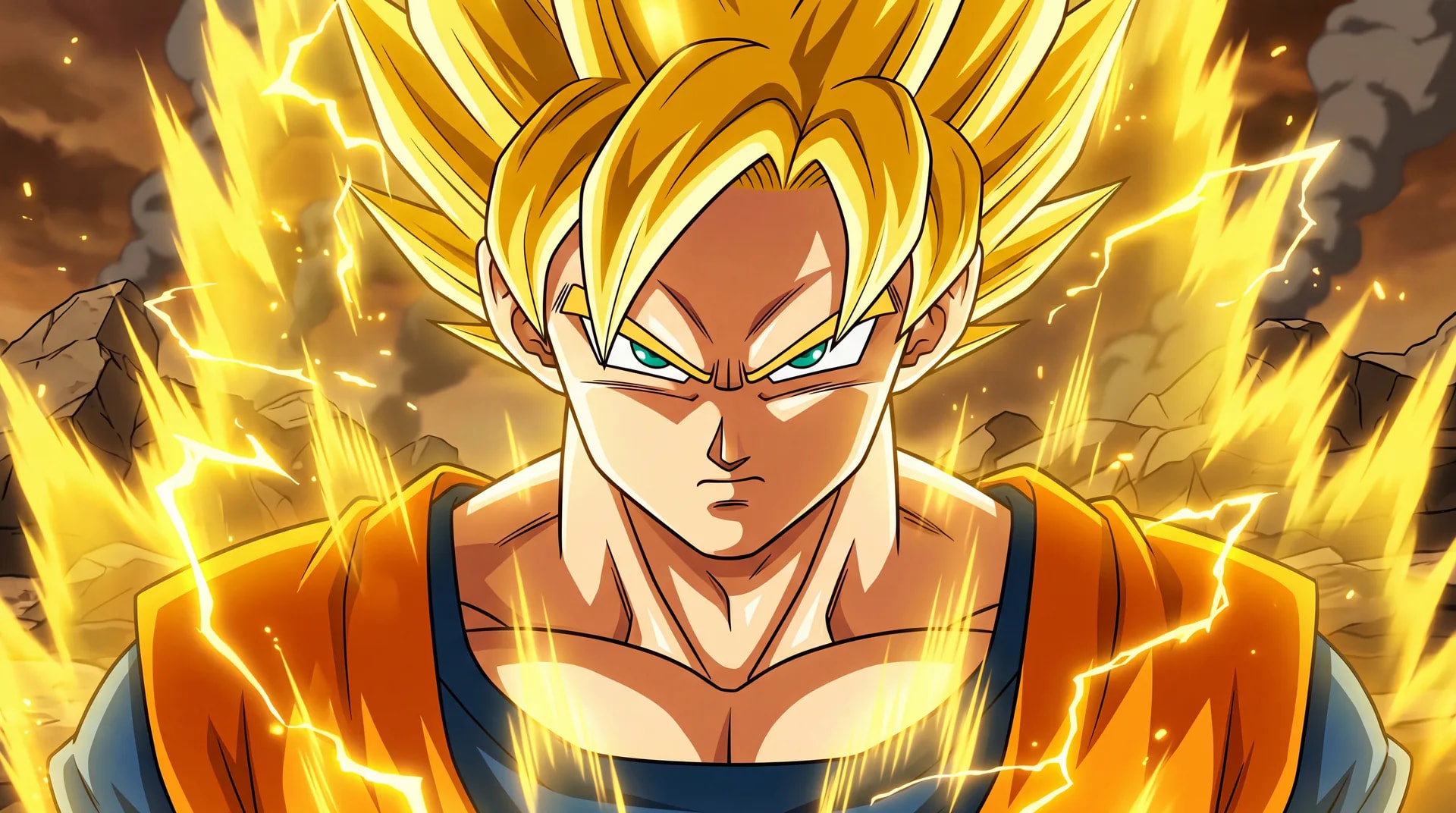
TransformationThe signature transformation of the Saiyan race and one of the most iconic elements of the Dragon Ball franchise. Once considered nothing more than a myth among the Saiyans, the form was first achieved in the modern era by Goku during his battle with Frieza on Planet Namek, driven by the rage of watching Krillin die. The transformation multiplies the user's power by approximately fifty times and produces the distinctive golden hair, green eyes, and blazing aura that have become synonymous with the series.
The Legend and the Transformation
For over a millennium, the Super Saiyan existed only as a legend among the Saiyan people. Vegeta recounted the tale of an ancient Saiyan warrior named Yamoshi whose power was so overwhelming it could only be sustained through a Great Ape transformation, and this figure became the basis of the legend. The story was dismissed by most Saiyans as folklore, but Frieza took it seriously. His fear of a Super Saiyan rising among the Saiyans was one of the primary reasons he chose to annihilate Planet Vegeta and nearly the entire Saiyan race. Twenty-five years later, the legend proved true on Namek.
How the Transformation Works
Every Saiyan possesses microscopic components called S-Cells, and accumulating enough of them is the biological prerequisite for the transformation. Saiyans with gentle spirits naturally develop more S-Cells, as do those who push their battle power higher through training. Once the threshold is met, a powerful emotional response, most commonly rage or grief, can trigger the initial transformation. Goku's trigger was watching Frieza murder Krillin. Vegeta's was sheer frustration at being surpassed by Goku. Bardock's, in an alternate timeline, was witnessing a child being attacked by Frieza's ancestor Chilled.
After the first transformation, a Saiyan can access the form at will by concentrating their energy into a focal point along the spine between the shoulder blades. Children of powerful Saiyans inherit elevated S-Cell counts from their parents, which is why Goten and Trunks could transform at remarkably young ages with little apparent effort. By the Buu Saga, Vegeta noted that the once-legendary transformation had been reduced to a child's plaything.
The Physical and Psychological Effects
The most immediate visual change is the hair: it turns golden and stands upright in a flame-like shape, a design choice Akira Toriyama made partly so his assistants would no longer have to spend time inking Goku's black hair. The eyes shift to a sharp teal green, muscle definition increases, and the body radiates a golden aura of excess energy. Toriyama also based Goku's intense Super Saiyan expression on the piercing glare of Bruce Lee.
The personality shift is just as significant as the physical one. Calm, kind-hearted Saiyans become aggressive and vengeful upon first transforming. When Goku initially transformed on Namek, he warned his own son Gohan to leave immediately, admitting he was losing what little rational control he had left. This aggression can be tempered through training. Goku and Gohan spent time in the Hyperbolic Time Chamber learning to remain in the form constantly, eliminating both the emotional volatility and the stamina drain, a mastered state known as Super Saiyan Full Power.

Power, Limitations, and the Graded Stages
According to the Daizenshuu guide, the Super Saiyan form multiplies the user's base power by fifty times, though Toriyama himself has suggested this figure may be an exaggeration and that his original intent was closer to a tenfold increase. Regardless of the exact number, the power leap is staggering. On Namek, Goku had been completely outmatched by Frieza even while using Kaio-ken at twenty times his base power. The moment he transformed, Frieza's full power was no longer enough. The tyrant's strongest attacks could not put Goku down, and his energy drained rapidly while Goku's output remained steady.
The Graded Stages
As the Saiyan characters trained during the Android and Cell Sagas, they discovered ways to push the Super Saiyan form beyond its base output, though each approach carried significant trade-offs.
Super Saiyan Second Grade
Vegeta and Future Trunks developed this stage in the Hyperbolic Time Chamber. It increases muscle mass and raw power output considerably. Vegeta used it to completely dominate Semi-Perfect Cell before Cell absorbed Android 18. The speed reduction is moderate, making it a viable combat form against slower opponents.
Super Saiyan Third Grade
Future Trunks pushed the muscle-enhancing path to its extreme. The raw power output surpasses Second Grade significantly, but the enormous muscle mass reduces speed so drastically that Trunks could not land a single blow on the faster Perfect Cell. Cell mocked him for relying on it, revealing that he had also discovered and rejected the form for the same reason. Goku confirmed he knew about the stage too but understood it was a dead end.
Super Saiyan Full Power
Rather than chasing raw power through the graded stages, Goku and Gohan took a different path: they trained to maintain Super Saiyan so constantly that it became their natural resting state. By eliminating the energy waste and emotional strain, they could fight at full Super Saiyan output indefinitely with no stamina penalty. This approach proved far superior to the brute-force stages, as Gohan demonstrated at the Cell Games before ascending further to Super Saiyan 2.
The Super Saiyan Legacy Across the Series
The Super Saiyan form debuted as the ultimate power in the Frieza Saga, but the escalation of threats across Dragon Ball Z, GT, and Super steadily pushed it from the pinnacle of Saiyan power to a foundational baseline. Future Trunks arrived from his timeline already possessing the form and effortlessly killed both Mecha Frieza and King Cold, demonstrating how quickly the transformation had spread among surviving Saiyans. Vegeta achieved it through sheer frustration at being surpassed, and by the time the Androids appeared, multiple Super Saiyans existed on Earth, yet the form was insufficient to defeat Android 17 and 18.
The Cell Saga introduced Super Saiyan 2 through Gohan, and the Buu Saga brought Super Saiyan 3 via Goku, each form rendering its predecessor less relevant in top-tier combat. Dragon Ball GT added Super Saiyan 4, which took a different evolutionary path through the Great Ape transformation. Dragon Ball Super shifted the paradigm entirely with godly ki, producing Super Saiyan God and Super Saiyan Blue, though the base Super Saiyan form remained useful throughout.
Expanding the Circle of Users
What began as Goku's singular achievement eventually spread far beyond the original cast. Goku's sons Gohan, Goten, and their fusion Gotenks all achieved the form. Vegeta's son Trunks and the father-son Potara fusion Vegito followed. The Dragon Ball Super era introduced Cabba, Caulifla, and Kale from Universe 6, with Caulifla notably achieving the form not through rage but by following Cabba's instructions to focus energy into her back. This demonstrated that the transformation's emotional component is tied to the initial trigger, not a permanent requirement.
The villain Goku Black, actually the rogue Kai Zamasu in a stolen Saiyan body, used the form as the basis for his own divine variant, Super Saiyan Rose. Cell, a bio-android containing Saiyan DNA, also utilized Super Saiyan energy at full power. Even in the distant future of Dragon Ball GT, Goku Jr. and Vegeta Jr. proved that the Super Saiyan gene persisted across generations.
Behind the Scenes
Toriyama designed the golden-haired transformation partly out of practical necessity: coloring Goku's hair black in every panel was time-consuming for his assistants, and blond hair solved the problem while also making Goku look visibly more powerful. The piercing expression was inspired by Bruce Lee's famous fighting glare, and anime character designer Tadayoshi Yamamuro confirmed he used Lee as a direct reference for Goku's Super Saiyan pose and expression. The concept of a legendary warrior transformation was first hinted at by Nappa early in Dragon Ball Z, and what began as a plot device for the Frieza Saga became the defining feature of the entire franchise.
Related Reading
See all
Krillin's on the Tinder: How the Ultimate Short King Survived the Height Filter
Tinder built a height filter. Dragon Ball built a five foot legend. What happened when we sent the ultimate short king into the modern dating hellscape....
Infinite Zeni Glitch: When Yamcha Never Pays and Mr. Popo Always Does
The internet found an infinite money glitch. So did Yamcha. A smooth R&B track about the easiest money in the Dragon Ball world and the one man who keeps paying for it....
Frequently Asked Questions
Who is the Super Saiyan in Dragon Ball?
The signature transformation of the Saiyan race and one of the most iconic elements of the Dragon Ball franchise. Once considered nothing more than a myth among the Saiyans, the form was first achieved in the modern era by Goku during his battle with Frieza on Planet Namek, driven by the rage of watching Krillin die.
How is Super Saiyan achieved?
The user must possess a sufficient number of S-Cells and experience a powerful emotional trigger, typically intense rage or grief. A high enough power level can allow transformation without a specific trigger. Once achieved, the user can transform at will by focusing energy into a point along the spine between the shoulder blades.
What does Super Saiyan look like?
Hair turns golden and stands upright in a flame-like shape. Eyes change to a sharp teal green. Muscle tone becomes more defined, skin appears lighter under the golden aura.
What are the drawbacks of Super Saiyan?
Initial transformations produce emotional instability and increased aggression. The form consumes more energy than the user's base state unless mastered. Graded power-up stages sacrifice speed for strength.
What are the advantages of Super Saiyan?
Roughly 50x increase to base power. Massive boost to speed, strength, and energy output. Can be mastered to eliminate stamina drain entirely.
Sources & Information
Looking for more on Super Saiyan? The Dragon Ball Wiki on Fandom has a dedicated page with community notes.
View on FandomThis content is original writing by Daddy Jim Headquarters based on the Dragon Ball anime series, manga, and official materials. Episode and chapter references are cited where applicable.
Character and scene imagery on this site is original artwork by Daddy Jim Headquarters, not screenshots or licensed imagery. Official cover art is used on three types of pages for editorial commentary:
- Movie pages: theatrical posters and key visuals, credited to Toei Animation and Shueisha.
- Game pages: official box art, credited to Bandai Namco, Atari, and other publishers.
- Manga chapter pages: Jump Comics volume covers, credited to Shueisha and Akira Toriyama.
Browse our episode guides:
Official resources:
Help Us Keep This Wiki Accurate
Daddy Jim Headquarters maintains this encyclopedia. If you spot an error, a translation issue, or something that doesn't look right, let us know.