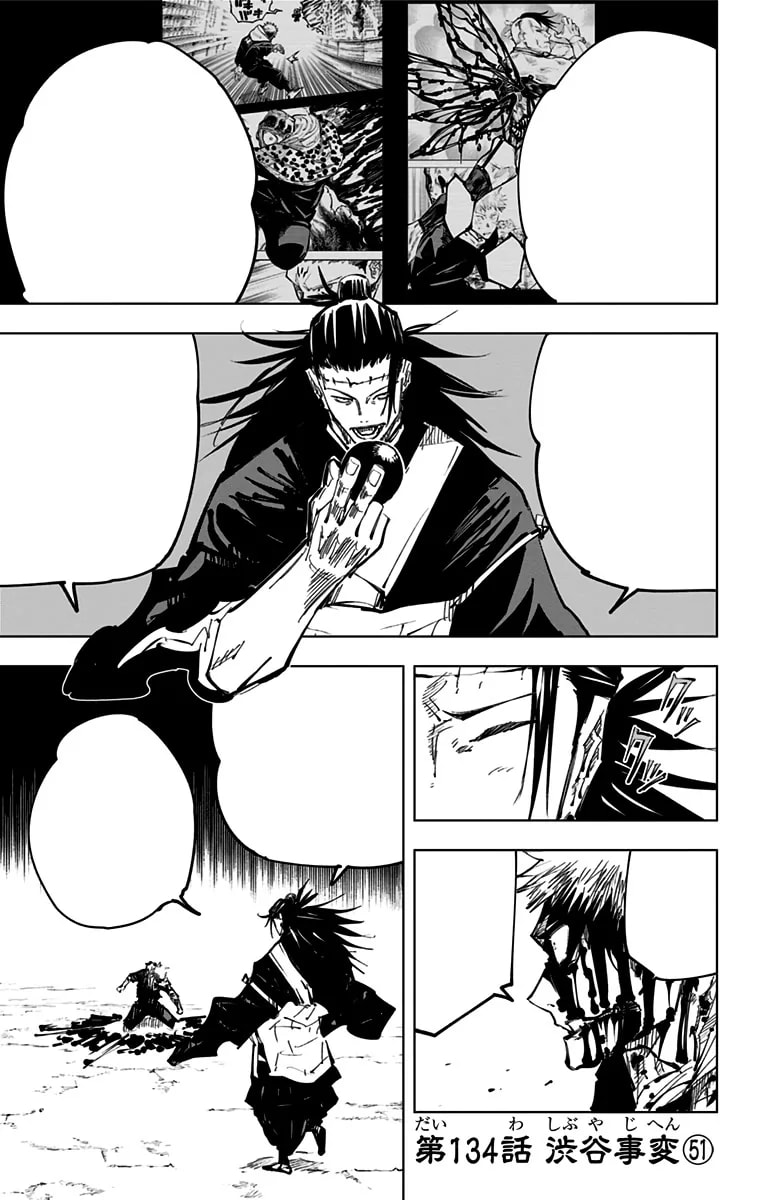
Numbered 134 and billed as the fifty-first segment of the Shibuya Incident, this chapter drags the Kyoto students into the open fight against Pseudo-Geto, then lets Choso step up and expose who is really wearing Suguru Geto's body.
Summary
With Mahito sealed inside a black sphere in his hand, Pseudo-Geto walks Yuji through the idea of Maximum Techniques, an innate ability's strongest form aside from a domain. He breaks down Cursed Spirit Manipulation: Maximum Uzumaki, which fuses the curses he carries into one super-condensed discharge of energy. Mid-lecture he catches himself laughing like Suguru, then concedes he was wrong to assume Uzumaki wasted his roster, since drawing in spirits of semi-grade 1 and above lets him peel off and keep their techniques.
He gulps down the orb to make Mahito part of the collection, noting that he already sensed the trap overhead. Momo signals with a lantern, and the Kyoto students attack from afar. Cursed-energy arrows fly from Noritoshi Kamo, Mai's sniper rifle wins Geto's nod for choosing ordinary weapons against human sorcerers, and Kasumi Miwa, her family hardships flashing past, rushes in with Batto Sword Drawing before Geto snaps the blade barehanded.
Key Events
Maximum Uzumaki is Geto's reply, gouging a fissure through the ground, yet New Shadow Style lets Kusakabe blunt part of the blast and shield Miwa, with Momo and Utahime beside him. Panda shows up glad to see Yuji ruling his own body again, and when Noritoshi demands a name, Panda can only describe an unknown figure piloting Suguru Geto. Choso's entrance turns the tide: he names the man as one of the three who made him, the sorcerer who tortured his mother into producing the Death Painting Wombs, history's most repulsive sorcerer, Noritoshi Kamo. What sets Choso off here is the realization that this thing steered his own fists toward Yuji, the younger brother he never knew he had. He charges, but Uraume slides in front of Geto and snaps at the bottom-feeder to move.
Notes
Belonging to the Shibuya Incident Arc, the installment landed in Volume 16, ran in 2021, and reached screens through Episode 46. Eso, Kechizu, and Jogo show up purely in flashback, while the ancestor Noritoshi Kamo appears in a picture. The clash with Pseudo-Geto and Uraume keeps going. Akutami's side note singles out a favored Arlong design from a fighting game.
Related Reading
See all
Super Saiyan Pubes: The Song About Where Super Saiyan Hair Actually Goes
The transformation everyone knows, the follow-up question nobody would touch. Why we made a smooth R&B track about the golden glow Dragon Ball never talks about....
The Bleach Female Characters Nobody Can Agree On, Settled
Five Bleach female characters, ranked and settled. Yoruichi sits at number five, the spot nobody expects, and our number one is an Arrancar with a soft heart....
Frequently Asked Questions
What volume is Chapter 134 of Jujutsu Kaisen in?
Chapter 134 belongs to the Shibuya Incident Arc and was collected in Volume 16 of Jujutsu Kaisen, which ran in 2021.
What happens in Jujutsu Kaisen Chapter 134?
Chapter 134, the fifty-first part of the Shibuya Incident, drags the Kyoto students into the open fight against Pseudo-Geto, then lets Choso step up and expose who is really wearing Suguru Geto's body.
Who does Choso reveal Pseudo-Geto really is in Chapter 134?
In Chapter 134, Choso names the figure piloting Suguru Geto's body as Noritoshi Kamo, one of the three sorcerers who made him, the man who tortured his mother into producing the Death Painting Wombs.
What is Cursed Spirit Manipulation: Maximum Uzumaki in Chapter 134?
In Chapter 134, Pseudo-Geto explains that Maximum Uzumaki is the Maximum Technique of Cursed Spirit Manipulation, fusing all the curses he carries into one super-condensed discharge of energy, which he fires to gouge a fissure through the ground.
How do the Kyoto students attack Pseudo-Geto in Chapter 134?
In Chapter 134, the Kyoto students strike from afar after Momo signals with a lantern: Noritoshi Kamo fires cursed-energy arrows, Mai uses a sniper rifle, and Kasumi Miwa rushes in with Batto Sword Drawing before Geto snaps the blade barehanded.
Sources & Information
Looking for more on Chapter 134? The Jujutsu Kaisen Wiki on Fandom has a dedicated page with community notes.
View on FandomThis content is original writing by Daddy Jim Headquarters based on the Jujutsu Kaisen anime series, manga, and official materials. Episode and chapter references are cited where applicable.
Character and scene imagery on this site is original artwork by Daddy Jim Headquarters, not screenshots or licensed imagery. Official cover art is used on three types of pages for editorial commentary:
- Movie pages: theatrical posters and key visuals, credited to MAPPA and Toho.
- Game pages: official box art for Jujutsu Kaisen Cursed Clash, credited to Bandai Namco.
- Manga chapter pages: Jump Comics volume covers, credited to Shueisha and Gege Akutami.
Official resources:
Help Us Keep This Wiki Accurate
Daddy Jim Headquarters maintains this encyclopedia. If you spot an error, a translation issue, or something that doesn't look right, let us know.