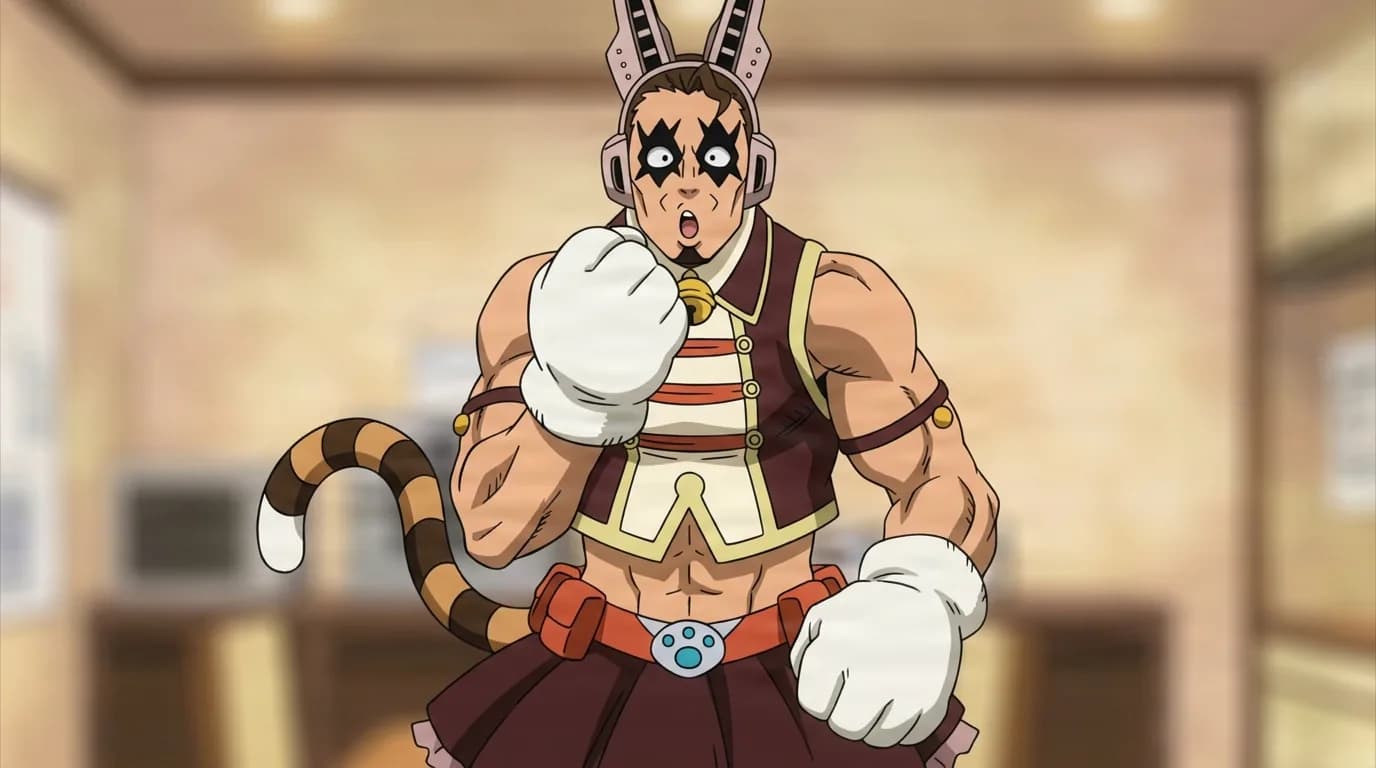
Yawara Chatora
CharacterTiger is the muscle of the Wild, Wild Pussycats, a wall of a man who can flatten and stretch himself like taffy and who frightens U.A. students into becoming better than they were the day before. Behind the drill-sergeant glare is somebody whose favorite things in the world are his teammates.
Appearance
A small triangular beard sits below short brown hair on a frame that reaches 190 centimeters and is built to match. His eyes read as blank white, ringed by dark markings. He wears the Pussycats team costume, his version rendered in brown.
Yawara is a transgender man. Born female, he transitioned in Thailand many years ago, and how he looks and lives has matched who he is ever since.

Personality
The aura arrives first: macho, severe, and engineered to intimidate, which it does to nearly every student who crosses him. It coexists with the same goofy eccentricity the rest of his team runs on.
Training U.A. High's students is something he treats as close to sacred. He pushes them past comfort, invites them to tear their muscles so they grow back stronger, tolerates no slacking, and will physically discipline anyone he judges to be falling short of Plus Ultra. Underneath that is a protective streak he does not hide, aimed at students and teammates alike. Watching Magne brutalize Pixie-Bob sent him into a rage. His Ultra Analysis profile sums him up as a true friend, and he names his teammates as his favorite thing.
Related Reading
See all
Naruto vs Luffy: Does the Fight Change if Luffy Tickles Hinata?
Naruto vs Luffy with the twist nobody asked for: Luffy tickled Hinata on date night, and she kind of liked it. We break down the whole fight and commit to a winner....
Namek Has No Women, and Piccolo Pulls Anyway
There are no women on Namek. That isn't an oversight, it's the biology. Why we handed Piccolo the one thing his own species rules out, and why it had to be trap soul....
Abilities
Pliabody, written to mean soft body, lets him stretch, flatten, and bend himself into shapes a human frame has no business holding. Considerable raw strength backs it up, though the exact ceiling has never been measured. He apprehended and defeated the notorious Magne, and he knocked Izuku Midoriya clean back while Izuku was running One For All at five percent. His musculature makes him the designated combat specialist on his team.
Away from the field he produces My Boot Camp, an original video series that has grown popular online, with Ragdoll deserving most of the credit for how far it spread.
Frequently Asked Questions
What is Tiger's Quirk in My Hero Academia?
Tiger's Quirk is called Pliabody, meaning soft body, which lets him stretch, flatten, and bend himself into shapes a human frame should not be able to hold. He backs it with considerable raw strength, serving as the combat specialist for the Wild, Wild Pussycats.
Is Tiger from My Hero Academia canonically transgender?
Yes, Tiger, whose real name is Yawara Chatora, is a transgender man. He was born female and transitioned in Thailand many years before the story's events, and how he looks and lives has matched who he is ever since.
Is Tiger from MHA a girl?
No, Tiger, real name Yawara Chatora, is a man. He was born female but transitioned in Thailand years earlier, and he has lived and presented as male ever since.
Is there a Quirk called Tiger in My Hero Academia?
No, the hero known as Tiger actually has a Quirk called Pliabody, which lets him stretch and flatten his body. Tiger is simply his hero alias, taken from his real name, Yawara Chatora.
What team does Tiger belong to?
Tiger is a member of the Wild, Wild Pussycats, working as the team's combat specialist thanks to his Pliabody Quirk and considerable strength. He is known for pushing U.A. students hard during their training, including apprehending the villain Magne.
Sources & Information
Looking for more on Yawara Chatora? The My Hero Academia Wiki on Fandom has a dedicated page with community notes.
View on FandomThis content is original writing by Daddy Jim Headquarters based on the My Hero Academia anime series, manga, and official materials. My Hero Academia was created by Kohei Horikoshi, published by Shueisha, and animated by Bones. All rights to My Hero Academia and its characters belong to their respective owners. Episode and chapter references are cited where applicable.
Rights holders
All rights belong to their respective owners.
Character and scene imagery on this site is original artwork by Daddy Jim Headquarters, not screenshots or licensed imagery. Official cover art is used on three types of pages for editorial commentary:
- Movie pages: theatrical posters and key visuals, credited to Bones and Shueisha.
- Game pages: official box art, credited to the game's respective publishers.
- Manga chapter pages: volume covers, credited to Shueisha and Kohei Horikoshi.
Official resources:
Help Us Keep This Wiki Accurate
Daddy Jim Headquarters maintains this encyclopedia. If you spot an error, a translation issue, or something that doesn't look right, let us know.