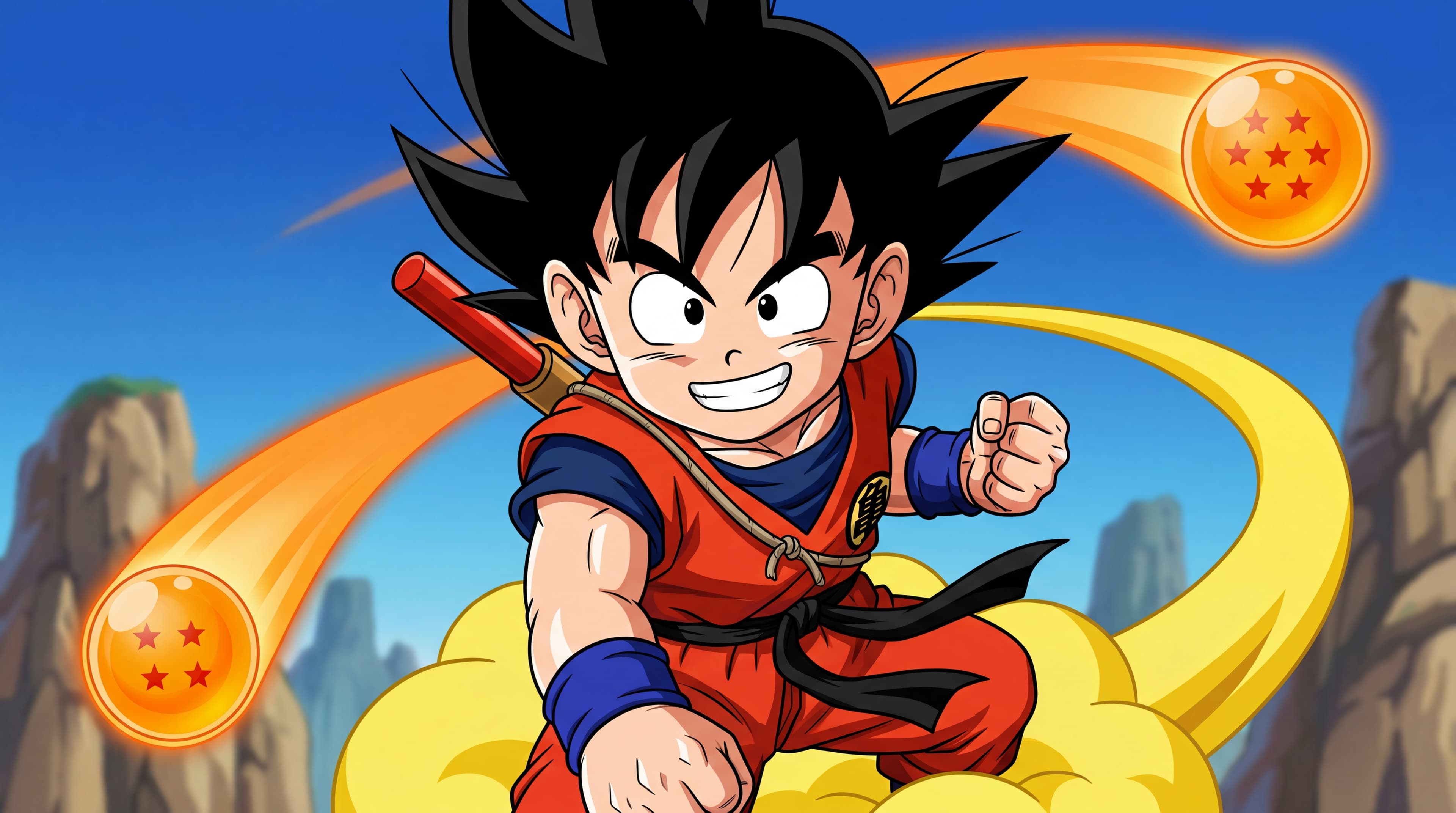
Roshi's training method is not what anyone expected. Before sunrise, Goku and Krillin must deliver bottles of milk across the entire island on foot, sprinting up mountains and zigzagging through forests. It is grueling, unglamorous, and exactly what they need.
Before Breakfast, Before Dawn
Training day arrives, but it does not begin with punches or energy blasts. Master Roshi wakes Goku and Krillin before sunrise, an event complicated by Goku having shared a bed with Launch, whose violent form greets them with machine gun fire. After Goku knocks her out with a swift kick, the actual training begins.
Roshi takes the boys to collect milk bottles from a local dairy farmer. The exercise is simple in concept: deliver every bottle to every house on the island, on foot, before breakfast. The route is anything but simple. They sprint through open roads, zigzag between long stretches of trees (Krillin tries to cheat by running straight through, and Roshi makes him start over), and climb what seems like an endless flight of stone steps to reach a house perched on a mountaintop.
When Goku's legs begin to give out on the staircase, Roshi tells him that his late grandfather completed this very same exercise without a single complaint. The mention of Grandpa Gohan transforms Goku's exhaustion into determination, and he charges up the remaining stairs with renewed energy. Krillin, with no such emotional fuel, drags himself to the top on willpower alone. After every last bottle is delivered, Roshi informs them that milk delivery was merely the early morning session. Mid-morning training is about to begin.
Meanwhile, in West City, Yamcha trains at a dojo, demolishing students and their master while Bulma cheers from the sidelines. Both camps are preparing for the same destination: the World Martial Arts Tournament.

The Stairs That Built Legends
The mountain staircase sequence is the episode's emotional core. Watching Goku's legs shake and nearly buckle is striking because the audience has only seen him as unstoppable until now. Roshi's invocation of Grandpa Gohan at the precise moment of Goku's greatest fatigue is masterful coaching, turning the old man's memory into rocket fuel.
Krillin's attempts to cheat through the tree zigzag provide the episode's best comedy. His straight-line shortcut is immediately caught, and Roshi's calm insistence that he start over perfectly captures the master's teaching style: there are no shortcuts in the Turtle School. The brief cut to Yamcha training in West City adds a competitive dimension, reminding the audience that Goku and Krillin are not the only ones getting stronger.
Related Reading
See all
Namek Has No Women, and Piccolo Pulls Anyway
There are no women on Namek. That isn't an oversight, it's the biology. Why we handed Piccolo the one thing his own species rules out, and why it had to be trap soul....

1000 Times Over: Who Is John Dragon Ball Singing To?
Dragon Ball handed us a protagonist with no history and the internet named him John Dragon Ball. So we built him somebody to talk to....


Building Strength the Old-Fashioned Way
Roshi's training philosophy is revealed in full here: martial arts mastery comes from building the body through mundane physical labor, not through combat drills. This approach, strengthening the foundation before teaching technique, becomes a defining element of the Turtle School and directly influences how Goku trains for the rest of his life. The World Martial Arts Tournament is mentioned explicitly for the first time, giving the training arc a concrete goal. The mention of Grandpa Gohan completing the same regimen ties the past to the present, connecting Goku to a martial arts lineage that stretches back generations.
Frequently Asked Questions
What episode of Dragon Ball is Milk Delivery?
"Milk Delivery" is episode 17 of Dragon Ball. It airs during the Tournament Saga.
What happens in the Dragon Ball episode Milk Delivery?
Roshi's training method is not what anyone expected. Before sunrise, Goku and Krillin must deliver bottles of milk across the entire island on foot, sprinting up mountains and zigzagging through forests. It is grueling, unglamorous, and exactly what they need.
Which characters appear in Milk Delivery?
The episode features Master Roshi, Goku, Krillin, Launch, Grandpa Gohan, Yamcha, and Bulma. Master Roshi carries the action across this Tournament Saga episode.
What is the standout moment in Milk Delivery?
The mountain staircase sequence is the episode's emotional core. Watching Goku's legs shake and nearly buckle is striking because the audience has only seen him as unstoppable until now.
Why is Milk Delivery important in Dragon Ball?
Roshi's training philosophy is revealed in full here: martial arts mastery comes from building the body through mundane physical labor, not through combat drills. This approach, strengthening the foundation before teaching technique, becomes a defining element of the Turtle School and directly influences how Goku trains for the rest of his life.
Sources & Information
Looking for more on Milk Delivery? The Dragon Ball Wiki on Fandom has a dedicated page with community notes.
View on FandomThis content is original writing by Daddy Jim Headquarters based on the Dragon Ball anime series, manga, and official materials. Episode and chapter references are cited where applicable.
Rights holders
- Created byAkira Toriyama
- Published byShueisha
- Animated byToei Animation
All rights belong to their respective owners.
Character and scene imagery on this site is original artwork by Daddy Jim Headquarters, not screenshots or licensed imagery. Official cover art is used on three types of pages for editorial commentary:
- Movie pages: theatrical posters and key visuals, credited to Toei Animation and Shueisha.
- Game pages: official box art, credited to Bandai Namco, Atari, and other publishers.
- Manga chapter pages: Jump Comics volume covers, credited to Shueisha and Akira Toriyama.
Browse our episode guides:
Official resources:
Help Us Keep This Wiki Accurate
Daddy Jim Headquarters maintains this encyclopedia. If you spot an error, a translation issue, or something that doesn't look right, let us know.