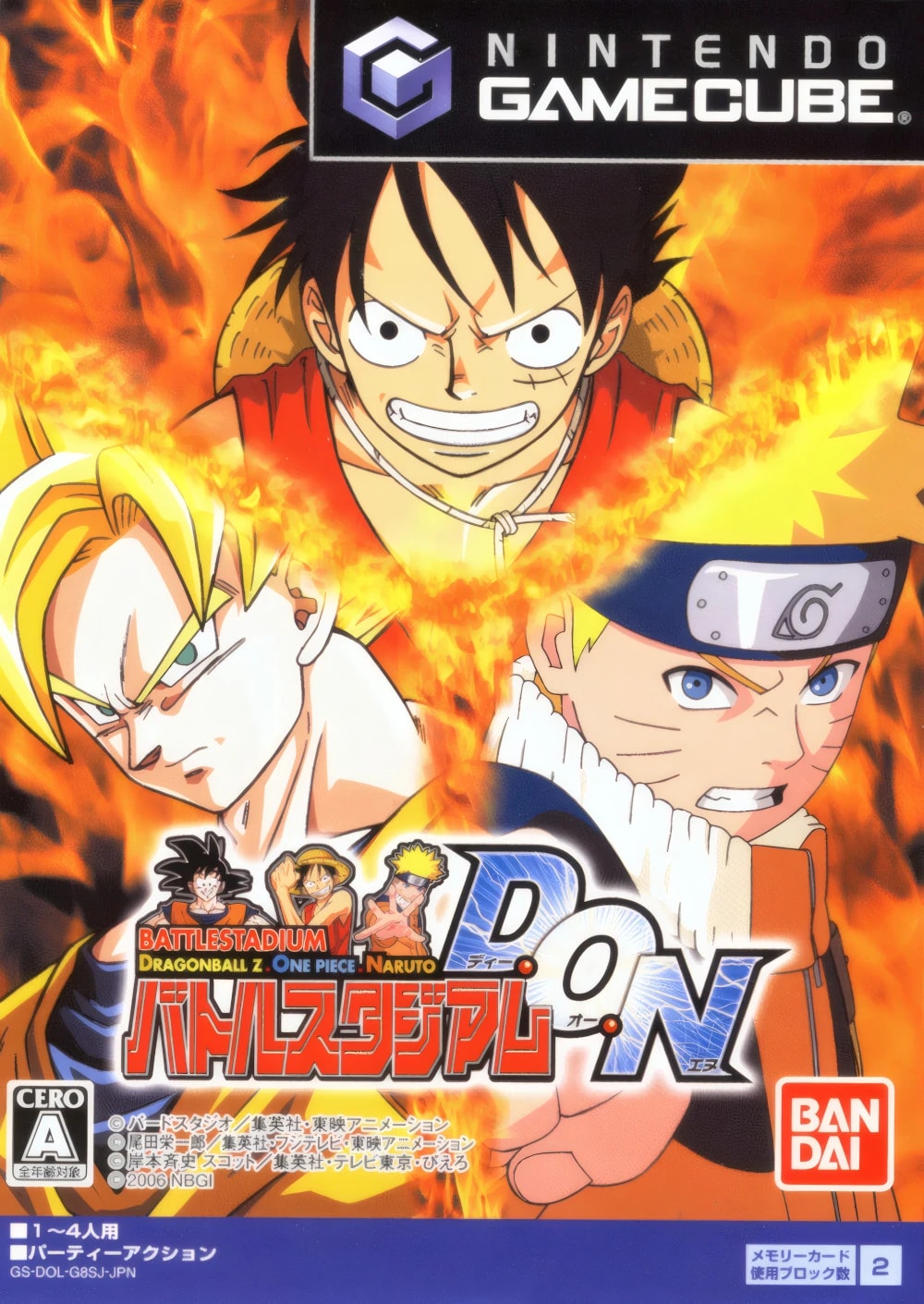
Battle Stadium D.O.N
GameBattle Stadium D.O.N.O.N|Batoru Sutajiamu Dī Ō En}} is a fighting video game for the Nintendo GameCube and PlayStation 2. It was released only in Japan on July 20, 2006, and it features characters from the popular anime and manga series Dragon Ball, One Piece, and Naruto (hence the D.O.N).
Combat System
Battle Stadium D.O.N is a crossover fighting game for the Nintendo GameCube and PlayStation 2, released exclusively in Japan on July 20, 2006. The game draws its roster from Dragon Ball Z, One Piece, and Naruto, with the title name reflecting the first letters of each franchise. Its combat system takes clear inspiration from the Super Smash Bros. series, placing characters on interactive stages rather than in a traditional one-on-one fighting arena. Stages range from static to moving environments, with borrowings from Power Stone in terms of environmental interaction.
The game uses a shared health gauge mechanic that sets it apart from conventional fighting games. Dealing damage to an opponent causes them to drop red orbs that any player can absorb to restore their own health. To win, a player must push their portion of the health bar until it fills the entire gauge. This design can theoretically extend matches indefinitely without a time limit, rewarding aggressive and consistent pressure over a single knockout blow.
Each character possesses six basic attacks, seven strong attacks tied to signature techniques, and a Super Attack charged through a shared meter. The meter also powers defensive shielding and rolling, so depleting it entirely leaves a character vulnerable to a guard break. Certain characters can enter a temporary Burst Mode when their health threshold is met, enabling fully charged moves without charging time. A Reverse Attack mechanic rewards players who successfully counter an opponent in Burst Mode with a large orb drop distributed among all fighters.


Characters & Modes
The Dragon Ball Z roster includes Goku, Teen Gohan, Piccolo, Future Trunks, Vegeta, Frieza, Cell, and Majin Buu, each represented in their most iconic Super Saiyan or powered-up forms. Super Attacks reflect the characters' signature techniques: Goku uses the Spirit Bomb and Super Spirit Bomb, Vegeta unleashes the Final Flash, and Cell fires the Super Kamehameha. The One Piece and Naruto rosters are equally complete, covering key fighters from those series in their most recognizable forms at the time of the game's release.
Single-player mode sends players through five rounds of combat, with randomly assigned missions during two or three of those rounds. Completing missions earns coins redeemable at a slot machine to unlock bonus content. Mission frequency scales with difficulty, so higher settings deliver more challenging objectives and greater rewards. Multiplayer supports up to four players, though PS2 users require a multitap adapter for more than two participants. Stage selection covers iconic Dragon Ball Z locations including West City, Planet Namek, the Room of Spirit and Time, and the World Martial Arts Tournament arena.
Series Context
Battle Stadium D.O.N occupies an interesting position as one of several mid-2000s experiments in crossover gaming that brought Shonen Jump's biggest properties together under one roof. Its Japan-only release limited its international impact, but the game arrived during a period when all three source franchises were at or near their peak popularity in Japan, making it a genuine cultural artifact of that moment in anime history.
The game's shared health bar mechanic and stage interaction systems were ambitious for a licensed crossover title of its time, and the combination of Dragon Ball Z, One Piece, and Naruto under a single engine anticipated the larger multi-franchise crossover games that would follow in later years. It remains a collector's item for fans of any of the three franchises, particularly those interested in the history of anime-licensed gaming.
Related Reading
See all
Krillin's on the Tinder: How the Ultimate Short King Survived the Height Filter
Tinder built a height filter. Dragon Ball built a five foot legend. What happened when we sent the ultimate short king into the modern dating hellscape....
Infinite Zeni Glitch: When Yamcha Never Pays and Mr. Popo Always Does
The internet found an infinite money glitch. So did Yamcha. A smooth R&B track about the easiest money in the Dragon Ball world and the one man who keeps paying for it....
Frequently Asked Questions
What is Battle Stadium Don?
Battle Stadium D.O.N.O.N is a fighting video game for the Nintendo GameCube and PlayStation 2. It was released only in Japan on July 20, 2006, and it features characters from the popular anime and manga series Dragon Ball, One Piece, and Naruto (hence the D.O.N).
What is Dragon Ball Z Battle of Z?
Battle Stadium D.O.N is a crossover fighting game for the Nintendo GameCube and PlayStation 2, released exclusively in Japan on July 20, 2006. The game draws its roster from Dragon Ball Z, One Piece, and Naruto, with the title name reflecting the first letters of each franchise. Its combat system takes clear inspiration from the Super Smash Bros. series, placing characters on interactive stages rather than in a traditional one-on-one fighting arena.
When was Battle Stadium D.O.N released?
Battle Stadium D.O.N was released in 2006. It was developed by 8ing / Q Entertainment and published by Namco Bandai.
Who developed Battle Stadium D.O.N?
Battle Stadium D.O.N was developed by 8ing / Q Entertainment. The game was published by Namco Bandai in 2006.
Who published Battle Stadium D.O.N?
Battle Stadium D.O.N was published by Namco Bandai. The game was developed by 8ing / Q Entertainment and released in 2006.
Sources & Information
Looking for more on Battle Stadium D.O.N? The Dragon Ball Wiki on Fandom has a dedicated page with community notes.
View on FandomThis content is original writing by Daddy Jim Headquarters based on the Dragon Ball anime series, manga, and official materials. Episode and chapter references are cited where applicable.
Character and scene imagery on this site is original artwork by Daddy Jim Headquarters, not screenshots or licensed imagery. Official cover art is used on three types of pages for editorial commentary:
- Movie pages: theatrical posters and key visuals, credited to Toei Animation and Shueisha.
- Game pages: official box art, credited to Bandai Namco, Atari, and other publishers.
- Manga chapter pages: Jump Comics volume covers, credited to Shueisha and Akira Toriyama.
Browse our episode guides:
Official resources:
Help Us Keep This Wiki Accurate
Daddy Jim Headquarters maintains this encyclopedia. If you spot an error, a translation issue, or something that doesn't look right, let us know.