Gameplay
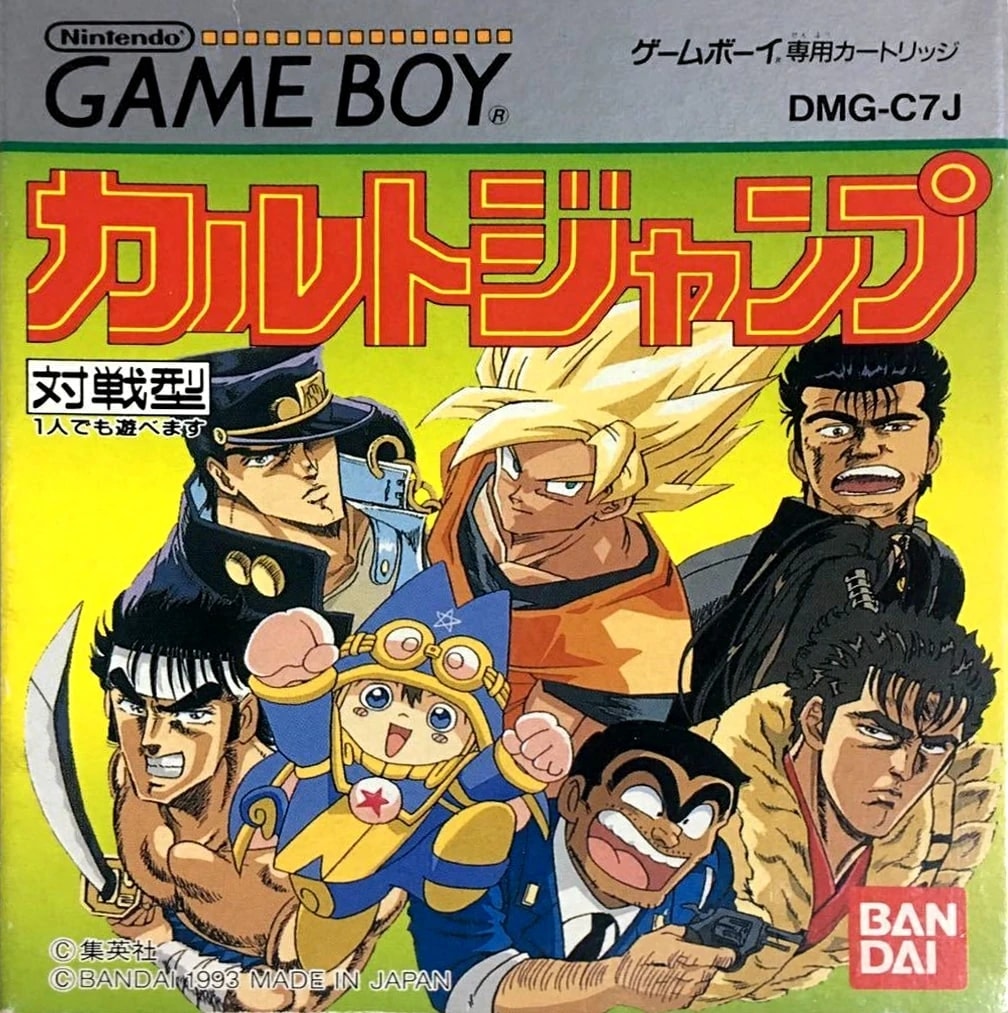
Cult Jump is a Shonen Jump crossover video game released for the Game Boy on September 10, 1993. The premise places the player in the role of a Shonen Jump reader tasked with rescuing the imprisoned king of the Jump world. Progress through the game depends entirely on the player's knowledge of Shonen Jump manga, as opponents must be defeated by answering trivia questions about the publisher's catalog of works. The game features 50 stages in total, each requiring correct answers to advance, with a password system provided after completing each stage to allow players to resume their progress.
The trivia format gives the game a unique structure among Dragon Ball releases of its era. Rather than direct combat or action gameplay, Cult Jump rewards familiarity with a wide range of Shonen Jump titles. This design made it a meaningful test for dedicated readers of the magazine while also functioning as a celebration of the publication's breadth of content at the time.



Characters & Content
Cult Jump features six main playable characters drawn from prominent Shonen Jump series of the early 1990s: Son Goku from Dragon Ball, Ryotsu Kankichi from KochiKame, Momotaro Tsurugi from Sakigake!! Otokojuku, Jotaro Kujo from JoJo's Bizarre Adventure, Taruruto from Magical Taruruto-kun, and Maeda Taison from Rokudenashi BLUES. The roster closely mirrors that of the 1991 Famicom game Famicom Jump II: Saikyou no Shichinin, with one character replaced.
Several additional Dragon Ball characters appear briefly throughout the game, including Vegeta, Krillin, Piccolo, Master Roshi, King Kai, Android 18, Dr. Gero, Frieza, and Cell. Their appearances serve more as cameos reflecting the series' extensive popularity within the Jump universe than as playable roster additions. Goku's inclusion as the Dragon Ball representative underscores his status as one of Shonen Jump's most iconic characters at the time of the game's release.

Historical Significance
Cult Jump arrived during a period when Shonen Jump was at the height of its cultural dominance in Japan, with Dragon Ball, JoJo's Bizarre Adventure, and other titles driving massive weekly readership. The game functions as both a piece of interactive merchandise and a trivia celebration of that publishing era. Its format, entirely built around knowledge of the magazine's contents, makes it a fascinating time capsule of what Shonen Jump represented to Japanese readers in the early 1990s.
For Dragon Ball enthusiasts, Cult Jump is a minor but genuine entry in the franchise's gaming history, notable for its crossover context and its early appearance alongside characters who would later star in far larger multi-franchise productions.
Related Reading
See all
Krillin's on the Tinder: How the Ultimate Short King Survived the Height Filter
Tinder built a height filter. Dragon Ball built a five foot legend. What happened when we sent the ultimate short king into the modern dating hellscape....

Infinite Zeni Glitch: When Yamcha Never Pays and Mr. Popo Always Does
The internet found an infinite money glitch. So did Yamcha. A smooth R&B track about the easiest money in the Dragon Ball world and the one man who keeps paying for it....

Frequently Asked Questions
What is Cult Jump?
Cult Jump is a crossover video game released for on September 10, 1993. Cult Jump is a Shonen Jump crossover video game released for the Game Boy on September 10, 1993.
What is Cult Jump about?
Cult Jump is a Shonen Jump crossover video game released for the Game Boy on September 10, 1993. The premise places the player in the role of a Shonen Jump reader tasked with rescuing the imprisoned king of the Jump world. Progress through the game depends entirely on the player's knowledge of Shonen Jump manga, as opponents must be defeated by answering trivia questions about the publisher's catalog of works.
When was Cult Jump released?
Cult Jump was released in 1993. It was developed by Sun L and published by Bandai.
Who developed Cult Jump?
Cult Jump was developed by Sun L. The game was published by Bandai in 1993.
Who published Cult Jump?
Cult Jump was published by Bandai. The game was developed by Sun L and released in 1993.
Sources & Information
Looking for more on Cult Jump? The Dragon Ball Wiki on Fandom has a dedicated page with community notes.
View on FandomThis content is original writing by Daddy Jim Headquarters based on the Dragon Ball anime series, manga, and official materials. Episode and chapter references are cited where applicable.
Character and scene imagery on this site is original artwork by Daddy Jim Headquarters, not screenshots or licensed imagery. Official cover art is used on three types of pages for editorial commentary:
- Movie pages: theatrical posters and key visuals, credited to Toei Animation and Shueisha.
- Game pages: official box art, credited to Bandai Namco, Atari, and other publishers.
- Manga chapter pages: Jump Comics volume covers, credited to Shueisha and Akira Toriyama.
Browse our episode guides:
Official resources:
Help Us Keep This Wiki Accurate
Daddy Jim Headquarters maintains this encyclopedia. If you spot an error, a translation issue, or something that doesn't look right, let us know.