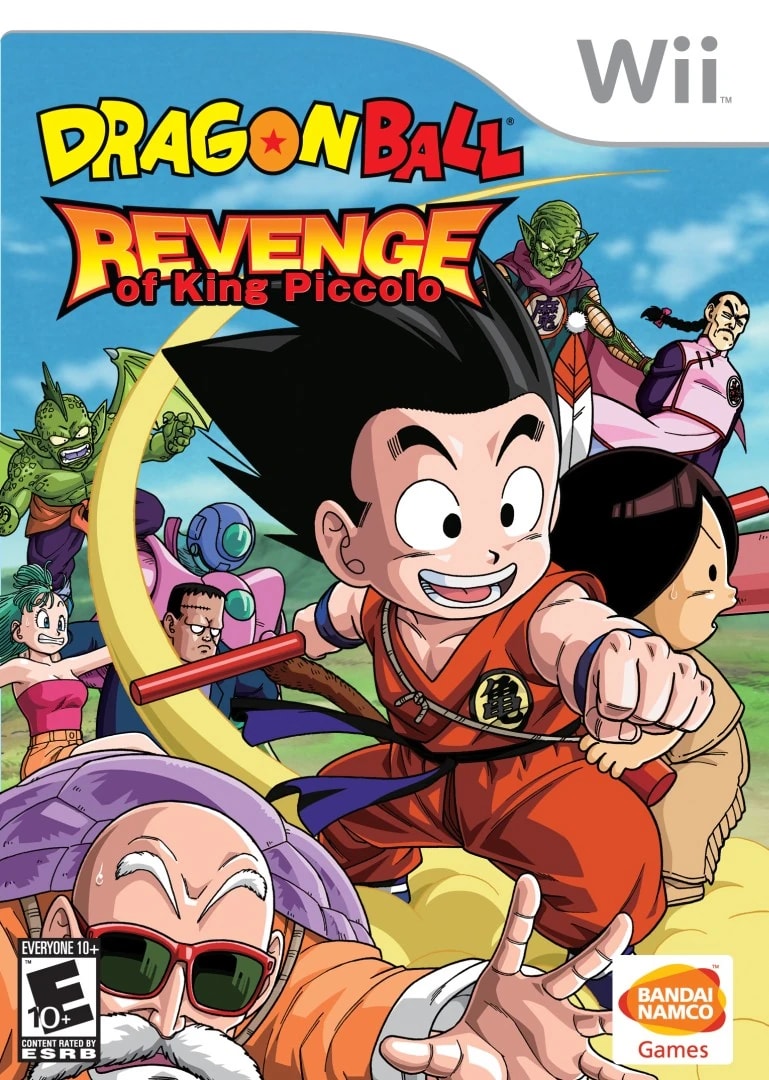
Dragon Ball: Revenge of King Piccolo
GameDragon Ball: Revenge of King Piccolo, released in Japan as , is a video game based on the Dragon Ball manga and anime series. It was developed by and published by Namco Bandai under the Bandai label for . It was released on July 23, 2009, in Japan. It was released on October 30, 2009, in Europe, on October 20, 2009, in North America, and October 15, 2009, in Australia.
Beat-'Em-Up Gameplay & Controls
Dragon Ball: Revenge of King Piccolo is a 3D beat-'em-up action game for the Nintendo Wii, setting it apart from the fighting games that dominated the Dragon Ball franchise at the time of its release. Players guide Goku through a series of stages populated with waves of enemies, using the Wiimote and Nunchuk to deliver standard melee combos, ki-powered attacks, and the iconic Kamehameha wave. An in-game currency system based on Zeni allows players to purchase power-up items that strengthen Goku between stages, introducing a light RPG element that rewards thorough exploration and efficient combat. Two health meters are tracked simultaneously on screen: one for physical endurance and one for ki reserves, requiring players to balance aggressive offense with strategic resource management.
A multiplayer versus mode rounds out the feature set, allowing two players to compete head-to-head using the game's expanded roster of playable fighters. The character selection includes major heroes such as Krillin, Yamcha, and Tien Shinhan, as well as notable adversaries like Mercenary Tao, General Blue, and the demonic servants of King Piccolo. Each character plays differently, lending replayability to the competitive mode. The game's visual presentation deliberately reproduces Akira Toriyama's original pen-and-ink line work in three-dimensional form, resulting in an art style that bridges the classic manga aesthetic with the technical capabilities of the Wii hardware. A variety of collectibles are also hidden throughout stages, rewarding thorough players with additional content.
The boss encounter design follows the narrative arc closely, culminating in multi-phase confrontations against iconic villains from both the Red Ribbon Army Saga and the King Piccolo Saga. Players face a wide array of named bosses including Major Metallitron, the Pilaf Machines, and ultimately both forms of King Piccolo himself, across a progression that mirrors the original story with high fidelity.



Story Coverage & Characters
Revenge of King Piccolo adapts a substantial portion of the original Dragon Ball manga and anime, opening with Goku's earliest adventures during the Red Ribbon Army Saga and concluding with the defeat of King Piccolo. The narrative scope is broader than most Dragon Ball Wii titles of its era, encompassing Goku's encounters with the Red Ribbon organization, his training at Korin Tower, his appearances before Fortuneteller Baba, the World Martial Arts Tournament circuit, and the full escalation of the King Piccolo threat. Key supporting characters including Bulma, Krillin, Master Roshi, and Korin appear in cutscenes that stitch the stage progression into a coherent story, maintaining the tone and pacing of the source material throughout.
The playable roster reflects the rich character tapestry of early Dragon Ball. Heroes such as Goku, Yamcha, Jackie Chun, Chiaotzu, and Tien Shinhan are joined by an unusually diverse selection of villains including Tambourine, Drum, and both the old and young forms of King Piccolo. Non-playable characters including Kami and Mr. Popo make brief appearances in the end credits, signaling the story's direction toward what would follow in Dragon Ball Z. The inclusion of Arale Norimaki from the Dr. Slump crossover adds a surprising guest fighter to the playable lineup, a nod to the shared universe between Toriyama's two major franchises.
Context & Platform Legacy
Released in October 2009 across North American, European, and Australian markets after its July Japan launch, Revenge of King Piccolo arrived during a period when the Wii was the dominant family gaming platform and publishers were actively seeking to expand Dragon Ball beyond its traditional fighting game format. The decision to design the game as a beat-'em-up rather than a one-on-one fighter positioned it as a companion piece to the earlier Game Boy Advance title Dragon Ball: Advanced Adventure, which had similarly adapted the original Dragon Ball saga in a side-scrolling brawler format.
Published by Namco Bandai under the Bandai label, the game represents one of the more ambitious attempts to adapt the pre-Z Dragon Ball era for a home console audience during the 2000s. Its emphasis on faithful visual reproduction of Toriyama's original artwork distinguished it aesthetically from many of its contemporaries, and the inclusion of both a story mode and a multiplayer versus component gave it broader appeal than a purely narrative-driven experience would have offered. The game remains a notable entry in the Wii's Dragon Ball library and a respectful adaptation of the classic saga.
Related Reading
See all
Krillin's on the Tinder: How the Ultimate Short King Survived the Height Filter
Tinder built a height filter. Dragon Ball built a five foot legend. What happened when we sent the ultimate short king into the modern dating hellscape....

Infinite Zeni Glitch: When Yamcha Never Pays and Mr. Popo Always Does
The internet found an infinite money glitch. So did Yamcha. A smooth R&B track about the easiest money in the Dragon Ball world and the one man who keeps paying for it....
Frequently Asked Questions
What is Dragon Ball: Revenge of King Piccolo?
Dragon Ball: Revenge of King Piccolo, released in Japan as, is a video game based on the Dragon Ball manga and anime series. It was developed by and published by Namco Bandai under the Bandai label for. It was released on July 23, 2009, in Japan.
Which characters appear in Dragon Ball: Revenge of King Piccolo?
Revenge of King Piccolo adapts a substantial portion of the original Dragon Ball manga and anime, opening with Goku's earliest adventures during the Red Ribbon Army Saga and concluding with the defeat of King Piccolo. The narrative scope is broader than most Dragon Ball Wii titles of its era, encompassing Goku's encounters with the Red Ribbon organization, his training at Korin Tower, his appearances before Fortuneteller Baba, the World Martial Arts Tournament circuit, and the full escalation of the King Piccolo threat. Key supporting characters including Bulma, Krillin, Master Roshi, and Korin appear in cutscenes that stitch the stage progression into a coherent story, maintaining the tone and pacing of the source material throughout.
What is Dragon Ball: Revenge of King Piccolo about?
Dragon Ball: Revenge of King Piccolo is a 3D beat-'em-up action game for the Nintendo Wii, setting it apart from the fighting games that dominated the Dragon Ball franchise at the time of its release. Players guide Goku through a series of stages populated with waves of enemies, using the Wiimote and Nunchuk to deliver standard melee combos, ki-powered attacks, and the iconic Kamehameha wave. An in-game currency system based on Zeni allows players to purchase power-up items that strengthen Goku between stages, introducing a light RPG element that rewards thorough exploration and efficient combat.
When was Dragon Ball: Revenge of King Piccolo released?
Dragon Ball: Revenge of King Piccolo was released in 2009. It was published by Namco Bandai.
Who published Dragon Ball: Revenge of King Piccolo?
Dragon Ball: Revenge of King Piccolo was published by Namco Bandai. It was released in 2009.
Sources & Information
Looking for more on Dragon Ball: Revenge of King Piccolo? The Dragon Ball Wiki on Fandom has a dedicated page with community notes.
View on FandomThis content is original writing by Daddy Jim Headquarters based on the Dragon Ball anime series, manga, and official materials. Episode and chapter references are cited where applicable.
Character and scene imagery on this site is original artwork by Daddy Jim Headquarters, not screenshots or licensed imagery. Official cover art is used on three types of pages for editorial commentary:
- Movie pages: theatrical posters and key visuals, credited to Toei Animation and Shueisha.
- Game pages: official box art, credited to Bandai Namco, Atari, and other publishers.
- Manga chapter pages: Jump Comics volume covers, credited to Shueisha and Akira Toriyama.
Browse our episode guides:
Official resources:
Help Us Keep This Wiki Accurate
Daddy Jim Headquarters maintains this encyclopedia. If you spot an error, a translation issue, or something that doesn't look right, let us know.