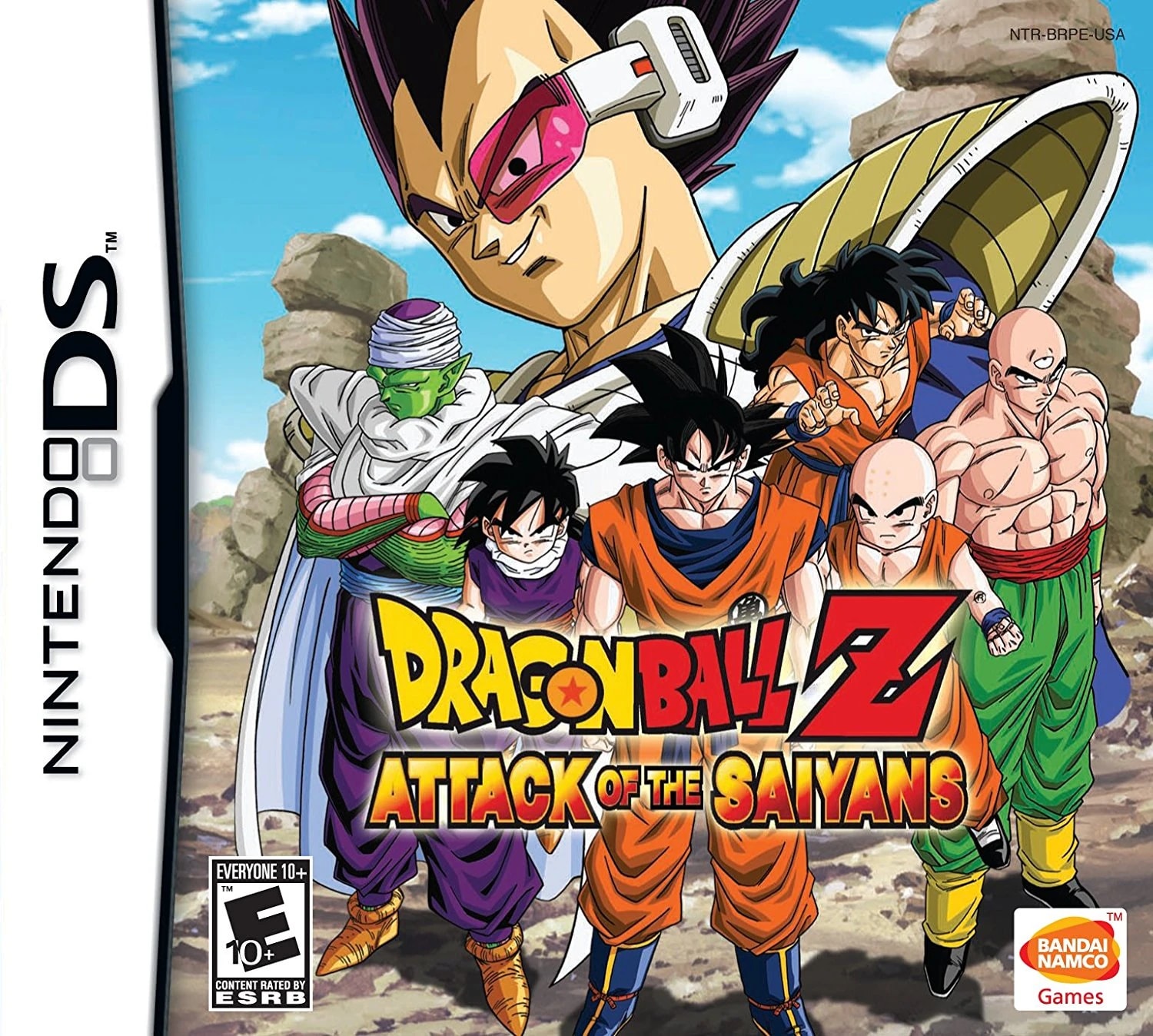
Dragon Ball Z: Attack of the Saiyans
GameDragon Ball Z: Attack of the Saiyans サイヤ人来襲|Doragon Bōru Kai Saiya-jin Raishū|lit. Dragon Ball Revised: Saiyan Invasion}} is a video game developed by , and distributed by Namco Bandai in North America and everywhere else under the Bandai label for the console. It was released in Japan on April 29, 2009. The game was released in Australia, Europe and America in November 2009 with the Dragon Ball Z label. In Japan, the game was originally planned to use the Z moniker, but was changed to Kai to associate it with the Dragon Ball Kai revision.
Gameplay
Dragon Ball Z: Attack of the Saiyans is a turn-based RPG developed by Monolith Soft for the Nintendo DS. Players control a party of up to three characters drawn from the Z Fighters roster, navigating a top-screen overworld that spans fields, forests, caves, and towns while the bottom touch screen displays available equipment dispensed from Capsule Corporation Dyno-Caps. Obstacles such as rocks and brush block progress through area maps and require ki blasts of varying strength to clear, adding a light puzzle element to exploration.
Combat places the active party against enemies or bosses on a dedicated battle screen, with commands entered via the control pad rather than the stylus. Each character carries a set of unlocked attacks alongside techniques that must be purchased or upgraded using Ability Points earned from victories. The Rage Gauge fills over the course of a fight and, when full, triggers Sparking! mode, surrounding the character with a red aura and enabling powerful ultimate attacks. If two or more characters reach Sparking! simultaneously, they can execute a Sparking Combo, a coordinated assault that depletes the gauge completely upon use. Players also benefit from the Active Guard system, which allows a chosen character to absorb minimal damage by pressing the corresponding button just before an enemy strike lands.
The game presents its visuals in traditional 2D animation sprites, maintaining an aesthetic consistent with the television series. Six playable characters are available, and the roster expands as the story progresses. The skill menu for each character forms a branching upgrade tree, so unlocking one ability frequently opens access to further techniques, encouraging players to invest AP thoughtfully across the entire party.



Story
Attack of the Saiyans begins its narrative at the 23rd World Martial Arts Tournament, well before the events that define Dragon Ball Z. This entry point allows the game to explore the training, rivalries, and camaraderie of the Z Fighters during a period the animated series covers only briefly. The story then advances through the arrival of Raditz, the death of Goku, and the desperate preparations the remaining warriors make before the Saiyan invasion reaches Earth.
The Saiyan Saga forms the climax of the campaign, culminating in the battle against Nappa and the final confrontation with Vegeta, who must be faced in both his base form and as a Great Ape. The game incorporates numerous alternate storylines designed to deepen the player's understanding of the Dragon Ball universe, including side quests and encounters not depicted in the anime. A secret boss encounter with Legendary Super Saiyan Broly is hidden within the game, rewarding thorough exploration beyond the main narrative path.
The narrative covers much of the same ground as the 1994 Game Boy title Dragon Ball Z: Goku Hishoden, but with significantly expanded scope and a far larger cast of supporting characters. The inclusion of original subplots and branching encounters gives the campaign a texture that distinguishes it from a straightforward adaptation, making it one of the more story-rich portable Dragon Ball titles of its era.
Reception and Legacy
Attack of the Saiyans received generally positive coverage from critics, who praised the battle system for its depth and the game's visual faithfulness to the source material. The RPG format was noted as a refreshing departure from the fighting game template that dominated Dragon Ball releases at the time, and the Sparking! combo mechanic drew particular attention for rewarding coordinated party management.
The game became the third best-selling video game in Japan during its release window, a strong commercial result for a handheld title based on a franchise already well represented in the market. Its North American and European launch in November 2009 coincided with Namco Bandai's acquisition of the Dragon Ball gaming license from Atari, marking a significant transition in how the franchise was published in Western territories. Attack of the Saiyans stands as one of the most accomplished Dragon Ball RPGs released for a portable platform and remains a reference point for fans interested in turn-based interpretations of the series.
Related Reading
See all
Krillin's on the Tinder: How the Ultimate Short King Survived the Height Filter
Tinder built a height filter. Dragon Ball built a five foot legend. What happened when we sent the ultimate short king into the modern dating hellscape....
Infinite Zeni Glitch: When Yamcha Never Pays and Mr. Popo Always Does
The internet found an infinite money glitch. So did Yamcha. A smooth R&B track about the easiest money in the Dragon Ball world and the one man who keeps paying for it....
Frequently Asked Questions
Is there a sequel to Attack of the Saiyans?
The game became the third best-selling video game in Japan during its release window, a strong commercial result for a handheld title based on a franchise already well represented in the market. Its North American and European launch in November 2009 coincided with Namco Bandai's acquisition of the Dragon Ball gaming license from Atari, marking a significant transition in how the franchise was published in Western territories. Attack of the Saiyans stands as one of the most accomplished Dragon Ball RPGs released for a portable platform and remains a reference point for fans interested in turn-based interpretations of the series.
Who is the secret boss in Dragon Ball Attack of the Saiyans?
Dragon Ball Z: Attack of the Saiyans was published by Namco Bandai / Bandai. It was released in 2009.
What is Dragon Ball Z: Attack of the Saiyans?
Dragon Ball Z: Attack of the Saiyans サイヤ人来襲 is a video game developed by, and distributed by Namco Bandai in North America and everywhere else under the Bandai label for the console. It was released in Japan on April 29, 2009. The game was released in Australia, Europe and America in November 2009 with the Dragon Ball Z label.
Which characters appear in Dragon Ball Z: Attack of the Saiyans?
Attack of the Saiyans begins its narrative at the 23rd World Martial Arts Tournament, well before the events that define Dragon Ball Z. This entry point allows the game to explore the training, rivalries, and camaraderie of the Z Fighters during a period the animated series covers only briefly. The story then advances through the arrival of Raditz, the death of Goku, and the desperate preparations the remaining warriors make before the Saiyan invasion reaches Earth.
What is Dragon Ball Z: Attack of the Saiyans about?
Dragon Ball Z: Attack of the Saiyans is a turn-based RPG developed by Monolith Soft for the Nintendo DS. Players control a party of up to three characters drawn from the Z Fighters roster, navigating a top-screen overworld that spans fields, forests, caves, and towns while the bottom touch screen displays available equipment dispensed from Capsule Corporation Dyno-Caps. Obstacles such as rocks and brush block progress through area maps and require ki blasts of varying strength to clear, adding a light puzzle element to exploration.
Sources & Information
Looking for more on Dragon Ball Z: Attack of the Saiyans? The Dragon Ball Wiki on Fandom has a dedicated page with community notes.
View on FandomThis content is original writing by Daddy Jim Headquarters based on the Dragon Ball anime series, manga, and official materials. Episode and chapter references are cited where applicable.
Character and scene imagery on this site is original artwork by Daddy Jim Headquarters, not screenshots or licensed imagery. Official cover art is used on three types of pages for editorial commentary:
- Movie pages: theatrical posters and key visuals, credited to Toei Animation and Shueisha.
- Game pages: official box art, credited to Bandai Namco, Atari, and other publishers.
- Manga chapter pages: Jump Comics volume covers, credited to Shueisha and Akira Toriyama.
Browse our episode guides:
Official resources:
Help Us Keep This Wiki Accurate
Daddy Jim Headquarters maintains this encyclopedia. If you spot an error, a translation issue, or something that doesn't look right, let us know.