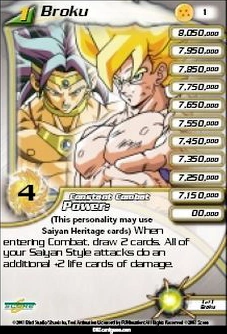
Dragon Ball Z Collectible Card Game
GameDragon Ball Z Trading Card Game (originally Dragon Ball Z Collectible Card Game and Dragon Ball GT Trading Card Game) is a based on the Dragon Ball series. It was initially produced by and then rebooted by Panini America. Direct shots from the anime of Dragon Ball Z and other Dragon Ball media are used as card artwork to recreate the feeling of the famous battles, characters and events as seen in the show.
Gameplay and Rules
The Dragon Ball Z Collectible Card Game is a physical trading card game originally produced by Score Entertainment and later rebooted by Panini America. Players construct decks around a Main Personality card representing their chosen character and declare a Tokui-Waza, or fighting style, by committing to a single style deck type. Six style options are available in the core game: Red, Blue, Orange, Black, Saiyan, and Namekian, plus Freestyle for mixed builds. Saiyan and Namekian Tokui-Waza can only be declared if the player's Main Personality is of the appropriate race, and Namekian style was phased out during the Dragon Ball GT Trading Card Game period before returning in the rebooted Dragon Ball Z Trading Card Game.
Combat is divided between Physical Combat cards representing martial arts techniques and Energy Combat cards depicting ki-based attacks. Non-Combat cards in the original Collectible Card Game, later renamed Support cards in the Trading Card Game and Non-Combat Setups in the GT Trading Card Game, cover events from the series. Mastery cards govern a deck's style advantages and sit alongside Personality cards as central deck construction elements. Sensei cards introduce a side-deck mechanic comparable to similar systems in other trading card games, requiring a dedicated Sensei card to activate. Dragon Balls held Non-Combat status in the early sets and received their own distinct card type from the Majin Buu Saga expansion onward.
Card rarity spans seven tiers from Common through Ultra Rare, with Foil and Alternate Foil variants increasing the collectible value of individual cards. Booster packs typically contained ten to twelve cards with one rare and a chance at a foil. Limited and Unlimited print distinctions, marked by a dragon symbol in the Z game or the GT logo in the GT game, affect card values among collectors. The Grand Kai Invitational distributed Alternate Foil versions of older cards to participants, creating a secondary tier of event-exclusive rarities. Score produced alternate versions of Ultra Rares from the Saiyan through Babidi Sagas as corrected reprints for previously poorly worded cards.


History and Sets
The game launched in 2000 with Saiyan Saga starter decks and booster packs. Over the following six years it released eighteen expansions, one virtual set, and multiple subsets including Broly-themed inserts. The Saiyan Saga set was acknowledged even by the publisher as unrefined; ambiguous card wordings and permissive rules about who could use race-specific cards were formally corrected through official errata on Score's website. The Frieza Saga expansion added the Namek story arc but was criticized for neglecting key characters: Frieza received minimal support despite being the saga's primary villain, Burter and Recoome appeared only in group Ginyu Force cards rather than individual personalities, and Frieza's second and third forms were never released in that expansion.
The Cell Saga, Majin Buu Saga, and subsequent sets introduced new mechanics incrementally. Majin cards, debuting in the World Games Saga, restricted play to Personality cards bearing the Majin designation. Dragon Balls received their own card type in the Majin Buu Saga expansion. After the Kid Buu Saga concluded the Z-era content, Score pivoted to Dragon Ball GT with a revised rule set that was incompatible with previous sets. A fifth GT expansion titled Anthology was planned but never released, and the GT series ended following its fourth set. The Dragon Ball Z Trading Card Game, a third distinct game built on the Funimation Ultimate Uncut Edition releases, followed with rules that broke compatibility with the earlier Z and GT products, creating what fans call the Re-Z era.
The game had accumulated 2,660 cards including promotional items by the time it was discontinued in June 2006. Its successor, the Dragon Ball Collectible Card Game published by a different company, arrived in July 2008 with a completely different rule set. Panini America subsequently produced a reboot of the Dragon Ball Z Trading Card Game beginning in 2014, reintroducing the property to a new generation of card game players.


Legacy
The Dragon Ball Z Collectible Card Game represents the franchise's most sustained commercial presence in the North American trading card game market during the early 2000s. Its arrival in 2000 coincided with the peak of Dragon Ball Z's broadcast popularity on Cartoon Network, and the card game benefited directly from that exposure by reaching a large youth audience already familiar with the characters and conflicts depicted on each card. Direct screenshots from the anime served as card artwork, giving the product an immediacy and authenticity that resonated with fans of the show.
The game is remembered fondly by players who engaged with the tournament circuit and the Grand Kai Invitational events during its run, as well as by collectors who pursued the rarer promotional and event-exclusive cards. The complications introduced by the GT expansion and the subsequent rule break of the Re-Z era are well documented in fan communities and serve as a case study in how licensing transitions and mechanical overhauls can fragment a card game's player base. The game's full run of 2,660 cards across eighteen expansions and multiple subsets constitutes one of the most extensive Dragon Ball branded card game catalogs ever assembled.
Sparking Zero May 26 Update Adds Demon World Stage and Reworks Transformation Healing
May 27, 2026Bandai Namco shipped a free Dragon Ball: Sparking Zero update on May 26, 2026 that introduces a new Demon World stage, overhauls transformation healing, and confirms the Daima Character Pack and Shallot DLC for release on June 27, 2026....
Dragon Ball FighterZ Adds Super Saiyan 4 Goku From Daima
May 25, 2026Dragon Ball FighterZ added Super Saiyan 4 Goku, the form featured in the Daima anime, as DLC on April 22, 2026. The 2018 fighting game is still getting new content nearly eight years on....
Dragon Ball Sparking Zero Super Limit-Breaking NEO DLC Adds 30 Plus Fighters for Summer 2026
Apr 20, 2026Bandai Namco and Spike Chunsoft unveiled the Super Limit-Breaking NEO expansion for Dragon Ball Sparking Zero at Battle Hour 2026. Summer 2026 release, 30 plus characters, four new stages, and a new solo mode....
Sources & Information
Looking for more on Dragon Ball Z Collectible Card Game? The Dragon Ball Wiki on Fandom has a dedicated page with community notes.
View on FandomThis content is original writing by Daddy Jim Headquarters based on the Dragon Ball anime series, manga, and official materials. Episode and chapter references are cited where applicable.
Character and scene imagery on this site is original artwork by Daddy Jim Headquarters, not screenshots or licensed imagery. Official cover art is used on three types of pages for editorial commentary:
- Movie pages: theatrical posters and key visuals, credited to Toei Animation and Shueisha.
- Game pages: official box art, credited to Bandai Namco, Atari, and other publishers.
- Manga chapter pages: Jump Comics volume covers, credited to Shueisha and Akira Toriyama.
Browse our episode guides:
Official resources:
Dragon Ball Music by Daddy Jim Headquarters
Come listen to some Dragon Ball R&B.
Help Us Keep This Wiki Accurate
Daddy Jim Headquarters maintains this encyclopedia across 13 languages. If you spot an error, a translation issue, or something that doesn't look right, let us know.