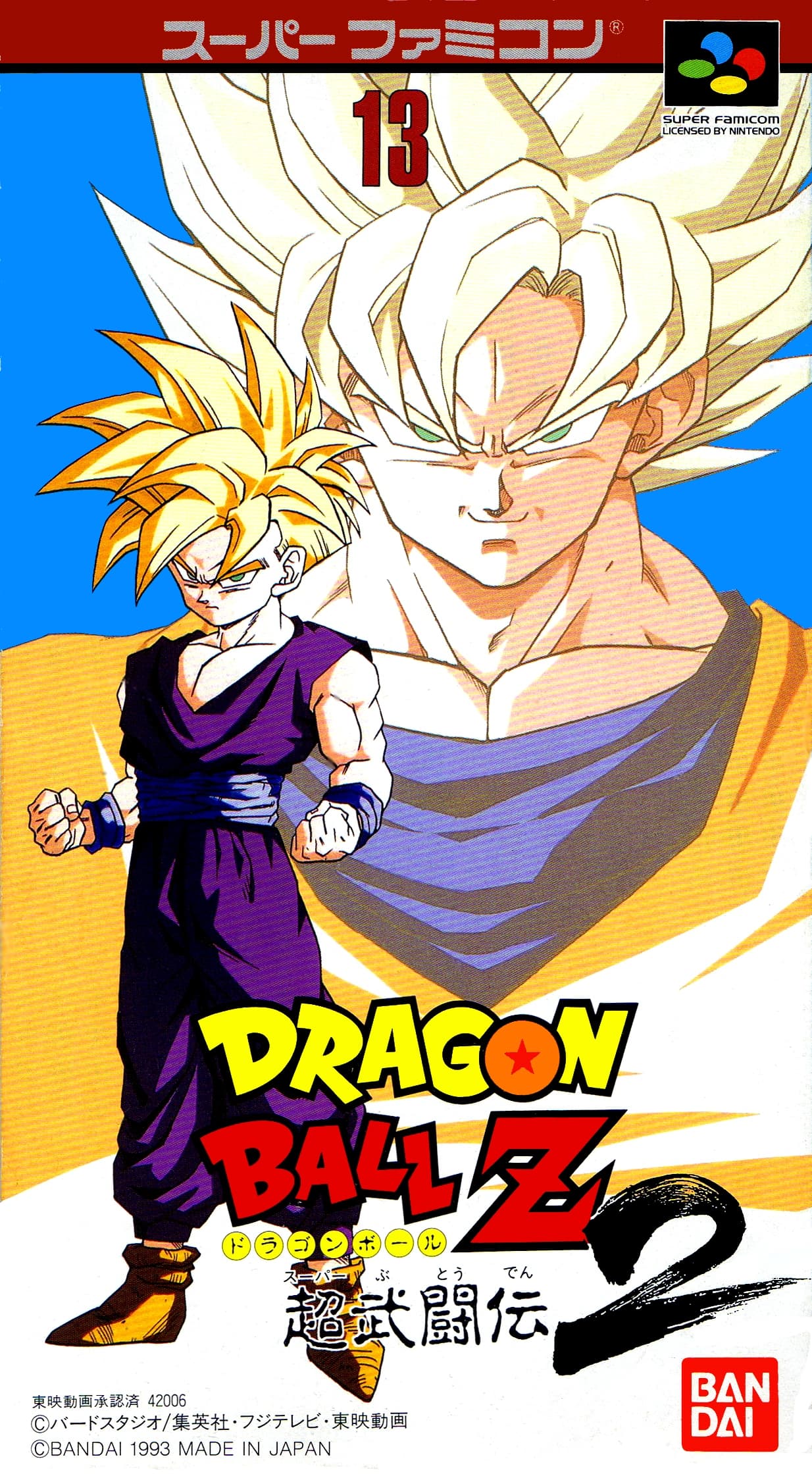
Dragon Ball Z: Super Butōden 2
GameDragon Ball Z: Super Butōden 2武闘伝2|Doragon Bōru Zetto Sūpā Butōden Tsū|lit. Dragon Ball Z: Super Fighting Legend 2}}, called Dragon Ball Z 2: la Légende Saien in France, is a fighting game and the second installment in the Butōden series. It was released for the Super Famicom on December 17, 1993, in Japan, and in June 1994 in France and Spain. Super Butōden 2 is also one of the games included in the game compilation J Legend Retsuden for Nintendo 3DS. Additionally, a digital copy of the game was made available as a bonus for fans who pre-ordered Dragon Ball Z: Extreme Butōden for the 3DS.
Gameplay
Dragon Ball Z: Super Butoden 2 is a 2D fighting game released for the Super Famicom on December 17, 1993, in Japan and in mid-1994 in France and Spain. It is the second entry in the Butoden series and features ten playable characters, including two unlockable fighters accessible via code. Combat takes place across twelve battle stages ranging from the World Martial Arts Tournament arena to forests, glaciers, and desert environments, each available in both daytime and nighttime variants for several locales.
The Story Mode is the game's defining feature, offering a branching narrative structure that changes based on whether the player wins or loses each battle. Players control Gohan, Future Trunks, Vegeta, or Piccolo, and the outcomes of their fights determine which story branch unfolds. The mode covers three primary storylines: "Fear! The Cell Games," which concludes the Cell arc; "Resurrection! Galaxy Warrior," featuring Bojack and Zangya; and "Legendary Super Saiyan?," an arc centered on Broly that unlocks under specific conditions on harder difficulty settings. The large number of branching possibilities made the Story Mode particularly popular at the time of release.
Charging Ki in Super Butoden 2 requires several seconds of sustained button input, a slower process than its predecessor or successor. The deliberate pacing of ki accumulation affects the rhythm of combat, making resource management a meaningful consideration. Players who master when to charge versus when to commit to attacks gain a substantial advantage over opponents.

Story
Super Butoden 2's Story Mode opens with the Cell Games arc and allows it to evolve in different directions depending on the player's performance. In the primary branch, Mr. Satan confronts Cell before Gohan steps in for the decisive battle. If the player does not defeat Cell in their second confrontation, Gohan ends the fight with the Father-Son Kamehameha, mirroring the climax of the Cell Games from the anime.
Unlocking the "Resurrection! Galaxy Warrior" story requires completing the Cell Games arc. This branch introduces Bojack and Zangya as villains who arrive on Earth seeking the Dragon Balls and use evil clones of the Z Fighters to sow confusion. An alternate sub-branch called "Sudden Shock! Duel" features these villains using the Destron Gas alongside Cell Juniors as soldiers. If the Z Fighters fail to stop Bojack, Broly appears and kills him, ending the mode on a dark note. The Broly-centered "Legendary Super Saiyan?" arc is the rarest branch, requiring specific task completion at higher difficulty levels to unlock.
Related Reading
See all
Namek Has No Women, and Piccolo Pulls Anyway
There are no women on Namek. That isn't an oversight, it's the biology. Why we handed Piccolo the one thing his own species rules out, and why it had to be trap soul....
1000 Times Over: Who Is John Dragon Ball Singing To?
Dragon Ball handed us a protagonist with no history and the internet named him John Dragon Ball. So we built him somebody to talk to....
Context and Legacy
Super Butoden 2 is also included in the J Legend Retsuden game compilation for Nintendo 3DS, and a digital copy was made available as a pre-order bonus for Dragon Ball Z: Extreme Butoden on the same platform. This regional bonus release remained untranslated from Japanese, limiting its accessibility for non-Japanese players. The game was known in France as Dragon Ball Z 2: la Legende Saien, reflecting the French localization common to the Butoden series in Europe.
The branching Story Mode is consistently cited as the strongest element of the game and one of the most ambitious story structures in the Butoden series. The French official translation is noted for being grammatically inconsistent and at times incomprehensible for readers unfamiliar with Dragon Ball Z, a quality that became a minor part of its reputation in European markets. Super Butoden 2 remains well-regarded among fans of 16-bit Dragon Ball Z games for its narrative ambition and varied content.
Frequently Asked Questions
What is Dragon Ball Z: Super Butōden 2?
Dragon Ball Z: Super Butoden 2 is a 2D fighting game released for the Super Famicom on December 17, 1993, in Japan and in mid-1994 in France and Spain. It is the second entry in the Butoden series and features ten playable characters, including two unlockable fighters accessible via code. Combat takes place across twelve battle stages ranging from the World Martial Arts Tournament arena to forests, glaciers, and desert environments, each available in both daytime and nighttime variants for several locales.
When was Dragon Ball Z: Super Butōden 2 released?
Dragon Ball Z: Super Butōden 2 was released in 1993. Bandai published it as part of the Butoden game series.
Who published Dragon Ball Z: Super Butōden 2?
Dragon Ball Z: Super Butōden 2 was published by Bandai. The release came in 1993.
What Dragon Ball series does Dragon Ball Z: Super Butōden 2 belong to?
Dragon Ball Z: Super Butōden 2 is part of the Butoden game series. The game launched in 1993.
What platforms is Dragon Ball Z: Super Butōden 2 available on?
Dragon Ball Z: Super Butōden 2 was released on Super Famicom and Nintendo 3DS. Dragon Ball Z: Super Butoden 2 is a 2D fighting game released for the Super Famicom on December 17, 1993, in Japan and in mid-1994 in France and Spain.
Sources & Information
Looking for more on Dragon Ball Z: Super Butōden 2? The Dragon Ball Wiki on Fandom has a dedicated page with community notes.
View on FandomThis content is original writing by Daddy Jim Headquarters based on the Dragon Ball anime series, manga, and official materials. Episode and chapter references are cited where applicable.
Rights holders
- Created byAkira Toriyama
- Published byShueisha
- Animated byToei Animation
All rights belong to their respective owners.
Character and scene imagery on this site is original artwork by Daddy Jim Headquarters, not screenshots or licensed imagery. Official cover art is used on three types of pages for editorial commentary:
- Movie pages: theatrical posters and key visuals, credited to Toei Animation and Shueisha.
- Game pages: official box art, credited to Bandai Namco, Atari, and other publishers.
- Manga chapter pages: Jump Comics volume covers, credited to Shueisha and Akira Toriyama.
Browse our episode guides:
Official resources:
Help Us Keep This Wiki Accurate
Daddy Jim Headquarters maintains this encyclopedia. If you spot an error, a translation issue, or something that doesn't look right, let us know.
