Dragon Ball Z: Bio-Broly
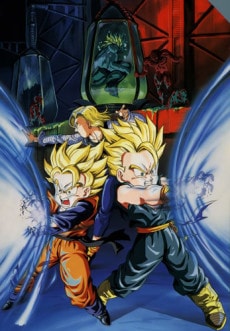
MovieThe final chapter of the original Broly trilogy. A wealthy industrialist clones the Legendary Super Saiyan, but the experiment goes horribly wrong when the clone mutates into a grotesque bio-organic monster that Goten, Trunks, Krillin, and Android 18 must stop before it consumes everything.
Clone Gone Wrong
The film opens in a high-tech laboratory where scientists employed by the eccentric Lord Jaguar are perfecting a line of genetically engineered fighters called Bio-Warriors. Jaguar, a wealthy industrialist with a grudge against Mr. Satan, plans to humiliate the World Champion by pitting his creations against him in combat. His ultimate weapon sits in a holding tank at the center of the lab: a clone grown from the blood of Broly, the Legendary Super Saiyan, whose frozen remains were sold to Jaguar by Maloja, the disgraced priest from Natade Village.
Blackmail and a Trip to the Island
Jaguar's cousin Men-Men arrives at Mr. Satan's mansion to deliver a blackmail ultimatum. Jaguar knows about a humiliating childhood secret (the champion's bed-wetting history), and Satan has no choice but to comply. He departs for Jaguar's island fortress, Mei Queen Castle, with Android 18 in pursuit (she is still owed prize money from the 25th World Martial Arts Tournament) and Goten and Trunks tagging along out of curiosity.
At the castle, Jaguar's Bio-Warriors prove too much for Mr. Satan, and Goten, Trunks, and Android 18 step in to handle them. The situation escalates dramatically when Jaguar reveals his prized specimen: the Broly clone. Before the children can destroy it in its tank, the clone senses their energy and awakens. It breaks free of containment, only to be drenched in the facility's bio-liquid, a mutagenic substance that transforms it into a hideous, slime-covered abomination. Bio-Broly is born, and the bio-liquid begins flooding the entire laboratory.
Fighting the Flood
Bio-Broly attacks with savage, mindless aggression. Android 18 is beaten badly before Krillin arrives to pull her to safety. Goten and Trunks fight the creature in waves, taking turns drawing its attention while the other rescues trapped scientists from the rising tide of bio-liquid, which dissolves anything it touches. Trunks fires a Finish Buster that accidentally ruptures a containment tank, showering Bio-Broly with more liquid and seemingly melting him. But the creature only grows stronger, and the bio-liquid begins consuming the entire island.
Salt Water Salvation
With the facility collapsing around them, the group evacuates everyone they can, including the reluctant Jaguar and Men-Men. Trunks discovers the bio-liquid's weakness by accident: it solidifies on contact with sea water. Goten, Trunks, and Krillin unleash a triple Kamehameha aimed at the ocean, launching a massive wave that floods the island and hardens all the bio-liquid into stone. Bio-Broly emerges from the sea as a towering giant, only to solidify instantly. Goten and Trunks blast the petrified monster to pieces, ending the Broly legacy once and for all. The film closes with Android 18 cheerfully extorting Mr. Satan for her money while Krillin remains comically stuck in the rock he was blasted into.



Slime, Screams, and the Kids Take Charge
Bio-Broly is unusual among Dragon Ball Z films in that its lead fighters are children and supporting characters rather than Goku or Vegeta. Goten, Trunks, Krillin, and Android 18 carry the entire film, which gives it a different energy than the typical DBZ movie formula.
The Triple Kamehameha
The film's most satisfying moment comes near the end when Goten, Trunks, and Krillin combine their Kamehameha waves to launch an ocean's worth of seawater onto the island. The visual of three beams converging on the ocean surface and the resulting tidal wave crashing over Bio-Broly is the closest the film gets to a traditional, triumphant Dragon Ball Z finale. The solution being environmental rather than purely combat-based sets it apart from the franchise's usual "bigger beam wins" approach.
Android 18 in the Spotlight
Android 18's role deserves mention. She fights Bio-Broly with genuine ferocity, takes a serious beating, and still comes back for more. Her scenes with Krillin carry a warmth that the rest of the film's frantic pacing does not always allow, and her running subplot of demanding payment from Mr. Satan provides most of the film's reliable comedy.
Bio-Broly as a Threat
The creature itself is a departure from the original Broly's appeal. Where the Legendary Super Saiyan was terrifying because of his overwhelming power and focused rage, Bio-Broly is terrifying because of his grotesque, mindless nature. He is less a warrior and more a force of contamination, a monster that grows stronger by absorbing the very substance that created him. The horror-adjacent tone of the laboratory sequences and the rising bio-liquid flooding is a genuinely different atmosphere for a Dragon Ball film.
The Trilogy's Controversial Closer
Dragon Ball Z: Bio-Broly is the fourteenth Dragon Ball film and the final installment of the original Broly trilogy, following Broly: The Legendary Super Saiyan and Broly: Second Coming. Released in Japanese theaters on July 9, 1994, with a runtime of just 47 minutes, it was written by Takao Koyama, directed by Yoshihiro Ueda, and scored by Shunsuke Kikuchi.
Reception
Bio-Broly has always been one of the more divisive entries in the Dragon Ball Z film catalog. Fans who loved the original Broly for his raw power and menacing design found the grotesque, slime-covered clone to be a poor substitute. The film's shorter runtime and lower stakes, combined with the absence of Goku and Vegeta as primary combatants, positioned it as a smaller, more contained story than its predecessors. It earned approximately 1.9 billion yen at the Japanese box office.
Home Video
Funimation released the English dub on DVD on September 13, 2005. The film was later bundled with its two predecessors in the "Broly Triple Threat" DVD set (September 12, 2006) and again in a remastered Triple Feature Blu-ray on March 31, 2009. Despite its mixed reputation, the film completes the Broly saga's arc and gives the supporting cast a rare chance to carry the story on their own terms.
Related Reading
See all
Krillin's on the Tinder: How the Ultimate Short King Survived the Height Filter
Tinder built a height filter. Dragon Ball built a five foot legend. What happened when we sent the ultimate short king into the modern dating hellscape....
Infinite Zeni Glitch: When Yamcha Never Pays and Mr. Popo Always Does
The internet found an infinite money glitch. So did Yamcha. A smooth R&B track about the easiest money in the Dragon Ball world and the one man who keeps paying for it....
Frequently Asked Questions
What is Dragon Ball Z: Bio-Broly?
The final chapter of the original Broly trilogy. A wealthy industrialist clones the Legendary Super Saiyan, but the experiment goes horribly wrong when the clone mutates into a grotesque bio-organic monster that Goten, Trunks, Krillin, and Android 18 must stop before it consumes everything.
What happens in Dragon Ball Z: Bio-Broly?
Mr. Satan's rival, the wealthy Lord Jaguar, has been secretly developing bio-engineered warriors on his private island. He blackmails Mr. Satan into fighting his creations by threatening to reveal embarrassing secrets. Android 18, who is owed prize money from Mr. Satan, follows him to the island along with Goten and Trunks.
When was Dragon Ball Z: Bio-Broly released?
Dragon Ball Z: Bio-Broly was released on July 9, 1994. It is a theatrical film in the Dragon Ball Z era.
Who is the main villain in Dragon Ball Z: Bio-Broly?
The main antagonist of Dragon Ball Z: Bio-Broly is Bio-Broly. Mr. Satan's rival, the wealthy Lord Jaguar, has been secretly developing bio-engineered warriors on his private island.
How long is Dragon Ball Z: Bio-Broly?
Dragon Ball Z: Bio-Broly has a runtime of 47 minutes. Its length is typical for a Dragon Ball theatrical film of its era.
Sources & Information
Looking for more on Dragon Ball Z: Bio-Broly? The Dragon Ball Wiki on Fandom has a dedicated page with community notes.
View on FandomThis content is original writing by Daddy Jim Headquarters based on the Dragon Ball anime series, manga, and official materials. Episode and chapter references are cited where applicable.
Character and scene imagery on this site is original artwork by Daddy Jim Headquarters, not screenshots or licensed imagery. Official cover art is used on three types of pages for editorial commentary:
- Movie pages: theatrical posters and key visuals, credited to Toei Animation and Shueisha.
- Game pages: official box art, credited to Bandai Namco, Atari, and other publishers.
- Manga chapter pages: Jump Comics volume covers, credited to Shueisha and Akira Toriyama.
Browse our episode guides:
Official resources:
Help Us Keep This Wiki Accurate
Daddy Jim Headquarters maintains this encyclopedia. If you spot an error, a translation issue, or something that doesn't look right, let us know.