Akira Toriyama
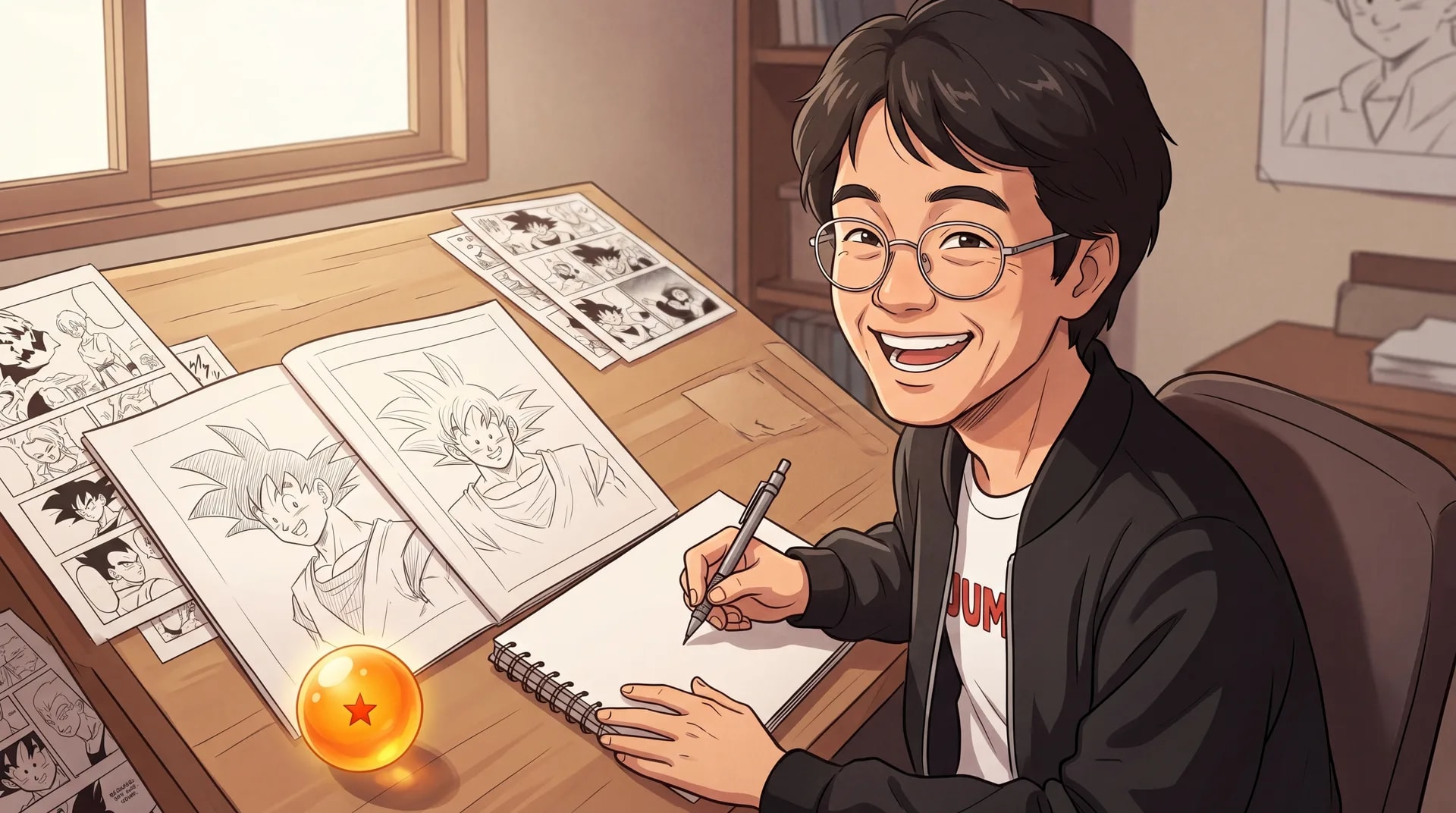
WriterThe creator of Dragon Ball. Akira Toriyama was a Japanese manga artist from Kiyosu whose sly humor, clean line work, and love of kung fu cinema turned a scrappy Journey to the West riff into the most influential shonen series ever drawn.
Creating Dragon Ball
Akira Toriyama launched Dragon Ball in Weekly Shonen Jump at the end of 1984, following a pair of short prototypes called Dragon Boy and The Adventures of Tongpoo. What began as a lighthearted martial arts adventure starring a tailed boy named Goku, a teenage Bulma, and a flying magic staff grew over eleven years into 519 chapters and 42 tankobon volumes, roughly nine thousand pages of story that carried readers from the 21st World Tournament all the way through the Majin Buu arc.
Toriyama drew the whole thing with just two assistants across his career, Hisashi Tanaka and Takashi Matsuyama, working out of his own Bird Studio. His editors Kazuhiko Torishima, Yu Kondo, and Fuyuto Takeda pushed him through the grueling weekly schedule, and the manga became one of the central pillars of what fans call the Golden Age of Jump. Every character, creature, vehicle, and environment in that original run came from his pen.
Style, Humor, and Influence
Toriyama's art is immediately recognizable for its clean outlines, confident anatomy, and an almost mechanical precision in hardware design. He was a devoted scale model hobbyist, which spilled into the tanks, pods, capsule houses, and spaceships that fill Dragon Ball. He openly credited Osamu Tezuka, Walt Disney, One Hundred and One Dalmatians, Godzilla, Ultraman, and Jackie Chan's Drunken Master as early influences, and his love of Westerns and science fiction shows in the genre hopping tone of his work.
Outside of Dragon Ball he was also the character designer for the Dragon Quest role playing series starting in 1986, and for Square's Chrono Trigger in 1994, two projects that gave his art a second life among video game fans. His earlier breakout, Dr. Slump, ran from 1980 to 1984 and proved his gift for goofy, affectionate comedy long before Goku ever powered up. Shy, private, and famously allergic to drawing vehicles even though he excelled at them, he preferred rural life, his family, his dogs, and his models to the Tokyo manga spotlight.
Passing and Legacy
Akira Toriyama died on March 1, 2024, at the age of 68, from an acute subdural hematoma. His former assistant Takashi Matsuyama later revealed that Toriyama had been dealing with a brain tumor and had undergone surgery shortly before his death. The news landed like a meteor across the global anime community, and tributes poured in from manga artists, game studios, and world leaders, a reminder of how deeply his work had reached outside Japan.
His legacy is almost impossible to overstate. Dragon Ball shaped the DNA of modern shonen, from One Piece to Naruto to My Hero Academia, and the Goku silhouette became shorthand for anime itself. Even in his final years he stayed close to the franchise, supervising Dragon Ball Super, designing new forms, and passing the manga torch to his handpicked successor Toyotarou. Dragon Ball keeps running, but every page still carries his fingerprints.
Related Reading
See all
I'll Do You 1000 (Times): Who Is John Dragon Ball Saying That To?
Dragon Ball handed us a protagonist with no history and the internet named him John Dragon Ball. So we built him somebody to talk to....

Majin Goon: The Most Dangerous Being in Dragon Ball Can't Get a Follow Back
Majin Buu can end a planet and can't get a single follow back. The story behind Majin Goon, our hard trap record about the most dangerous being in Dragon Ball losing to a read receipt....
Frequently Asked Questions
Which Dragon Ball did Akira Toriyama write?
Akira Toriyama has written for Dragon Ball Super. Akira Toriyama launched Dragon Ball in Weekly Shonen Jump at the end of 1984, following a pair of short prototypes called Dragon Boy and The Adventures of Tongpoo .
What is Akira Toriyama known for in Dragon Ball?
The creator of Dragon Ball. Akira Toriyama was a Japanese manga artist from Kiyosu whose sly humor, clean line work, and love of kung fu cinema turned a scrappy Journey to the West riff into the most influential shonen series ever drawn.
Where is Akira Toriyama from?
Akira Toriyama is a Japanese writer. The creator of Dragon Ball.
What role does Akira Toriyama play in the Dragon Ball franchise?
Akira Toriyama works in the Dragon Ball franchise as a manga artist. Specifically, their contribution is described as the creator of Dragon Ball. The creator of Dragon Ball.
When did Akira Toriyama become active in the entertainment industry?
Akira Toriyama has been active in the entertainment industry from 1978 to 2024. They were born in 1955 and died in 2024. The creator of Dragon Ball.
Sources & Information
Looking for more on Akira Toriyama? The Dragon Ball Wiki on Fandom has a dedicated page with community notes.
View on FandomThis content is original writing by Daddy Jim Headquarters based on the Dragon Ball anime series, manga, and official materials. Episode and chapter references are cited where applicable.
Character and scene imagery on this site is original artwork by Daddy Jim Headquarters, not screenshots or licensed imagery. Official cover art is used on three types of pages for editorial commentary:
- Movie pages: theatrical posters and key visuals, credited to Toei Animation and Shueisha.
- Game pages: official box art, credited to Bandai Namco, Atari, and other publishers.
- Manga chapter pages: Jump Comics volume covers, credited to Shueisha and Akira Toriyama.
Browse our episode guides:
Official resources:
Help Us Keep This Wiki Accurate
Daddy Jim Headquarters maintains this encyclopedia. If you spot an error, a translation issue, or something that doesn't look right, let us know.