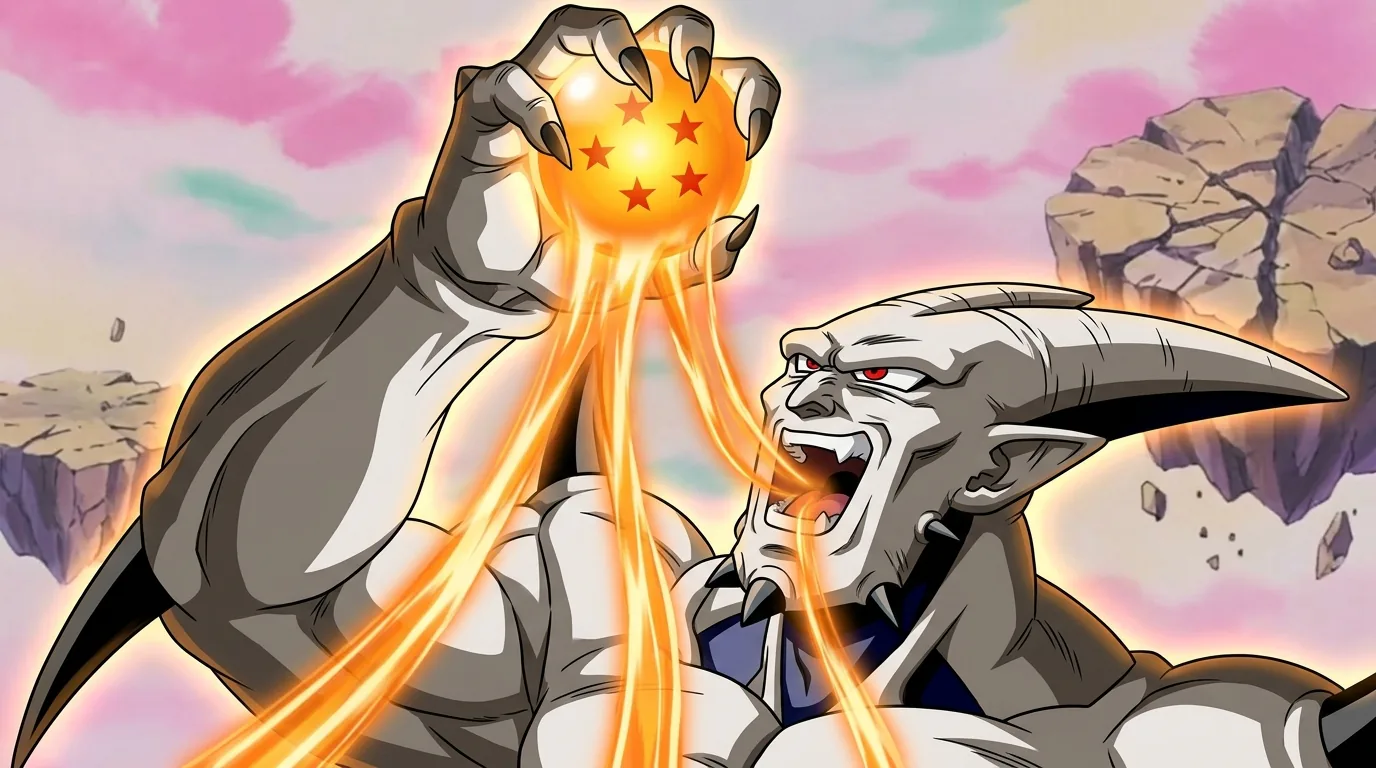
Power Abduction
TechniqueThe ability used by Syn Shenron to absorb the cracked Dragon Balls and gain the powers of all seven Shadow Dragons. This absorption technique transformed him into Omega Shenron, the final antagonist of Dragon Ball GT, by consolidating every Shadow Dragon's unique elemental abilities into a single overwhelmingly powerful body.
Absorbing the Seven Dragon Balls
Power Abduction is the technique Syn Shenron used to transform into Omega Shenron, the most powerful villain in Dragon Ball GT. After the other six Shadow Dragons were defeated by Goku and his allies, their cracked Dragon Balls became available for absorption. Syn Shenron, already the strongest individual Shadow Dragon as the one-star dragon, gathered these orbs into his body one by one.
Each Dragon Ball carried the essence and elemental abilities of its corresponding Shadow Dragon. By absorbing all seven, Syn Shenron gained access to Eis Shenron's ice manipulation, Nuova Shenron's fire control, Rage Shenron's electrical slime, Oceanus Shenron's wind and water abilities, Haze Shenron's pollution powers, and Naturon Shenron's earthquake capabilities. The resulting entity, Omega Shenron, could deploy any of these abilities at will while also possessing vastly amplified base power.
The transformation's weakness was that it could be reversed. When individual Dragon Balls were forcibly removed from Omega Shenron's body during combat, he lost the corresponding Shadow Dragon's powers. This provided a potential strategy for defeating him, though actually extracting the embedded orbs from such a powerful opponent proved extraordinarily difficult in practice.


Sources & Information
Looking for more on Power Abduction? The Dragon Ball Wiki on Fandom has a dedicated page with community notes.
View on FandomThis content is original writing by Daddy Jim Headquarters based on the Dragon Ball anime series, manga, and official materials. Episode and chapter references are cited where applicable.
Character and scene imagery on this site is original artwork by Daddy Jim Headquarters, not screenshots or licensed imagery. Official cover art is used on three types of pages for editorial commentary:
- Movie pages: theatrical posters and key visuals, credited to Toei Animation and Shueisha.
- Game pages: official box art, credited to Bandai Namco, Atari, and other publishers.
- Manga chapter pages: Jump Comics volume covers, credited to Shueisha and Akira Toriyama.
Browse our episode guides:
Official resources:
Dragon Ball Music by Daddy Jim Headquarters
Come listen to some Dragon Ball R&B.
Help Us Keep This Wiki Accurate
Daddy Jim Headquarters maintains this encyclopedia across 13 languages. If you spot an error, a translation issue, or something that doesn't look right, let us know.