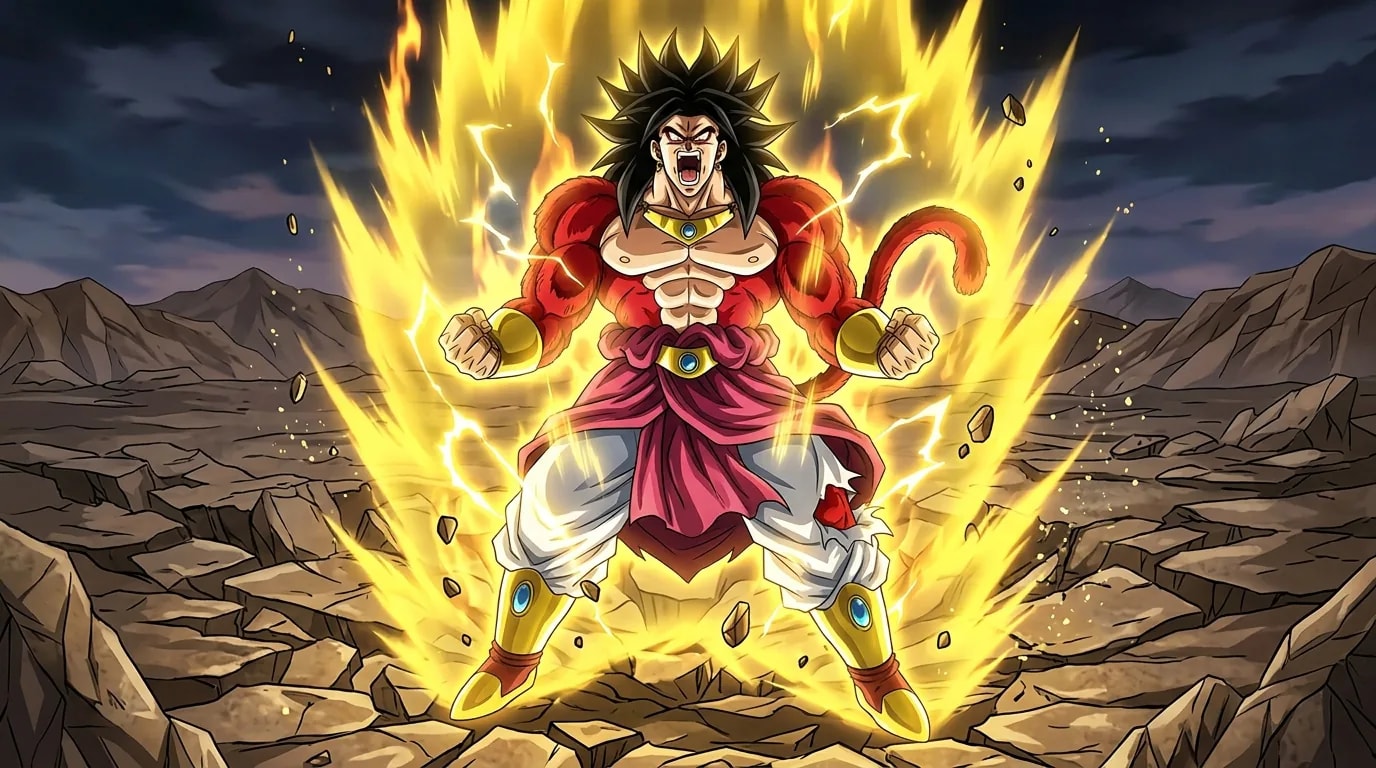
Super Full Power Saiyan 4
TransformationThe ultimate evolution of the Super Saiyan 4 transformation in Dragon Ball GT, achieved when the user's Super Saiyan 4 form is infused with additional Saiyan energy from allies. Goku first reached this state during his final battle against Omega Shenron, when the combined power of his friends and family elevated Super Saiyan 4 to its absolute maximum.
The Power of Family
Super Full Power Saiyan 4 emerged during the climactic final battle of Dragon Ball GT, when standard Super Saiyan 4 Goku found himself unable to match Omega Shenron's overwhelming power. Omega Shenron, having absorbed all seven cracked Dragon Balls and their corresponding Shadow Dragon abilities, was simply too strong for any individual fighter to handle alone.
The solution came through the collective power of Goku's family and allies. Pan, Gohan, Goten, and Trunks channeled their Saiyan energy into Goku, providing a massive external power boost that elevated his Super Saiyan 4 form beyond its normal limits. The infusion of additional Saiyan ki pushed the transformation to a level commonly referred to as its "ultra full power" state, granting Goku the strength needed to finally overpower Omega Shenron.
This moment served as Dragon Ball GT's thematic capstone, emphasizing the importance of bonds between fighters over individual power. Goku, throughout his entire journey from child to adult to legendary warrior, had always been strongest when supported by the people he cared about. Super Full Power Saiyan 4 literalized that theme, turning the love and strength of his family into a tangible combat advantage. The Universal Spirit Bomb that followed used this principle on an even grander scale, gathering energy from the entire universe to deliver the final blow against the Shadow Dragons.

Frequently Asked Questions
What is Super Full Power Saiyan 4?
Super Full Power Saiyan 4 is the mastered maximum-output version of Super Saiyan 4, in which the user accesses the full ceiling of the form without the unstable energy drain of the standard transformation. The state is featured in Dragon Ball Heroes as one of Goku and Vegeta's strongest Saiyan 4 tiers.
How does Super Full Power Saiyan 4 differ from regular Super Saiyan 4?
The red fur covering the user's body becomes more vibrant and may develop a slightly different hue. The user's aura becomes larger, more intense, and may crackle with additional energy. The overall physical presence becomes more imposing, though the body shape changes minimally compared to standard Super Saiyan 4.
How strong is Super Full Power Saiyan 4?
Super Full Power Saiyan 4 is positioned substantially beyond standard Super Saiyan 4 in the Dragon Ball Heroes power chart. The form is treated as the mastered ceiling of the Super Saiyan 4 transformation rather than a separate tier.
What are the requirements for Super Full Power Saiyan 4?
The user must already be in Super Saiyan 4 and receive a massive influx of external energy, typically from allies channeling their power into the user. Goku achieved this state when Pan, Trunks, Gohan, and Goten transferred their Saiyan energy to him.
Is Super Full Power Saiyan 4 canon?
Super Full Power Saiyan 4 is not part of the canonical Dragon Ball Super manga or anime. It originates in Dragon Ball Heroes, which sits outside the core canon timeline, and is treated as a Heroes-exclusive extension of the GT Super Saiyan 4 line.
Sources & Information
Looking for more on Super Full Power Saiyan 4? The Dragon Ball Wiki on Fandom has a dedicated page with community notes.
View on FandomThis content is original writing by Daddy Jim Headquarters based on the Dragon Ball anime series, manga, and official materials. Episode and chapter references are cited where applicable.
Character and scene imagery on this site is original artwork by Daddy Jim Headquarters, not screenshots or licensed imagery. Official cover art is used on three types of pages for editorial commentary:
- Movie pages: theatrical posters and key visuals, credited to Toei Animation and Shueisha.
- Game pages: official box art, credited to Bandai Namco, Atari, and other publishers.
- Manga chapter pages: Jump Comics volume covers, credited to Shueisha and Akira Toriyama.
Browse our episode guides:
Official resources:
Help Us Keep This Wiki Accurate
Daddy Jim Headquarters maintains this encyclopedia. If you spot an error, a translation issue, or something that doesn't look right, let us know.