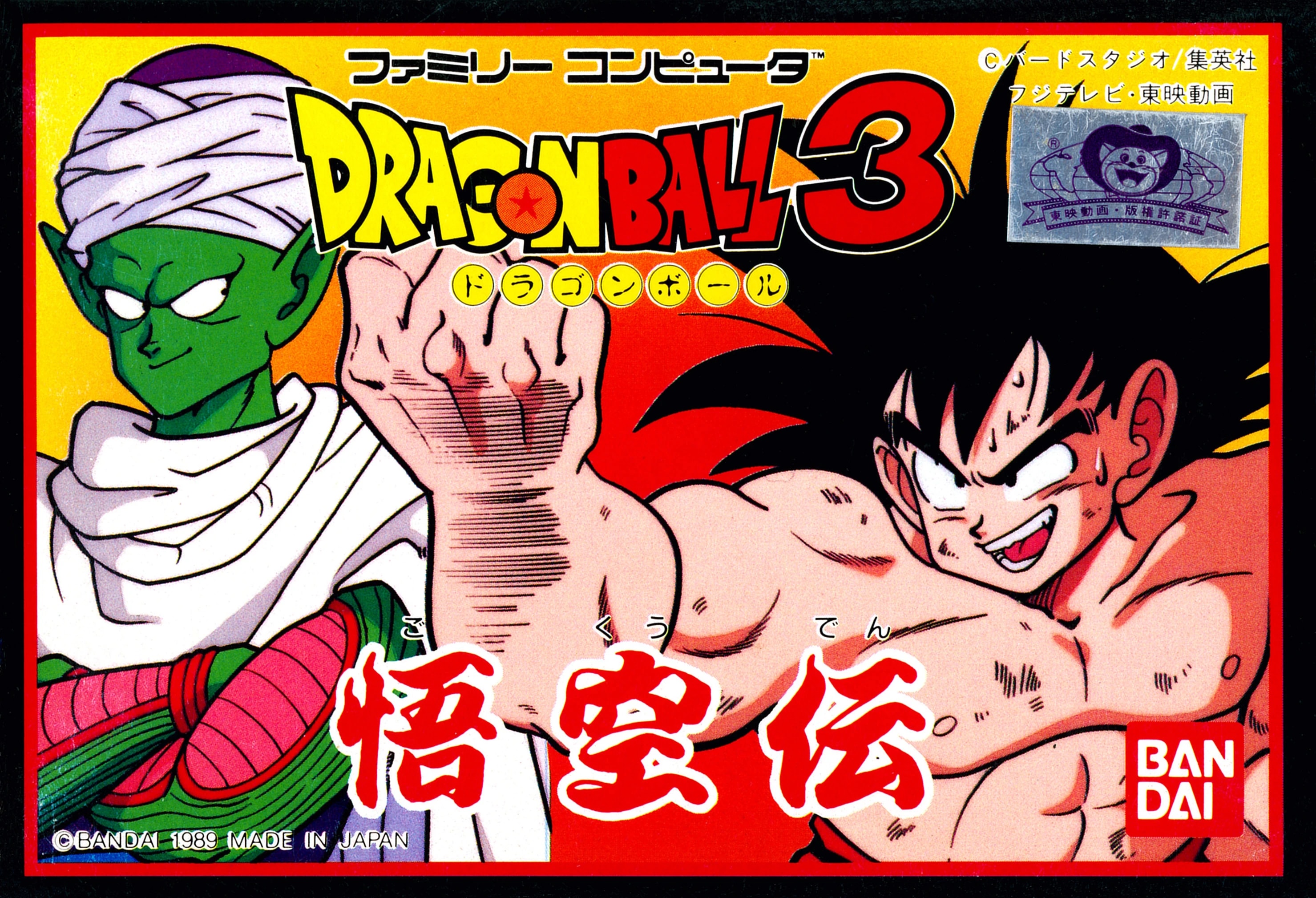
Dragon Ball 3: Gokuden
Gameis a role playing video game released only in Japan by Bandai on October 27, 1989, for the . It is the third Dragon Ball video game for Famicom (its predecessors being Dragon Ball: Shenron no Nazo and Dragon Ball: Daimaō Fukkatsu). Its sequel is Dragon Ball Z: Kyōshū! Saiyan.
Gameplay
Dragon Ball 3: Gokuden is a role-playing video game released exclusively in Japan by Bandai on October 27, 1989, for the Famicom. It is the third Dragon Ball video game for that platform and the final entry in the original Dragon Ball Famicom series, as the franchise then moved forward into Dragon Ball Z territory. The game uses a board-style world map that Goku traverses space by space, encountering characters along the way. Some offer information, while others must be defeated in combat.
Battles are resolved through a card-based system inherited from its predecessor, Dragon Ball: Daimaou Fukkatsu. Both players draw a hand of cards and take turns revealing them; the combination of card actions and the order of their reveal determines each attack, which plays out as an animated sequence above the card display. The system rewards understanding card interactions over reflexes, giving the combat a strategic puzzle quality. Goku can also be briefly replaced by Krillin or Yamcha in specific segments of the story.



Story
Dragon Ball 3: Gokuden covers the full Dragon Ball storyline from Goku's early adventures through the battle with Piccolo Jr., adapting the major story beats with some notable modifications for the game format. General Blue becomes the boss of Muscle Tower and kidnaps Upa, replacing the game's version of General White. The Pirate Cave and Penguin Village sections of the original story are omitted, and Mercenary Tao is fought directly at the Red Ribbon Army Headquarters rather than at the Sacred Land of Korin. King Piccolo appears already in his youth, bypassing the need to summon Shenron, and his lackey Piano transforms into Goku for a mid-game battle.
The game also includes optional boss encounters that reward exploration. Pressing the A button when certain cards are flipped during the credits sequence allows players to fight Raditz and Arale Norimaki, two characters who technically fall outside the main Dragon Ball storyline but were connected to it. Goku can visit Fire Mountain before the 23rd World Martial Arts Tournament and make his promise to Chi-Chi there, a moment of character continuity that mirrors the original manga even within the game's condensed narrative.
Legacy
Dragon Ball 3: Gokuden holds a distinguished place as the last Dragon Ball Famicom title and the conclusion of a trilogy that adapted Toriyama's original series for that platform. The Gokuden series helped establish what Dragon Ball video games could be during the franchise's formative years in Japan, laying groundwork for the far larger industry that would develop around Dragon Ball Z in subsequent console generations.
The game received a remake under the simple title Dragon Ball, planned for release on an updated platform on November 20, 2003, demonstrating that the original Famicom content retained enough appeal to justify a revisit more than a decade later. Dragon Ball 3: Gokuden is also included in J Legend Retsuden for the Nintendo 3DS, a compilation that preserves several of the foundational Jump-franchise games for modern audiences.
Related Reading
See all
Krillin's on the Tinder: How the Ultimate Short King Survived the Height Filter
Tinder built a height filter. Dragon Ball built a five foot legend. What happened when we sent the ultimate short king into the modern dating hellscape....

Infinite Zeni Glitch: When Yamcha Never Pays and Mr. Popo Always Does
The internet found an infinite money glitch. So did Yamcha. A smooth R&B track about the easiest money in the Dragon Ball world and the one man who keeps paying for it....

Frequently Asked Questions
What is Dragon Ball 3: Gokuden?
is a role playing video game released only in Japan by Bandai on October 27, 1989, for the. It is the third Dragon Ball video game for Famicom (its predecessors being Dragon Ball: Shenron no Nazo and Dragon Ball: Daimaō Fukkatsu). Its sequel is Dragon Ball Z: Kyōshū!
What is Dragon Ball 3: Gokuden about?
Dragon Ball 3: Gokuden is a role-playing video game released exclusively in Japan by Bandai on October 27, 1989, for the Famicom. It is the third Dragon Ball video game for that platform and the final entry in the original Dragon Ball Famicom series, as the franchise then moved forward into Dragon Ball Z territory. The game uses a board-style world map that Goku traverses space by space, encountering characters along the way.
When was Dragon Ball 3: Gokuden released?
Dragon Ball 3: Gokuden was released in 1989. It was published by Bandai.
Who published Dragon Ball 3: Gokuden?
Dragon Ball 3: Gokuden was published by Bandai. It was released in 1989.
What genre is Dragon Ball 3: Gokuden?
Dragon Ball 3: Gokuden is a rpg/card battle. It is tied to the Gokuden era of the franchise.
Sources & Information
Looking for more on Dragon Ball 3: Gokuden? The Dragon Ball Wiki on Fandom has a dedicated page with community notes.
View on FandomThis content is original writing by Daddy Jim Headquarters based on the Dragon Ball anime series, manga, and official materials. Episode and chapter references are cited where applicable.
Character and scene imagery on this site is original artwork by Daddy Jim Headquarters, not screenshots or licensed imagery. Official cover art is used on three types of pages for editorial commentary:
- Movie pages: theatrical posters and key visuals, credited to Toei Animation and Shueisha.
- Game pages: official box art, credited to Bandai Namco, Atari, and other publishers.
- Manga chapter pages: Jump Comics volume covers, credited to Shueisha and Akira Toriyama.
Browse our episode guides:
Official resources:
Help Us Keep This Wiki Accurate
Daddy Jim Headquarters maintains this encyclopedia. If you spot an error, a translation issue, or something that doesn't look right, let us know.