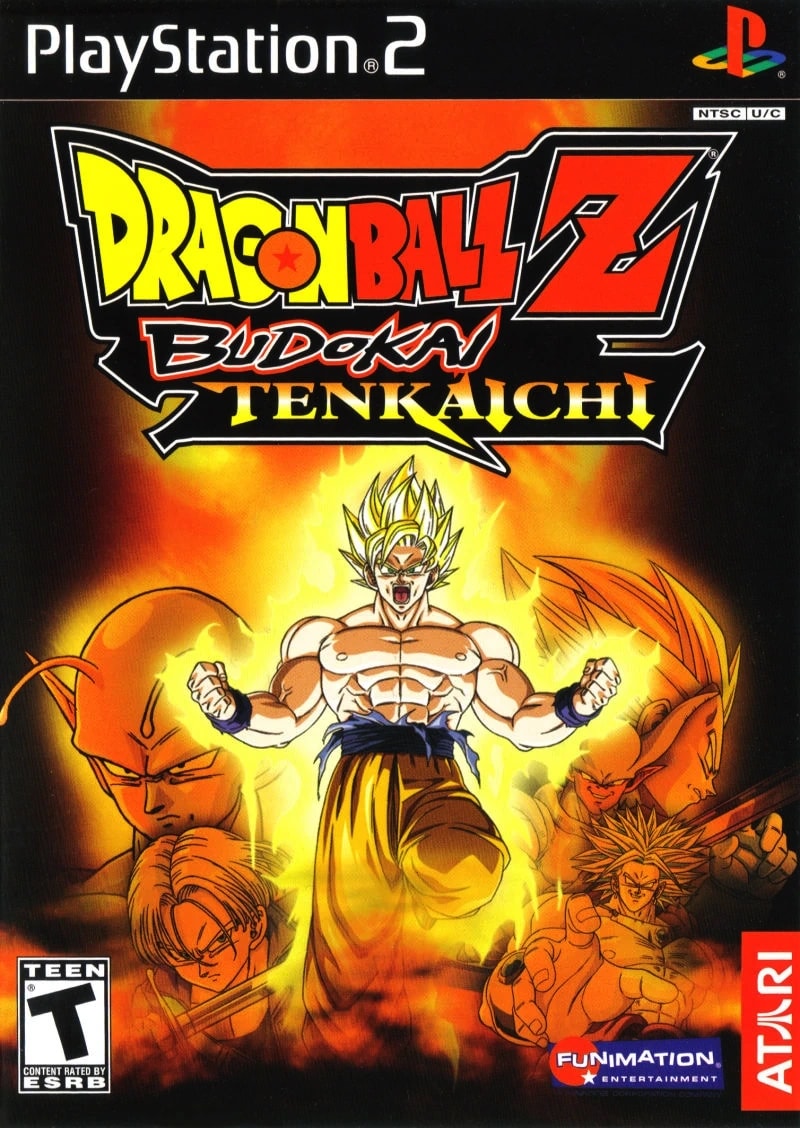
Dragon Ball Z: Budokai Tenkaichi
GameDragon Ball Z: Budokai Tenkaichi, originally published in Japan as , is a fighting video game released for the . The game was developed by Spike and published by Atari and Bandai in the U.S. and Japan, respectively.
Gameplay
Dragon Ball Z: Budokai Tenkaichi is a fighting game developed by Spike and published by Atari and Bandai for PlayStation 2. The game departs significantly from the Budokai series by adopting a behind-the-back camera perspective that places combat in wide three-dimensional arenas rather than on a 2.5D plane. Characters can fly, and the environments are fully destructible, allowing landscape elements to be broken apart during fights. The game features 58 playable characters spanning 90 playable forms drawn from the Dragon Ball Z television series and its associated films.
Unlike the Budokai series, Budokai Tenkaichi does not include in-game transformation mechanics; instead, each transformation is selected as a distinct form from the character selection screen before the match begins. Characters charge their Ki to perform super attacks, and Ki charges more slowly underwater. Several character classifications carry special battlefield properties: Artificial Humans will not appear on the radar unless locked on to and cannot manually charge Ki except to enter Max Power mode, while energy absorption variants like Androids 17 and 19 refill Ki by intercepting incoming energy attacks. Large characters such as Broly do not flinch from smaller fighters' melee strikes. Characters equipped with scouters, including Raditz, Nappa, Vegeta, Dodoria, Zarbon, and the Ginyu Force members, can lock onto opponents from anywhere on the map but lose the device after taking a certain amount of damage.
Mr. Satan is notable for being unable to stagger other characters with his melee strikes, and all of Majin Buu's forms regenerate health passively over time. The Z Battle Gate story mode follows individual saga battles with bookend objectives such as finishing with a specific move or completing the fight within a time limit. Optional bonus encounters unlock after clearing certain gates, and branching paths allow battles involving Dragon Ball GT and movie villains alongside core series conflicts.


Story and Modes
Z Battle Gate presents the Dragon Ball Z story through saga-structured battle sequences, allowing players to relive pivotal encounters from the Saiyan arc through the Majin Buu conflict. The mode branches to include battles not present in the main narrative, such as standalone conflicts against Dragon Ball GT villains and movie antagonists, as well as a tournament involving characters from both Dragon Ball and Dragon Ball Z. Dragon Balls are hidden within the destructible environments and can be uncovered during battle. After clearing specific gates, an additional unlockable fight may or may not become available depending on the player's performance.
Ultimate Battle mode pits the player's chosen fighter against a sequence of 100 opponents. Winning and losing points determine the player's rank, which begins and resets at 100. Secret characters occasionally interrupt fights before they begin, offering greater point rewards if defeated but steeper penalties if not. Winning five consecutive normal fights triggers a challenge from a fighter ranked five places higher; defeating that challenger advances the player five ranks at once. The mode incentivizes consecutive victories and provides a framework for long-term ranking progression.
The game's soundtrack differs notably between the Japanese and North American releases. Where the Japanese version, titled Sparking!, uses music from the Dragon Ball Z television series composed by Shunsuke Kikuchi, the American release features recycled compositions from the Budokai series by Kenji Yamamoto, a decision that confused some North American players who expected consistency with the Japanese product.
Reception and Legacy
The original Budokai Tenkaichi established the behind-the-back combat format that would define the sub-series through three entries and influence Dragon Ball fighting game design for years afterward. Critics acknowledged the game as a significant departure from the Budokai fighting formula, with some describing the experience as resembling a hybrid between the Budokai series and Dragon Ball Z: The Legend for Sega Saturn and PlayStation. Its fully destructible environments were cited as a visual and mechanical novelty that no previous Dragon Ball fighting game had delivered at this scale.
The misleading "Budokai Tenkaichi" title, which Atari applied to capitalize on the established Budokai brand recognition in Western markets, caused lasting confusion about the relationship between the two series, since they were developed by different companies and used entirely different game engines. The true Japanese title, Sparking!, references the first and last word of the Dragon Ball Z opening theme. Budokai Tenkaichi's commercial success justified both its sequel and the expansion of the Sparking line, with Budokai Tenkaichi 2 following in October and November 2006.
Related Reading
See all
Krillin's on the Tinder: How the Ultimate Short King Survived the Height Filter
Tinder built a height filter. Dragon Ball built a five foot legend. What happened when we sent the ultimate short king into the modern dating hellscape....
Infinite Zeni Glitch: When Yamcha Never Pays and Mr. Popo Always Does
The internet found an infinite money glitch. So did Yamcha. A smooth R&B track about the easiest money in the Dragon Ball world and the one man who keeps paying for it....
Frequently Asked Questions
What is the difference between Dragon Ball Z Budokai and Budokai Tenkaichi?
Dragon Ball Z: Budokai Tenkaichi, originally published in Japan as, is a fighting video game released for the. The game was developed by Spike and published by Atari and Bandai in the U.S. and Japan, respectively.
When was Dragon Ball Z: Budokai Tenkaichi released?
Dragon Ball Z: Budokai Tenkaichi was released in 2006. It was developed by Spike and published by Bandai / Atari.
Which characters appear in Dragon Ball Z: Budokai Tenkaichi?
Z Battle Gate presents the Dragon Ball Z story through saga-structured battle sequences, allowing players to relive pivotal encounters from the Saiyan arc through the Majin Buu conflict. The mode branches to include battles not present in the main narrative, such as standalone conflicts against Dragon Ball GT villains and movie antagonists, as well as a tournament involving characters from both Dragon Ball and Dragon Ball Z. Dragon Balls are hidden within the destructible environments and can be uncovered during battle.
What is Dragon Ball Z: Budokai Tenkaichi about?
Dragon Ball Z: Budokai Tenkaichi is a fighting game developed by Spike and published by Atari and Bandai for PlayStation 2. The game departs significantly from the Budokai series by adopting a behind-the-back camera perspective that places combat in wide three-dimensional arenas rather than on a 2.5D plane. Characters can fly, and the environments are fully destructible, allowing landscape elements to be broken apart during fights.
Who developed Dragon Ball Z: Budokai Tenkaichi?
Dragon Ball Z: Budokai Tenkaichi was developed by Spike. The game was published by Bandai / Atari in 2006.
Sources & Information
Looking for more on Dragon Ball Z: Budokai Tenkaichi? The Dragon Ball Wiki on Fandom has a dedicated page with community notes.
View on FandomThis content is original writing by Daddy Jim Headquarters based on the Dragon Ball anime series, manga, and official materials. Episode and chapter references are cited where applicable.
Character and scene imagery on this site is original artwork by Daddy Jim Headquarters, not screenshots or licensed imagery. Official cover art is used on three types of pages for editorial commentary:
- Movie pages: theatrical posters and key visuals, credited to Toei Animation and Shueisha.
- Game pages: official box art, credited to Bandai Namco, Atari, and other publishers.
- Manga chapter pages: Jump Comics volume covers, credited to Shueisha and Akira Toriyama.
Browse our episode guides:
Official resources:
Help Us Keep This Wiki Accurate
Daddy Jim Headquarters maintains this encyclopedia. If you spot an error, a translation issue, or something that doesn't look right, let us know.