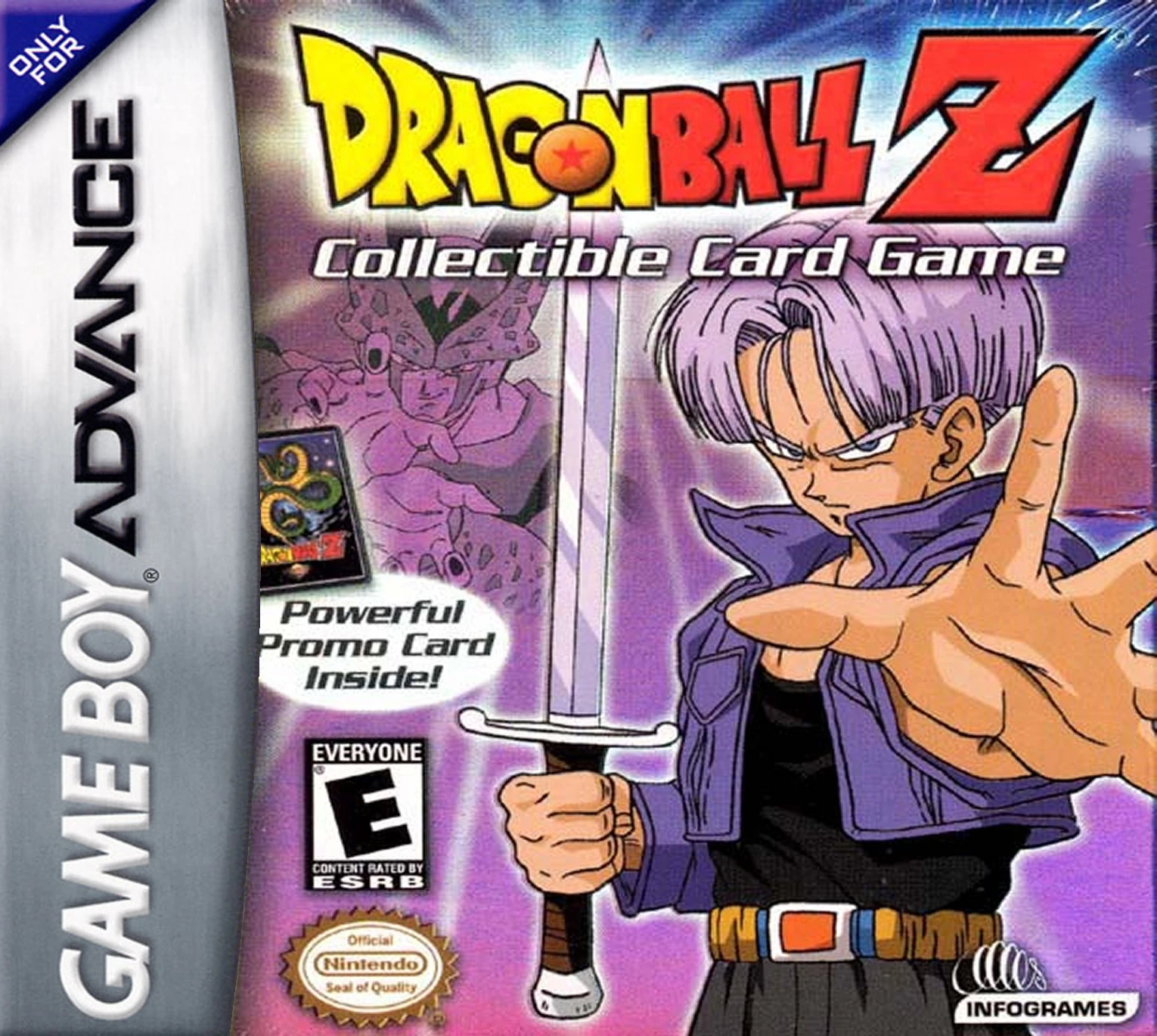
Dragon Ball Z: Collectible Card Game (video game)
GameDragon Ball Z: Collectible Card Game is a video game for the Game Boy Advance based on the Dragon Ball Z Collectible Card Game of the Dragon Ball franchise. Its Story Mode covers from the start of the Saiyan Saga to the end of the Cell Games Saga.
Gameplay
Dragon Ball Z: Collectible Card Game is a video game for the Game Boy Advance that adapts the rules and card set of the Dragon Ball Z Collectible Card Game tabletop game into a digital format. The game is played according to the same rules as the physical card game and uses the same card types, preserving the authenticity of the tabletop experience within the constraints of the handheld platform. Menu screens guide the player through card management and match setup, and summary screens provide quick reference information about card effects during play.
Players build decks from cards available in the game and compete against computer-controlled opponents drawn from the Dragon Ball Z villain roster. Each AI opponent uses a deck themed around their own personality cards from the physical game. As the player wins matches, new cards unlock and opponent difficulty increases, creating a progression curve that rewards consistent play. The card pool covers all sets from the Collectible Card Game up to and including the Cell Saga expansion, making it a comprehensive digital representation of the game's earlier release history.
The unlocking structure mirrors the physical card game's acquisition model, where beating successively harder opponents grants access to more powerful cards that were otherwise unavailable. This creates a loop of building a stronger deck, facing tougher opponents, and unlocking further cards that deepens and expands the available options. Story mode follows the Dragon Ball Z narrative from the beginning of the Saiyan Saga through the end of the Cell Games Saga, framing the card game matches within the dramatic context of those arcs.


Content and Card Sets
The game's story mode spans the Saiyan, Namekian, Android, and Cell Games Sagas, covering the full range of major Dragon Ball Z conflicts that defined the first half of the series. Each saga provides opponents whose decks reflect the personality and power of the characters associated with that arc, meaning players face Saiyan-aligned decks during the invasion, Frieza-affiliated opponents on Namek, and Cell-era fighters toward the campaign's conclusion. Opponents are presented as traditional Dragon Ball Z villains, grounding the abstract card game mechanics within the familiar narrative of the anime.
The digital card pool includes all sets from the game's initial Saiyan Saga release through the Cell Saga expansion, covering a substantial range of the physical game's catalog. Physical Combat cards representing martial arts techniques and Energy Combat cards depicting ki-based attacks form the combat backbone, supplemented by Non-Combat cards that capture events and support elements from the television series. The Personality cards that form each deck's core identity are built around the iconic characters who define each saga.
Unlocking cards through match victories gives the game replay value that extends beyond completing the story mode, as players who want access to the strongest available cards must continue engaging with increasingly difficult computer opponents. The game functions simultaneously as a standalone experience and as a digital primer for players unfamiliar with the physical card game's rule set.


Context and Legacy
The Dragon Ball Z Collectible Card Game video game arrived during a period when the physical card game was at the height of its commercial activity in North America, distributed alongside booster packs and starter decks through retail channels. The Game Boy Advance adaptation served both as an entry point for players who wanted to learn the game's mechanics and as a portable companion for those already invested in the physical product. Its faithfulness to the original card game's rules made it a genuine interactive version of the tabletop experience rather than a simplified approximation.
The game's coverage of the Saiyan through Cell Games Sagas placed it alongside the physical sets that anchored the card game's most popular release period. By the time the physical game was discontinued in June 2006 after eighteen expansions, the video game adaptation had already served its purpose as a promotional and educational companion to the card sets it drew from. It remains a historical artifact of the Dragon Ball Z Collectible Card Game's commercial peak and a demonstration of the franchise's willingness to translate its licensed products across multiple interactive formats.
Sparking Zero May 26 Update Adds Demon World Stage and Reworks Transformation Healing
May 27, 2026Bandai Namco shipped a free Dragon Ball: Sparking Zero update on May 26, 2026 that introduces a new Demon World stage, overhauls transformation healing, and confirms the Daima Character Pack and Shallot DLC for release on June 27, 2026....
Dragon Ball FighterZ Adds Super Saiyan 4 Goku From Daima
May 25, 2026Dragon Ball FighterZ added Super Saiyan 4 Goku, the form featured in the Daima anime, as DLC on April 22, 2026. The 2018 fighting game is still getting new content nearly eight years on....

Dragon Ball Sparking Zero Super Limit-Breaking NEO DLC Adds 30 Plus Fighters for Summer 2026
Apr 20, 2026Bandai Namco and Spike Chunsoft unveiled the Super Limit-Breaking NEO expansion for Dragon Ball Sparking Zero at Battle Hour 2026. Summer 2026 release, 30 plus characters, four new stages, and a new solo mode....
Sources & Information
Looking for more on Dragon Ball Z: Collectible Card Game (video game)? The Dragon Ball Wiki on Fandom has a dedicated page with community notes.
View on FandomThis content is original writing by Daddy Jim Headquarters based on the Dragon Ball anime series, manga, and official materials. Episode and chapter references are cited where applicable.
Character and scene imagery on this site is original artwork by Daddy Jim Headquarters, not screenshots or licensed imagery. Official cover art is used on three types of pages for editorial commentary:
- Movie pages: theatrical posters and key visuals, credited to Toei Animation and Shueisha.
- Game pages: official box art, credited to Bandai Namco, Atari, and other publishers.
- Manga chapter pages: Jump Comics volume covers, credited to Shueisha and Akira Toriyama.
Browse our episode guides:
Official resources:
Dragon Ball Music by Daddy Jim Headquarters
Come listen to some Dragon Ball R&B.
Help Us Keep This Wiki Accurate
Daddy Jim Headquarters maintains this encyclopedia across 13 languages. If you spot an error, a translation issue, or something that doesn't look right, let us know.