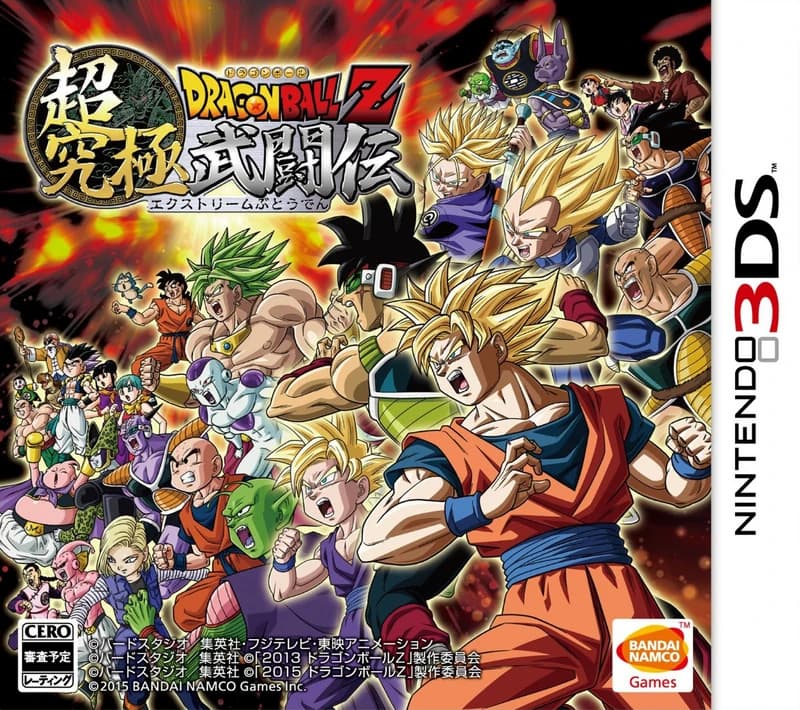
Dragon Ball Z: Extreme Butōden
Gameis a fighting game for the Nintendo 3DS published by Bandai Namco and developed by Arc System Works.
Gameplay
Dragon Ball Z: Extreme Butoden is a 2D fighting game for the Nintendo 3DS developed by Arc System Works and published by Bandai Namco. Players assemble teams composed of battle characters and support characters, then compete in one-on-one matches where the goal is to deplete all fighters on the opposing team. Attacks consist of weak, strong, and special inputs that chain into combos, with a Hyper Dash option available to extend offensive sequences.
The game uses a Spirit Gauge that begins chargeable to 150 percent. Spending 25 percent of the gauge executes a Blitz Attack, while a 50 percent expenditure triggers a Burst Strike. Each fighter possesses two Super Special Moves activated after completing Ultimate Combos, with the available options differing based on whether combat takes place in the Ground Stage or Air Stage. Successful Meteor Combos launch opponents between stages, creating additional follow-up opportunities or applying impact damage on landing. When a team's total health drops below 50 percent, the Awakened state activates, raising the Spirit Gauge cap to 200 percent and unlocking Final Ultimate Combos and the Dragon Soul transformation, which temporarily amplifies damage at the cost of constantly draining the fighter's remaining health.
The roster spans over 100 fighters, including both direct battle participants and a large pool of Z Assist support characters summoned from the touch screen. A November 2016 update added cross-play functionality with One Piece: Great Pirate Colosseum, enabling local and online battles between players of either game.

Story
Extreme Butoden offers two distinct narrative modes. Z Story presents a structured retelling of the Dragon Ball Z saga from the Saiyan Saga through the end of the Kid Buu Saga, divided into five scenario paths following individual Dragon Team members. A separate villain path allows players to experience key battles through the perspectives of antagonists including Frieza, Cell, Majin Buu, and Broly.
Adventure Mode, unlocked after completing all Z Story scenarios, serves as the game's original campaign. At the request of the Supreme Kai, Goku sets out to collect seven Ultimate Dragon Balls needed to seal off the minus energy unleashed by Omega Shenron, who has used that power to resurrect villains from across the Dragon Ball Z timeline. Players travel through multiple worlds, fulfilling mission objectives and facing both familiar enemies and resurrected major antagonists. Achieving S-rank ratings on missions unlocks additional Z Assist characters and battle items, encouraging thorough completion of optional objectives.
Related Reading
See all
Namek Has No Women, and Piccolo Pulls Anyway
There are no women on Namek. That isn't an oversight, it's the biology. Why we handed Piccolo the one thing his own species rules out, and why it had to be trap soul....
1000 Times Over: Who Is John Dragon Ball Singing To?
Dragon Ball handed us a protagonist with no history and the internet named him John Dragon Ball. So we built him somebody to talk to....

Legacy
Extreme Butoden marked the return of Dragon Ball to handheld 2D fighting gameplay for the first time in many years, arriving on the Nintendo 3DS with a production quality that distinguished it from earlier portable entries. Its development by Arc System Works, a studio with deep expertise in 2D fighters, gave the game a technical depth appropriate to the competitive fighting game audience. The cross-play partnership with One Piece: Great Pirate Colosseum was an unusual collaboration within licensed anime games, reflecting a willingness to experiment with crossover content in the handheld space.
Frequently Asked Questions
What is Dragon Ball Z: Extreme Butōden?
Dragon Ball Z: Extreme Butōden is a fighting game for the Nintendo 3DS published by Bandai Namco and developed by Arc System Works. Dragon Ball Z: Extreme Butoden is a 2D fighting game for the Nintendo 3DS developed by Arc System Works and published by Bandai Namco.
What is Dragon Ball Z: Extreme Butōden about?
Dragon Ball Z: Extreme Butoden is a 2D fighting game for the Nintendo 3DS developed by Arc System Works and published by Bandai Namco. Players assemble teams composed of battle characters and support characters, then compete in one-on-one matches where the goal is to deplete all fighters on the opposing team. Attacks consist of weak, strong, and special inputs that chain into combos, with a Hyper Dash option available to extend offensive sequences.
When was Dragon Ball Z: Extreme Butōden released?
Dragon Ball Z: Extreme Butōden was released in 2016. It was developed by Namco Bandai.
Who developed Dragon Ball Z: Extreme Butōden?
Dragon Ball Z: Extreme Butōden was developed by Namco Bandai. It was released in 2016.
Who published Dragon Ball Z: Extreme Butōden?
Dragon Ball Z: Extreme Butōden was published by Namco Bandai. It was released in 2016.
Sources & Information
Looking for more on Dragon Ball Z: Extreme Butōden? The Dragon Ball Wiki on Fandom has a dedicated page with community notes.
View on FandomThis content is original writing by Daddy Jim Headquarters based on the Dragon Ball anime series, manga, and official materials. Episode and chapter references are cited where applicable.
Rights holders
- Created byAkira Toriyama
- Published byShueisha
- Animated byToei Animation
All rights belong to their respective owners.
Character and scene imagery on this site is original artwork by Daddy Jim Headquarters, not screenshots or licensed imagery. Official cover art is used on three types of pages for editorial commentary:
- Movie pages: theatrical posters and key visuals, credited to Toei Animation and Shueisha.
- Game pages: official box art, credited to Bandai Namco, Atari, and other publishers.
- Manga chapter pages: Jump Comics volume covers, credited to Shueisha and Akira Toriyama.
Browse our episode guides:
Official resources:
Help Us Keep This Wiki Accurate
Daddy Jim Headquarters maintains this encyclopedia. If you spot an error, a translation issue, or something that doesn't look right, let us know.