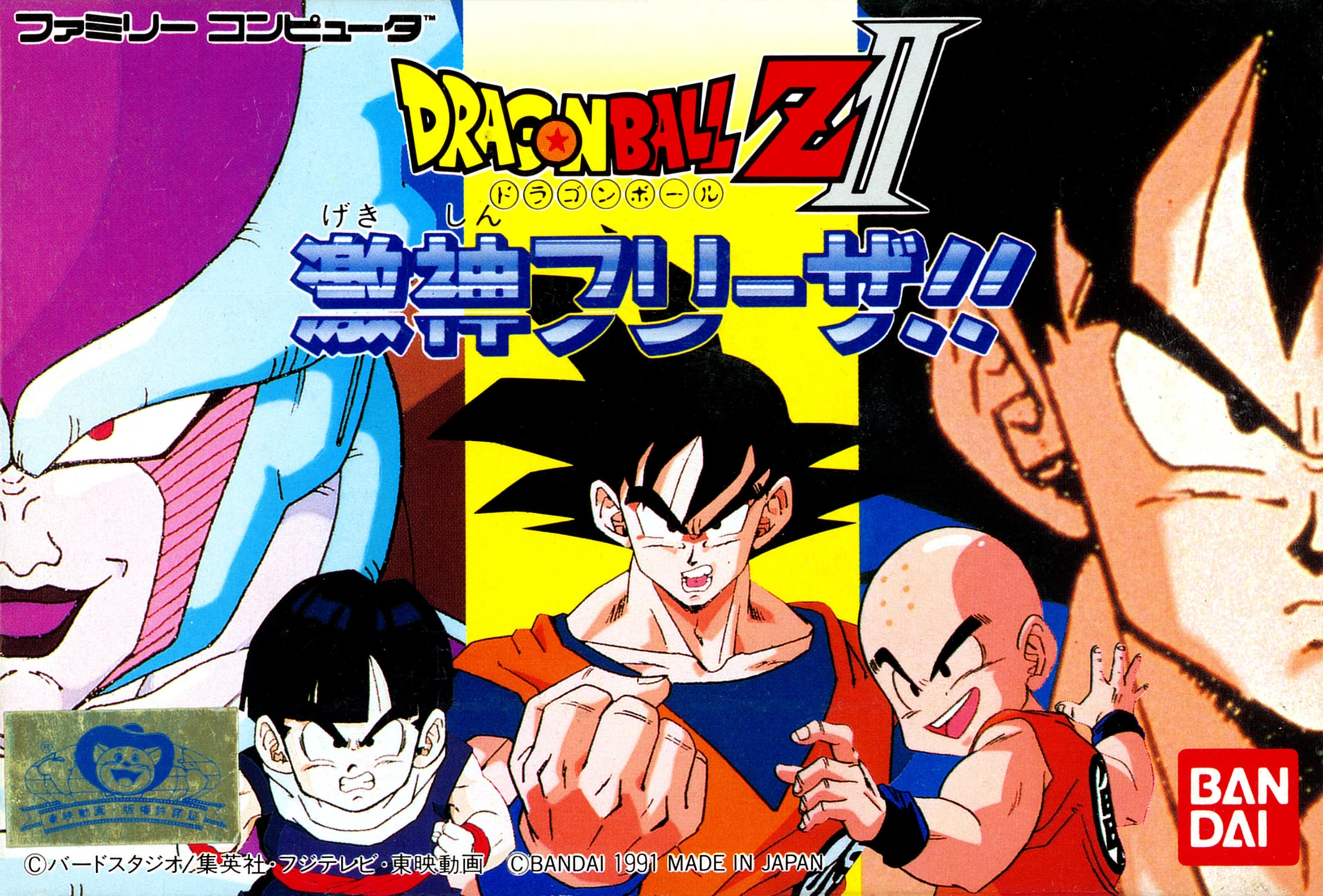
Dragon Ball Z II: Gekishin Freeza
GameDragon Ball Z II: Gekishin Freeza!!神フリーザ!! |Doragon Bōru Zetto Tsū Gekishin Furīza!!|lit. Dragon Ball Z II: A Fierce God Freeza!!}} is a role playing video game released only in Japan by Bandai on August 10, 1991, for the . Gekishin Freeza!! is also one of the games downloadable in the game compilation J Legend Retsuden for Nintendo 3DS.
Gameplay
Dragon Ball Z II: Gekishin Freeza is a role-playing video game released exclusively in Japan by Bandai on August 10, 1991, for the Famicom. It is the second entry in the Gokuden series and directly continues the story from Dragon Ball Z: Kyoshu! Saiyan. The game follows the Namek Saga and concludes at the end of the Frieza Saga, covering the full range of Frieza's battle forms in the final encounter. Unlike the anime's depiction, the player faces all of Frieza's transformations in sequence, including 100% power, without any of those encounters being handled by a different protagonist.
Combat uses a card-based system where players use cards acquired by defeating enemies. These cards represent characters such as Bulma, Dende, King Kai, and Porunga, each providing specific in-battle effects. Bulma heals HP and Battle Energy once per turn, Dende fully restores both meters, Porunga grants three wishes, and Mr. Popo blocks the enemy's ability to use Ki attacks. The Namek Frog card carries a specific counter against Captain Ginyu's body-swap ability, preventing the switch if Ginyu attempts it. A Scouter card reveals enemy stats but stops functioning against Frieza's second form and beyond.
The game was combined with its predecessor in 1992 to produce the Super Nintendo title Dragon Ball Z: Super Saiya Densetsu. It is also available as a downloadable game within the J Legend Retsuden compilation for Nintendo 3DS.
Story
Gekishin Freeza begins with the Dragon Team on Earth following the events of the Saiyan Saga, then follows Gohan, Krillin, and Bulma's journey to Namek aboard a spaceship. The party includes Tien Shinhan, Yamcha, and Chiaotzu, who are alive in this version of events unlike in the anime, alongside Gohan and Krillin as the primary Namek combatants. The game briefly features Planet Kanassa and the Fake Namek, adding detail drawn from the anime filler content of the period.
Goku's journey to Namek includes a stop at Planet Kanassa, where a surviving Kanassan recognizes Goku's resemblance to Bardock and references Bardock's conquest of the planet for Frieza. The encounter ties the game's narrative to the events of the Dragon Ball Z: Bardock - The Father of Goku television special. Enemy soldiers encountered throughout the Namek campaign are original characters with scaled battle powers, filling the rank-and-file opposition between named boss encounters. The story serves as a sequel to Dragon Ball Z: Kyoshu! Saiyan and its own sequel is Dragon Ball Z III: Ressen Jinzooningen.
Legacy
Gekishin Freeza was a formative entry in the Gokuden series, establishing the RPG card-system framework that carried through subsequent installments. Its eventual absorption into Dragon Ball Z: Super Saiya Densetsu on Super Nintendo gave it a second life as part of a larger compilation, exposing the game's story content to a broader audience. The title's availability in J Legend Retsuden further extended its reach into the Nintendo 3DS era, preserving it as part of the accessible Dragon Ball Famicom library for later generations of players.
Related Reading
See all
Krillin's on the Tinder: How the Ultimate Short King Survived the Height Filter
Tinder built a height filter. Dragon Ball built a five foot legend. What happened when we sent the ultimate short king into the modern dating hellscape....
Infinite Zeni Glitch: When Yamcha Never Pays and Mr. Popo Always Does
The internet found an infinite money glitch. So did Yamcha. A smooth R&B track about the easiest money in the Dragon Ball world and the one man who keeps paying for it....
Frequently Asked Questions
What is Dragon Ball Z II: Gekishin Freeza?
Dragon Ball Z II: Gekishin Freeza!!神フリーザ!! is a role playing video game released only in Japan by Bandai on August 10, 1991, for the. Gekishin Freeza!! is also one of the games downloadable in the game compilation J Legend Retsuden for Nintendo 3DS.
When was Dragon Ball Z II: Gekishin Freeza released?
Dragon Ball Z II: Gekishin Freeza was released in 1991. It was developed by TOSE Software Co. and published by Bandai.
What is Dragon Ball Z II: Gekishin Freeza about?
Dragon Ball Z II: Gekishin Freeza is a role-playing video game released exclusively in Japan by Bandai on August 10, 1991, for the Famicom. It is the second entry in the Gokuden series and directly continues the story from Dragon Ball Z: Kyoshu! Saiyan.
Who developed Dragon Ball Z II: Gekishin Freeza?
Dragon Ball Z II: Gekishin Freeza was developed by TOSE Software Co.. The game was published by Bandai in 1991.
Who published Dragon Ball Z II: Gekishin Freeza?
Dragon Ball Z II: Gekishin Freeza was published by Bandai. The game was developed by TOSE Software Co. and released in 1991.
Sources & Information
Looking for more on Dragon Ball Z II: Gekishin Freeza? The Dragon Ball Wiki on Fandom has a dedicated page with community notes.
View on FandomThis content is original writing by Daddy Jim Headquarters based on the Dragon Ball anime series, manga, and official materials. Episode and chapter references are cited where applicable.
Character and scene imagery on this site is original artwork by Daddy Jim Headquarters, not screenshots or licensed imagery. Official cover art is used on three types of pages for editorial commentary:
- Movie pages: theatrical posters and key visuals, credited to Toei Animation and Shueisha.
- Game pages: official box art, credited to Bandai Namco, Atari, and other publishers.
- Manga chapter pages: Jump Comics volume covers, credited to Shueisha and Akira Toriyama.
Browse our episode guides:
Official resources:
Help Us Keep This Wiki Accurate
Daddy Jim Headquarters maintains this encyclopedia. If you spot an error, a translation issue, or something that doesn't look right, let us know.