Gameplay
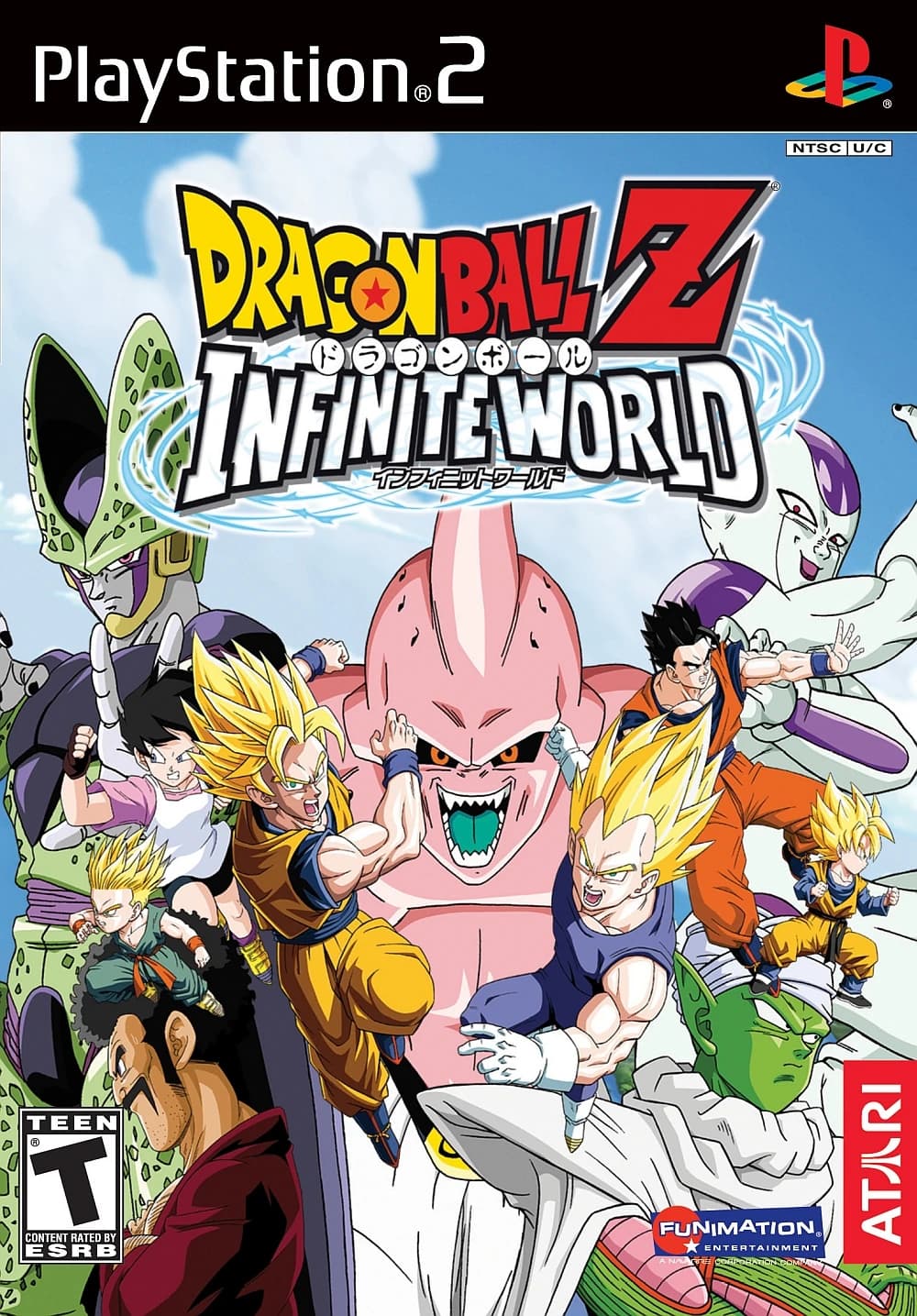
Dragon Ball Z: Infinite World is a fighting game developed by Dimps and released for the PlayStation 2. Published by Atari in North America and Namco Bandai in Europe and Japan, it was the last Dragon Ball Z title for the PlayStation 2 and the final game published under Atari's Dragon Ball license. The game uses the Capsule System, allowing players to purchase and equip skills on a customizable Skill Tray to tailor each fighter's capabilities. The combat engine derives from Dragon Ball Z: Budokai 3 but incorporates a modified Aura Burning mechanic and several gameplay adjustments drawn from Dragon Ball Z: Burst Limit.
Key differences from Budokai 3 include the removal of Hyper Mode, Dragon Rushes, and beam struggles, replaced by freely usable Ultimate attacks. Transformations now end through fatigue rather than Ki depletion, and a new dash attack and secondary throw option expand the baseline moveset. The skill slot system was condensed, with transformation chains for characters such as Goku requiring only a single TRANSFORM slot instead of one slot per transformation. Most characters received revised combo strings, and several were given new or reassigned special moves. The tournament mode present in Budokai 3 was removed, and all GT-era characters introduced in that game were retained alongside several new additions including Goku (GT), Vegeta (GT), Pan, Baby Vegeta, Super 17, and Syn Shenron in his base form.
The Dragon Missions story mode presents the Saiyan, Frieza, Androids, Majin Buu, and GT sagas alongside an Another Story segment where movie antagonists including Cooler, Broly, and Janemba serve as opponents. Minigames embedded in the mode cover events such as Snake Way traversal and catching Bubbles on King Kai's Planet.

Characters
Infinite World carries forward the core cast from the Budokai series while making targeted additions and removals. Characters absent from Budokai 3 that appear here for the first time in the line include Goku and Vegeta in their GT appearances, Great Saiyaman 2, Pikkon, Pan, Super Janemba, Baby Vegeta in Super Baby 2 form, Super 17, and Syn Shenron in base form, the last of these being an expansion over Budokai 3 which only included Omega Shenron. Characters removed from the previous game include Dodoria, Zarbon, Android 19, Kid Goku, Supreme Kai, Uub, and Cell Jr.
Each character includes multiple costume variants in addition to their standard appearance, expanding the visual customization available to players. Fusion characters such as Gogeta, Vegito, and Gotenks are available with their respective transformation chains intact. The roster spans characters from the beginning of Dragon Ball Z through the end of Dragon Ball GT, representing the full scope of the franchise as it existed at the time of the game's release in 2008.
Related Reading
See all
Namek Has No Women, and Piccolo Pulls Anyway
There are no women on Namek. That isn't an oversight, it's the biology. Why we handed Piccolo the one thing his own species rules out, and why it had to be trap soul....
1000 Times Over: Who Is John Dragon Ball Singing To?
Dragon Ball handed us a protagonist with no history and the internet named him John Dragon Ball. So we built him somebody to talk to....
Legacy
Infinite World served as the capstone of the PlayStation 2 era for Dragon Ball Z games, closing out a generation of fighting game releases that began with Budokai in 2002. Its position as the final Atari-published Dragon Ball title marked the end of a publishing relationship that had brought the franchise to Western audiences throughout the 2000s. The game was designed to provide an accessible entry point for players who had not purchased Dragon Ball Z: Burst Limit on seventh-generation hardware, ensuring PS2 owners received a current-generation gameplay experience before the platform moved on.
Frequently Asked Questions
What is Dragon Ball Z: Infinite World?
Dragon Ball Z: Infinite World is a fighting video game developed by Dimps and published in North America by Atari for the PlayStation 2 and Europe and Japan by Namco Bandai under the Bandai Label. Dragon Ball Z: Infinite World is a fighting game developed by Dimps and released for the PlayStation 2.
How does Dragon Ball Z: Infinite World play?
Dragon Ball Z: Infinite World is a fighting game developed by Dimps and released for the PlayStation 2. Published by Atari in North America and Namco Bandai in Europe and Japan, it was the last Dragon Ball Z title for the PlayStation 2 and the final game published under Atari's Dragon Ball license. The game uses the Capsule System, allowing players to purchase and equip skills on a customizable Skill Tray to tailor each fighter's capabilities.
Which characters appear in Dragon Ball Z: Infinite World?
Infinite World carries forward the core cast from the Budokai series while making targeted additions and removals. Characters absent from Budokai 3 that appear here for the first time in the line include Goku and Vegeta in their GT appearances, Great Saiyaman 2, Pikkon, Pan, Super Janemba, Baby Vegeta in Super Baby 2 form, Super 17, and Syn Shenron in base form, the last of these being an expansion over Budokai 3 which only included Omega Shenron. Characters removed from the previous game include Dodoria, Zarbon, Android 19, Kid Goku, Supreme Kai, Uub, and Cell Jr. Each character includes multiple costume variants in addition to their standard appearance, expanding the visual customization available to players.
When was Dragon Ball Z: Infinite World released?
Dragon Ball Z: Infinite World was released in 2002. It was developed by Dimps and published by Atari.
Who developed Dragon Ball Z: Infinite World?
Dragon Ball Z: Infinite World was developed by Dimps. The game was published by Atari in 2002.
Sources & Information
Looking for more on Dragon Ball Z: Infinite World? The Dragon Ball Wiki on Fandom has a dedicated page with community notes.
View on FandomThis content is original writing by Daddy Jim Headquarters based on the Dragon Ball anime series, manga, and official materials. Episode and chapter references are cited where applicable.
Rights holders
- Created byAkira Toriyama
- Published byShueisha
- Animated byToei Animation
All rights belong to their respective owners.
Character and scene imagery on this site is original artwork by Daddy Jim Headquarters, not screenshots or licensed imagery. Official cover art is used on three types of pages for editorial commentary:
- Movie pages: theatrical posters and key visuals, credited to Toei Animation and Shueisha.
- Game pages: official box art, credited to Bandai Namco, Atari, and other publishers.
- Manga chapter pages: Jump Comics volume covers, credited to Shueisha and Akira Toriyama.
Browse our episode guides:
Official resources:
Help Us Keep This Wiki Accurate
Daddy Jim Headquarters maintains this encyclopedia. If you spot an error, a translation issue, or something that doesn't look right, let us know.