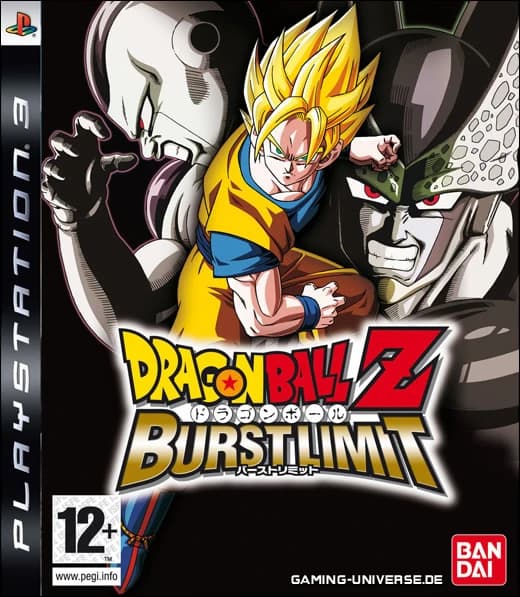
Dragon Ball Z: Burst Limit
Gameis a fighting video game based on the popular anime/manga series Dragon Ball Z, released for the Xbox 360 and PlayStation 3 consoles. It was announced in the Shonen Jump magazine on December 12, 2007.
Gameplay
Dragon Ball Z: Burst Limit is a fighting game released for Xbox 360 and PlayStation 3, applying the core mechanics of the Budokai series to high-definition hardware for the first time. Combat involves standard punch and kick inputs, combo chains, Ki Blast attacks, and directional variants that trigger signature techniques like the Kamehameha or Destructo Disc. A key distinction from earlier Budokai games is that Ki regenerates automatically rather than requiring manual charging, keeping the pace of battle consistently high. Characters can transform by pressing R1 on PlayStation 3 or RB on Xbox 360, with each transformation consuming Ki from the regenerating meter.
The game uses a multiple health block system with each character having up to six individual health segments. Once all blocks are depleted the character is knocked out. Two additional meters shape the fight: the Fatigue Meter, which empties as the player blocks or absorbs certain attacks and stuns the character briefly when fully drained, and the Ki Meter, which regenerates gradually and powers larger energy attacks, transformations, power-up states, and ultimate attacks. Drama Scenes are in-fight cinematic interruptions that activate when specific battle conditions are met, such as reaching 30 percent health, fully draining the fatigue bar, or achieving a final transformation. These cutscenes can show a character deflecting a beam, taking no damage from an attack, or having another fighter intervene to defend them, with gameplay consequences including enhanced Ki regeneration, damage reduction, or fatigue recovery.
Support characters may be selected before each fight and activated during combat in a manner similar to Drama Scenes. A support cutscene plays and the chosen character interferes in the battle in a helpful way, such as deflecting an energy blast or standing in the path of an attack. Any character in the roster can function as a support, giving players a wide range of tactical options. The game also includes an online mode for local and international player-versus-player battles and high score posting across its challenge modes.

Story
Burst Limit's Z Chronicles mode charts the Dragon Ball Z narrative from the opening of the Saiyan Saga through the conclusion of the Cell Saga. Players control whichever fighter won the battle being depicted at each point in the series, allowing the perspective to shift between heroes and villains as the story progresses. The coverage ends with the Cell Games, deliberately stopping before the Majin Buu arc that defined the final chapters of Dragon Ball Z.
Two exclusive what-if storylines appear within Z Chronicles. The first depicts Bardock defeating Frieza and finding himself mysteriously transported to present-day Earth, placing the legendary Saiyan warrior in an unexpected confrontation with the world he never knew. The second follows Broly journeying to Earth in search of Goku, presenting an alternate version of the Legendary Super Saiyan's grudge as a self-contained narrative episode. These scenarios expand the game's story content beyond the main saga coverage without requiring new playable characters.
The playable roster covers 21 characters, each with their canonical transformation progressions where applicable. Frieza appears across all five forms including Full Power, Cell spans Imperfect through Super Perfect form, and Goku includes his Kaioken state alongside Super Saiyan. Characters are unlocked by progressing through Z Chronicles, encouraging players to complete the story mode before accessing the full roster for Versus and challenge play.
Related Reading
See all
Namek Has No Women, and Piccolo Pulls Anyway
There are no women on Namek. That isn't an oversight, it's the biology. Why we handed Piccolo the one thing his own species rules out, and why it had to be trap soul....
1000 Times Over: Who Is John Dragon Ball Singing To?
Dragon Ball handed us a protagonist with no history and the internet named him John Dragon Ball. So we built him somebody to talk to....

Reception and Context
Burst Limit arrived as the first Dragon Ball Z fighting game built natively for seventh-generation hardware, giving it a visual clarity unavailable to the PlayStation 2 titles that had defined the franchise's fighting game output up to that point. Its automatic Ki regeneration and Drama Scene system were received as thoughtful modernizations of the Budokai formula, with the Drama Scenes in particular praised for evoking the cinematic rhythm of the television series without removing the player's agency.
The decision to end the story at the Cell Saga, leaving out the Majin Buu arc entirely, was a notable limitation that critics and players highlighted as the game's most significant content gap. The roster of 21 characters was smaller than those found in the PlayStation 2 Budokai and Budokai Tenkaichi entries, which limited its competitive depth. Despite these constraints, Burst Limit demonstrated that the Dragon Ball Z fighting game format translated effectively to high-definition platforms and served as a foundation for the more expansive titles that followed it on seventh-generation consoles.
Frequently Asked Questions
What is Dragon Ball Z Burst Limit on?
Dragon Ball Z: Burst Limit is a fighting video game based on the popular anime/manga series Dragon Ball Z, released for the Xbox 360 and PlayStation 3 consoles. It was announced in the Shonen Jump magazine on December 12, 2007.
What is the burst limit?
Dragon Ball Z: Burst Limit is a fighting game released for Xbox 360 and PlayStation 3, applying the core mechanics of the Budokai series to high-definition hardware for the first time. Combat involves standard punch and kick inputs, combo chains, Ki Blast attacks, and directional variants that trigger signature techniques like the Kamehameha or Destructo Disc. A key distinction from earlier Budokai games is that Ki regenerates automatically rather than requiring manual charging, keeping the pace of battle consistently high.
What platforms is Dragon Ball Z: Burst Limit available on?
Dragon Ball Z: Burst Limit was released on PlayStation 3, PlayStation 2, PlayStation, Xbox 360, and Xbox. The game first launched in 2007.
Which characters appear in Dragon Ball Z: Burst Limit?
Burst Limit's Z Chronicles mode charts the Dragon Ball Z narrative from the opening of the Saiyan Saga through the conclusion of the Cell Saga. Players control whichever fighter won the battle being depicted at each point in the series, allowing the perspective to shift between heroes and villains as the story progresses. The coverage ends with the Cell Games, deliberately stopping before the Majin Buu arc that defined the final chapters of Dragon Ball Z.
When was Dragon Ball Z: Burst Limit released?
Dragon Ball Z: Burst Limit was released in 2007. It was developed by Dimps and published by Bandai Namco / Atari.
Sources & Information
Looking for more on Dragon Ball Z: Burst Limit? The Dragon Ball Wiki on Fandom has a dedicated page with community notes.
View on FandomThis content is original writing by Daddy Jim Headquarters based on the Dragon Ball anime series, manga, and official materials. Episode and chapter references are cited where applicable.
Rights holders
- Created byAkira Toriyama
- Published byShueisha
- Animated byToei Animation
All rights belong to their respective owners.
Character and scene imagery on this site is original artwork by Daddy Jim Headquarters, not screenshots or licensed imagery. Official cover art is used on three types of pages for editorial commentary:
- Movie pages: theatrical posters and key visuals, credited to Toei Animation and Shueisha.
- Game pages: official box art, credited to Bandai Namco, Atari, and other publishers.
- Manga chapter pages: Jump Comics volume covers, credited to Shueisha and Akira Toriyama.
Browse our episode guides:
Official resources:
Help Us Keep This Wiki Accurate
Daddy Jim Headquarters maintains this encyclopedia. If you spot an error, a translation issue, or something that doesn't look right, let us know.