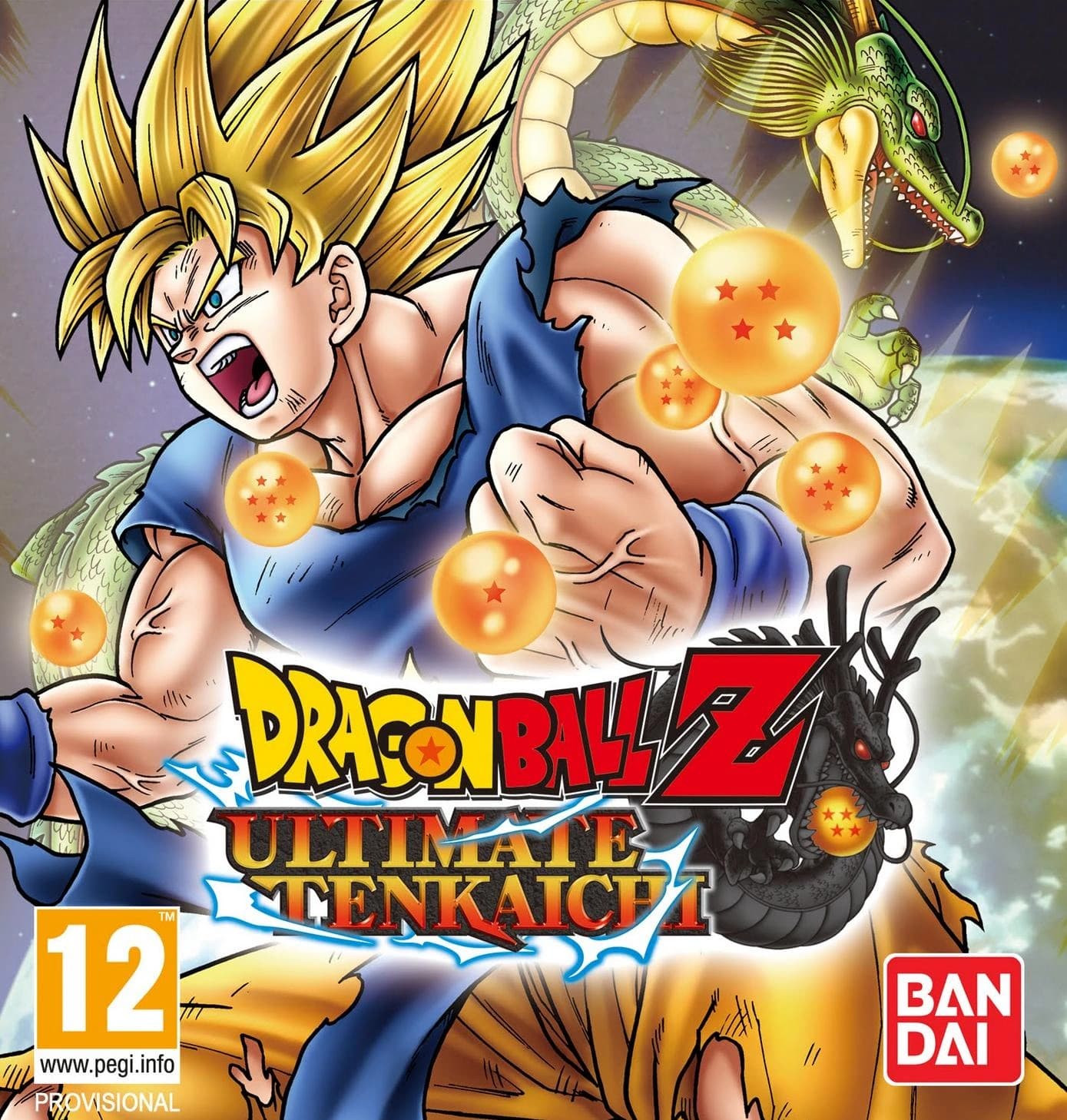
Dragon Ball Z: Ultimate Tenkaichi
GameDragon Ball Z: Ultimate Tenkaichi, known as in Japan, is a fighting video game released by Bandai Namco for and . The game was announced by Weekly Shōnen Jump under the code name Dragon Ball Game Project: Age 2011. Internauts could vote for the name of the game, having the choice between: Dragon Ball Z: Tenkaichi Z, Dragon Ball Z: Saiyan Rising, Dragon Ball Z: Awakening Saiyans, Dragon Ball Z: Ultimate Tenkaichi, and Dragon Ball Z: Saiyan Warriors in Europe and North America. The title Dragon Ball Z: Ultimate Tenkaichi was eventually chosen and officially revealed on June 30, 2011.
Gameplay
Dragon Ball Z: Ultimate Tenkaichi builds on the Budokai Tenkaichi series framework with a revised control scheme designed to lower the barrier to entry while preserving tactical depth in extended exchanges. The Impact Break system enables large-scale environment destruction during fights, including realistic craters and Kamehameha blast trails that cut across the sky. Battles move fluidly between long-range Ki exchanges and close-range melee confrontations, with improved mechanics facilitating faster transitions between combat distances. Quick Time Events appear during certain combo sequences, a borrowing from the Budokai series that adds interactive momentum to high-damage exchanges.
Character and environment visuals are rendered in a style that closely matches the anime, with the original Japanese voice track and series music including "Cha-La Head-Cha-La" included in the release. A health recovery system and expanded set of cinematic camera angles are present throughout. Characters at low health have their standard taunt replaced by a Blast 1 ability from the Tenkaichi series, such as Give Me Energy for Goku, creating a distinctive signal that a fight is nearing its end. Giant boss characters up to fifteen times the height of playable fighters appear in both story battles and cinematics.

Modes and Story
The enhanced Story Mode covers Dragon Ball Z from Bardock's battle against Frieza through the conclusion of Dragon Ball GT, ending with the fight between Super Saiyan 4 Gogeta and Omega Shenron. Free-roam exploration between key battles allows players to ride the Nimbus Cloud, pursue side objectives, and complete chase sequences. Fifteen animated boss encounters are incorporated into the campaign, and digitally remastered anime scenes supplement the in-game presentation. A Dragon Radar on the free-roam screen marks objectives with beams of light rising from the ground, and scouter-equipped characters can activate their scouters during exploration.
Hero Mode provides a separate custom character experience with a complete original story. Players design a male Saiyan fighter with full appearance and ability customization, then guide that character through a narrative involving Captain Ginyu, Androids 17 and 18, Piccolo, and eventually Omega Shenron. The hero must gather Dragon Balls, defeat escalating opponents, and ultimately restore the world by making a wish to Ultimate Shenron. A Tournament Mode allows up to sixteen characters to compete in a bracket, and custom characters can participate alongside the standard roster.
Related Reading
See all
Namek Has No Women, and Piccolo Pulls Anyway
There are no women on Namek. That isn't an oversight, it's the biology. Why we handed Piccolo the one thing his own species rules out, and why it had to be trap soul....
1000 Times Over: Who Is John Dragon Ball Singing To?
Dragon Ball handed us a protagonist with no history and the internet named him John Dragon Ball. So we built him somebody to talk to....
Development and Reception
Ultimate Tenkaichi was released by Bandai Namco for PlayStation 3 and Xbox 360 after being announced under the code name Dragon Ball Game Project Age 2011. Its final title was selected through a public online vote among five candidate names, an approach that generated community engagement during the pre-release period. The game was officially revealed on June 30, 2011, and launched shortly thereafter in North America and Europe.
Reception was mixed. The visuals and destructible environments received praise for their fidelity to the anime aesthetic, and Hero Mode was recognized as an ambitious original addition. However, the simplified button-based combat system was frequently cited as a regression from the deeper mechanics of earlier Tenkaichi entries, with critics noting it felt designed for accessibility at the expense of longtime series fans. The game remains the last entry in the numbered Tenkaichi line before the franchise moved to other formats.
Frequently Asked Questions
What is Dragon Ball Ultimate Tenkaichi?
Dragon Ball Z: Ultimate Tenkaichi, known as in Japan, is a fighting video game released by Bandai Namco for and . The game was announced by Weekly Shōnen Jump under the code name Dragon Ball Game Project: Age 2011. Internauts could vote for the name of the game, having the choice between: Dragon Ball Z: Tenkaichi Z, Dragon Ball Z: Saiyan Rising, Dragon Ball Z: Awakening Saiyans, Dragon Ball Z: Ultimate Tenkaichi, and Dragon Ball Z: Saiyan Warriors in Europe and North America.
What game modes does Dragon Ball Z: Ultimate Tenkaichi have?
Dragon Ball Z: Ultimate Tenkaichi builds on the Budokai Tenkaichi series framework with a revised control scheme designed to lower the barrier to entry while preserving tactical depth in extended exchanges. The Impact Break system enables large-scale environment destruction during fights, including realistic craters and Kamehameha blast trails that cut across the sky. Battles move fluidly between long-range Ki exchanges and close-range melee confrontations, with improved mechanics facilitating faster transitions between combat distances.
Which characters appear in Dragon Ball Z: Ultimate Tenkaichi?
Character and environment visuals are rendered in a style that closely matches the anime, with the original Japanese voice track and series music including "Cha-La Head-Cha-La" included in the release. Characters at low health have their standard taunt replaced by a Blast 1 ability from the Tenkaichi series, such as Give Me Energy for Goku, creating a distinctive signal that a fight is nearing its end. Giant boss characters up to fifteen times the height of playable fighters appear in both story battles and cinematics.
When was Dragon Ball Z: Ultimate Tenkaichi released?
Dragon Ball Z: Ultimate Tenkaichi was released in 2011. Bandai Namco published it as part of the Budokai Tenkaichi game series.
Who developed Dragon Ball Z: Ultimate Tenkaichi?
Dragon Ball Z: Ultimate Tenkaichi was developed by Spike. Bandai Namco published the title in 2011.
Sources & Information
Looking for more on Dragon Ball Z: Ultimate Tenkaichi? The Dragon Ball Wiki on Fandom has a dedicated page with community notes.
View on FandomThis content is original writing by Daddy Jim Headquarters based on the Dragon Ball anime series, manga, and official materials. Episode and chapter references are cited where applicable.
Rights holders
- Created byAkira Toriyama
- Published byShueisha
- Animated byToei Animation
All rights belong to their respective owners.
Character and scene imagery on this site is original artwork by Daddy Jim Headquarters, not screenshots or licensed imagery. Official cover art is used on three types of pages for editorial commentary:
- Movie pages: theatrical posters and key visuals, credited to Toei Animation and Shueisha.
- Game pages: official box art, credited to Bandai Namco, Atari, and other publishers.
- Manga chapter pages: Jump Comics volume covers, credited to Shueisha and Akira Toriyama.
Browse our episode guides:
Official resources:
Help Us Keep This Wiki Accurate
Daddy Jim Headquarters maintains this encyclopedia. If you spot an error, a translation issue, or something that doesn't look right, let us know.