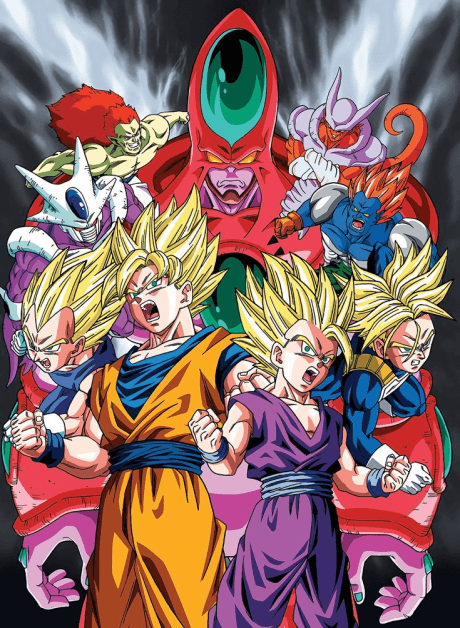
Dragon Ball: Plan to Eradicate the Saiyans
MovieA Tuffle scientist named Dr. Lychee enacts his revenge against the surviving Saiyans by flooding Earth with Destron Gas and unleashing Ghost Warriors of Frieza, Cooler, Turles, and Lord Slug. Goku, Vegeta, Gohan, Trunks, and Piccolo must destroy the devices and track Lychee to the Dark Planet.
Ghosts of a Genocide
Long before the Saiyans became warriors in Frieza's army, they shared their homeworld with another race: the Tuffles, a technologically advanced civilization that the Saiyans slaughtered and displaced. Dr. Lychee was one of the few Tuffles to escape the genocide, fleeing to the Dark Planet at the edge of the universe with nothing but a capsule and a machine called Hatchiyack, a device designed to absorb and channel hatred into raw power. Decades of isolation have distilled Lychee's grief into a single, consuming purpose: eradicate every last Saiyan.
His plan begins with Destron Gas generators placed at strategic locations across Earth. The gas is lethal to all life, and Mr. Popo discovers that the planet has only hours before the atmosphere becomes uninhabitable. Goku, Gohan, Vegeta, Future Trunks, and Piccolo split up to destroy the generators. They succeed in dismantling all but one, which is protected by an impenetrable energy barrier and guarded by the Ghost Warriors: spectral reconstructions of Frieza, Cooler, Turles, and Lord Slug, each possessing the full power they wielded in life.
The Dark Planet
King Kai reveals that Ghost Warriors will regenerate indefinitely unless defeated in the same manner they originally died. The heroes manage to put down the phantoms and trace Lychee's signal to the Dark Planet itself. There, they discover the truth: Lychee himself is a Ghost Warrior, a dead man sustained by Hatchiyack's hatred engine. When Vegeta vaporizes Lychee completely, preventing his regeneration, the machine responds by exceeding its operational limits and manifesting a physical body of its own. Hatchiyack stands before them as a towering android whose power, according to Goku, may rival or even surpass Broly's.
The combined might of all four Super Saiyans and Piccolo converges in a final, desperate salvo: Goku's Super Kamehameha, Gohan's Super Masenko, Vegeta's Final Flash, Trunks's Burning Attack, and Piccolo's Special Beam Cannon. The coordinated assault overwhelms Hatchiyack, ending the threat of the Ghost Warriors once and for all. As the Dark Planet begins to collapse from the intensity of the battle, Goku teleports the group back to Earth with Instant Transmission.
Five Beams, One Target
The Ghost Warrior encounters provide a unique challenge rarely seen elsewhere in Dragon Ball. Fighting enemies who simply reform after every defeat forces the heroes to think strategically rather than just hit harder. The requirement to replicate each villain's original death adds a puzzle-solving element to what would otherwise be straightforward brawls.
Hatchiyack's physical form is the film's true spectacle. The android tanks everything thrown at it individually, shrugging off attacks that would obliterate most enemies. The final combined energy wave is one of the few moments in Dragon Ball where every hero contributes equally to a single decisive blow. There is no chosen one carrying the team; it is genuine cooperation, with each fighter's signature technique woven into a unified assault.
Goku's offhand remark that Hatchiyack might be stronger than Broly carries significant weight, establishing the OVA's timeline as occurring during the ten-day wait before the Cell Games, after the events of the first Broly film. It is a small piece of dialogue, but it anchors the entire story within the broader Dragon Ball Z continuity.
From Famicom to Blu-Ray
Plan to Eradicate the Saiyans occupies a unique position in Dragon Ball history. The original OVA was released across two home video cassettes in Japan in 1993, serving as a companion piece to the Famicom game of the same name. Written by Takao Koyama and directed by Shigeyasu Yamauchi, the 60-minute original features character designs by Tadayoshi Yamamuro, the animator who would go on to define the look of Dragon Ball Z for years.
In 2010, the OVA was completely remade as "Plan to Eradicate the Super Saiyans," a 30-minute reimagining included as a bonus disc with Dragon Ball: Raging Blast 2. Directed by Yoshihiro Ueda, the remake was re-scripted and re-animated from scratch, finally bringing the story to Western audiences for the first time. The remake also appeared as a bonus with the March 2012 issue of Saikyo Jump, alongside the Episode of Bardock OVA.
The Tuffle revenge narrative taps into one of Dragon Ball's most morally complex threads: the Saiyans were conquerors long before they became heroes. Dr. Lychee's hatred is not irrational; the genocide he survived was real, and the Saiyans who stand against him are descendants of the perpetrators. The story does not excuse Lychee's methods, but it also refuses to pretend the Saiyans' history is clean. For an OVA tied to a video game promotion, it carries a surprising amount of thematic weight.
Related Reading
See all
Krillin's on the Tinder: How the Ultimate Short King Survived the Height Filter
Tinder built a height filter. Dragon Ball built a five foot legend. What happened when we sent the ultimate short king into the modern dating hellscape....
Infinite Zeni Glitch: When Yamcha Never Pays and Mr. Popo Always Does
The internet found an infinite money glitch. So did Yamcha. A smooth R&B track about the easiest money in the Dragon Ball world and the one man who keeps paying for it....
Frequently Asked Questions
What is the plan to eradicate the Saiyans special?
A Tuffle scientist named Dr. Lychee enacts his revenge against the surviving Saiyans by flooding Earth with Destron Gas and unleashing Ghost Warriors of Frieza, Cooler, Turles, and Lord Slug. Goku, Vegeta, Gohan, Trunks, and Piccolo must destroy the devices and track Lychee to the Dark Planet.
Is Dragon Ball Plan to Eradicate the Super Saiyans canon?
Dragon Ball: Plan to Eradicate the Saiyans is an OVA from the Dragon Ball era. It was released on August 6, 1993.
What happens in Dragon Ball: Plan to Eradicate the Saiyans?
Dr. Lychee, a Tuffle scientist who escaped the Saiyan genocide of his race, has spent decades on the Dark Planet at the edge of the universe perfecting his revenge. He deploys Destron Gas generators on Earth that release a poison deadly to all living things, with the Saiyans as his primary targets. Goku, Gohan, Vegeta, Trunks, and Piccolo split up to destroy the generators located around the world.
When was Dragon Ball: Plan to Eradicate the Saiyans released?
Dragon Ball: Plan to Eradicate the Saiyans was released on August 6, 1993. It is an OVA in the Dragon Ball era.
Who is the main villain in Dragon Ball: Plan to Eradicate the Saiyans?
The main antagonist of Dragon Ball: Plan to Eradicate the Saiyans is Hatchiyack. Dr. Lychee, a Tuffle scientist who escaped the Saiyan genocide of his race, has spent decades on the Dark Planet at the edge of the universe perfecting his revenge.
Sources & Information
Looking for more on Dragon Ball: Plan to Eradicate the Saiyans? The Dragon Ball Wiki on Fandom has a dedicated page with community notes.
View on FandomThis content is original writing by Daddy Jim Headquarters based on the Dragon Ball anime series, manga, and official materials. Episode and chapter references are cited where applicable.
Character and scene imagery on this site is original artwork by Daddy Jim Headquarters, not screenshots or licensed imagery. Official cover art is used on three types of pages for editorial commentary:
- Movie pages: theatrical posters and key visuals, credited to Toei Animation and Shueisha.
- Game pages: official box art, credited to Bandai Namco, Atari, and other publishers.
- Manga chapter pages: Jump Comics volume covers, credited to Shueisha and Akira Toriyama.
Browse our episode guides:
Official resources:
Help Us Keep This Wiki Accurate
Daddy Jim Headquarters maintains this encyclopedia. If you spot an error, a translation issue, or something that doesn't look right, let us know.