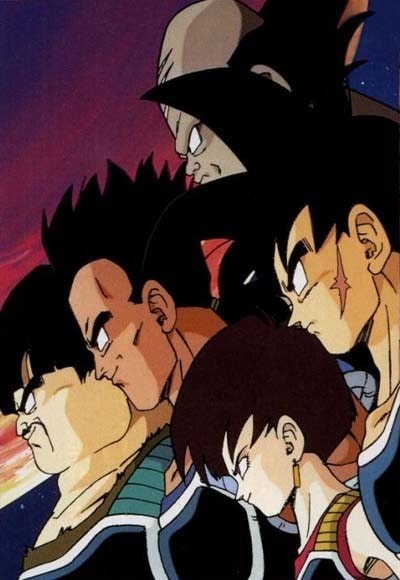
Dragon Ball Z: Bardock - The Father of Goku
MovieThe tragic origin story of Goku's father, a low-class Saiyan warrior who foresees the destruction of his entire race at Frieza's hands and mounts a doomed, solitary rebellion against the tyrant in a desperate attempt to change the future.
A Solitary Final Battle
The story begins not with heroes, but with soldiers. Bardock and his crew, a squad of low-class Saiyan warriors in the service of the galactic tyrant Frieza, are finishing a brutal assignment on Planet Kanassa. The mission has gone well. The Kanassan resistance has been wiped out, and the team rests among the ruins of a civilization they just erased. Bardock is not troubled by any of this. He is a Saiyan. Conquest is his profession, and he is very good at it.
The Curse of Foresight
As the squad celebrates, a lone surviving Kanassan warrior emerges from the rubble and strikes Bardock with a strange energy attack. Rather than killing him, the blow implants something far worse: the ability to see the future. Bardock collapses, and in the fever that follows, he is plagued by visions. He sees Planet Vegeta consumed in fire. He sees Frieza, grinning from the viewport of his ship, watching the explosion with satisfaction. And he sees a boy, his own infant son Kakarot, grown into a man with golden hair, standing against Frieza on a dying world. Bardock does not understand these visions. He does not want to understand them. He dismisses them as hallucinations and, once recovered, heads to Planet Meat to rejoin his crew.
Betrayal on Planet Meat
But his crew is already dead. Frieza, growing increasingly paranoid about the Saiyans' rapidly increasing power levels, has ordered his lieutenant Dodoria to eliminate Bardock's team. Bardock arrives to find the bodies of his comrades scattered across the battlefield. Tora, his closest friend, is barely alive, and with his final breaths he warns Bardock that Frieza has turned against them. Using Tora's blood-soaked armband as a headband, Bardock fights Dodoria's elite soldiers and defeats them all, but Dodoria himself intervenes with a single devastating mouth blast that leaves Bardock broken and barely conscious.
Elsewhere in the cosmos, aboard Frieza's flagship, the tyrant confers with his advisors Zarbon and Dodoria about the Saiyan problem. Zarbon reports that a squad of low-class Saiyans conquered Kanassa in mere days, a job that even Frieza's elite squadrons had struggled with for months. The implication is clear: the Saiyans are getting stronger at an alarming rate. If the trend continues, they could eventually challenge Frieza himself. Zarbon recommends preemptive extermination. Frieza agrees.
A Prophet Nobody Believes
Bardock drags himself back to Planet Vegeta, passing the space pod carrying his newborn son Kakarot toward Earth along the way. He crashes into the streets of the Saiyan capital, bloodied and half-dead, and tries to warn his people. Frieza is coming to destroy them all. He has seen it. But the other Saiyans only laugh. Bardock is a low-class warrior raving about visions and conspiracies. Nobody takes him seriously. When he screams at them, they fall silent out of fear, not belief. It does not matter. Bardock realizes he is alone in this, as the title says: it will be a solitary final battle.
The Last Stand
Frieza's enormous warship appears in the sky above Planet Vegeta, blotting out the sun. Bardock launches himself into space, punching through wave after wave of Frieza's foot soldiers with a ferocity born of total desperation. He fights through dozens, then hundreds, leaving a trail of broken bodies behind him as he claws his way toward Frieza's ship. The tyrant watches from his hoverpod with barely contained fury, then orders Zarbon to prepare for departure. He intends to handle this personally.
Bardock reaches the outer hull and comes face to face with Frieza himself. He gives a defiant speech, declaring the Saiyans free from the tyrant's rule, and hurls his Final Spirit Cannon directly at Frieza. For one shining moment, it seems as though he might actually change the future. But Frieza responds by raising a single finger and generating a Supernova, an enormous sphere of energy that swallows Bardock's attack, consumes Bardock himself, engulfs the legions of Frieza's own soldiers hovering nearby, and continues downward into Planet Vegeta. The planet detonates. The Saiyan race, save for a handful of survivors scattered across the galaxy, ceases to exist. Frieza watches the explosion and laughs, instructing Zarbon and Dodoria to enjoy the "beautiful fireworks."
The Vision Fulfilled
As the energy of the Supernova tears Bardock apart, he sees one final vision: his son Kakarot, fully grown, standing on the surface of a green planet, facing Frieza with clenched fists. Bardock smiles. He was never going to save his world. He knows that now. But his son will avenge it. With that small, broken smile, Bardock disintegrates alongside everything he ever knew.
On a distant planet, the young Prince Vegeta receives word that his homeworld has been destroyed. His face betrays nothing. Elsewhere, Kakarot's space pod touches down on Earth, where an elderly martial artist named Gohan finds the alien baby and, charmed by his giggling, decides to raise him as his own grandson. He names the boy Goku. The film closes with a montage of Goku's life on Earth, his adventures, his battles, and his growth into the hero who will one day fulfill his father's dying vision.

Blood, Fire, and the Weight of Knowing
Bardock: The Father of Goku is structured as a slow, grinding tragedy, and its most powerful moments are not its flashiest. The special earns its emotional devastation through accumulation, building dread scene by scene until the final minutes deliver one of the most iconic sequences in all of Dragon Ball.
The Kanassan's Gift
The inciting incident is masterfully executed. The Kanassan warrior's ambush on Bardock is not framed as a typical attack but as an act of poetic justice. Here is a soldier who has spent his life destroying civilizations without a second thought, and his punishment is to see, with absolute clarity, the destruction of his own. The cruel irony is that the visions do not give Bardock the power to prevent anything. They only ensure that he suffers with full knowledge of what is coming. It is a curse disguised as a gift, and the entire emotional arc of the special flows from this single moment.
The Massacre on Planet Meat
Bardock's discovery of his fallen comrades is the special's emotional turning point. Tora, clinging to life just long enough to deliver his warning, dies in Bardock's arms. The scene of Bardock wrapping Tora's blood-soaked armband around his own forehead is one of the most iconic images in Dragon Ball history. It transforms a piece of cloth into a symbol of everything Bardock is fighting for: not the Saiyan empire, not his own survival, but the memory of the friends who trusted him. His subsequent battle against Dodoria's elite is brutal and satisfying, but Dodoria's casual mouth blast, delivered almost as an afterthought, reminds the audience exactly where Bardock sits in the power hierarchy. He is strong for a low-class warrior. Against Frieza's officers, that means nothing.
The Streets of Planet Vegeta
Bardock's attempt to rally his people is the special's most painful sequence. He staggers through the streets, bleeding and desperate, shouting warnings that nobody wants to hear. The other Saiyans laugh at him. These are a proud, violent people who cannot conceive of a threat they cannot punch their way through, and they certainly are not going to listen to a battered low-class warrior raving about psychic visions. Bardock's isolation in this scene is total. He has the knowledge to save his entire race, and it is completely worthless because nobody will believe him. The frustration is agonizing to watch.
Bardock vs. The Universe
The final assault is the centerpiece, and it works because of everything that precedes it. Bardock knows he cannot win. The audience knows he cannot win. And yet he flies into the sky anyway, tearing through Frieza's soldiers with the desperate energy of a man who has decided that dying on his feet is better than dying on his knees. The animation captures the mounting toll beautifully: each punch costs him a little more, each blast takes a little longer to fire, but he keeps climbing. When he finally reaches Frieza and hurls his Final Spirit Cannon, there is a split second where the trajectory bends toward the tyrant's face and it feels, impossibly, like Bardock might actually do it.
Then the Supernova appears. The scale of it is overwhelming. It dwarfs Bardock, dwarfs his attack, dwarfs the planet itself. Frieza's laughter echoes as the sphere descends, and Bardock's final expression, that small, knowing smile as he sees Kakarot standing against Frieza in the future, is one of the most emotionally devastating moments in the entire franchise. He dies not in victory but in hope, and that distinction is what elevates the scene from spectacle to art.
Vegeta's Silence
A brief but crucial scene follows the destruction: Prince Vegeta, on a distant planet, learning that everything he came from is gone. His response is to show nothing. No tears, no rage, just the cold mask of a boy who has already learned that vulnerability is weakness. In thirty seconds of screen time, the special explains decades of Vegeta's character. His pride, his cruelty, his inability to process loss except through anger. It is a masterclass in efficient storytelling.
The Special That Defined a Father
Dragon Ball Z: Bardock, The Father of Goku holds a singular place in the franchise. It is technically a television special rather than a theatrical film, first airing on Fuji TV on October 17, 1990, but its impact on the Dragon Ball universe has been as profound as any movie in the series. Written by Takao Koyama and directed by Mitsuo Hashimoto, the special was produced to provide backstory for the Frieza Saga, which was airing concurrently. It accomplished that goal and then some, creating a character so compelling that he fundamentally changed how fans understood Goku's origins.
Bardock Before and After
Before this special, Bardock did not exist as a meaningful character. The manga offered only the briefest glimpse of Goku's Saiyan parents, and Frieza's destruction of Planet Vegeta was presented as background exposition rather than a dramatic event. Koyama's screenplay transformed this footnote into the emotional foundation of the entire Saiyan narrative. By giving Goku's father a personality, a crew, a sense of loyalty, and a tragic arc, the special retroactively enriched every scene involving the Saiyans, Frieza, and the legacy of Planet Vegeta. Toriyama himself was reportedly impressed enough to incorporate Bardock into the manga, canonizing the character with a brief appearance during the Frieza Saga.
Shunsuke Kikuchi's Score
The musical direction deserves particular attention. Shunsuke Kikuchi's score for the Japanese version matches the escalating tragedy beat for beat, moving from ominous tension during the Kanassan visions to martial urgency during the Planet Meat massacre to a devastating, almost funereal tone during Bardock's final charge. The Funimation dub replaced Kikuchi's work with a soundtrack of licensed American rock bands and an original score by Dale Kelly, Andy Baylor, and Mark Akin. A 2008 remastered release offered both audio tracks, allowing fans to experience each version.
Release History
The special premiered on Japanese television in October 1990 and was later included in the Dragon Box Z, Vol. 1 set released on March 19, 2003. Funimation first brought it to Western audiences on VHS and DVD in January 2001, making it the first Dragon Ball Z feature dubbed by their in-house voice cast. A remastered Double Feature release, paired with The History of Trunks, followed on February 19, 2008, with a new widescreen transfer and dual audio options. The special also aired on Toonami on September 5, 2003, as the opening event of a month-long "DBZ Movies" Friday block.
Legacy
Bardock's influence on the franchise extends far beyond this single special. He has appeared in numerous Dragon Ball video games, received an alternate-timeline sequel in Episode of Bardock, and was given a completely reimagined backstory in the Dragon Ball Super manga's Granolah the Survivor Saga. In every iteration, the core appeal remains the same: a common soldier who saw the end of the world and chose to fight it alone. The Father of Goku is not just one of the best Dragon Ball specials. It is one of the best pieces of storytelling the franchise has ever produced, a 48-minute tragedy that transforms a nameless background character into one of the most beloved figures in anime history.
Related Reading
See all
Krillin's on the Tinder: How the Ultimate Short King Survived the Height Filter
Tinder built a height filter. Dragon Ball built a five foot legend. What happened when we sent the ultimate short king into the modern dating hellscape....
Infinite Zeni Glitch: When Yamcha Never Pays and Mr. Popo Always Does
The internet found an infinite money glitch. So did Yamcha. A smooth R&B track about the easiest money in the Dragon Ball world and the one man who keeps paying for it....
Frequently Asked Questions
What is Dragon Ball Z: Bardock - The Father of Goku?
The tragic origin story of Goku's father, a low-class Saiyan warrior who foresees the destruction of his entire race at Frieza's hands and mounts a doomed, solitary rebellion against the tyrant in a desperate attempt to change the future. Bardock and his crew of low-class Saiyan warriors finish conquering Planet Kanassa when one surviving Kanassan warrior strikes Bardock with a psychic blow, cursing him with the ability to see the future.
What happens in Dragon Ball Z: Bardock - The Father of Goku?
Bardock and his crew of low-class Saiyan warriors finish conquering Planet Kanassa when one surviving Kanassan warrior strikes Bardock with a psychic blow, cursing him with the ability to see the future. After recovering, Bardock begins having visions of Planet Vegeta's destruction and his son Kakarot's future on Earth. His crew is sent on another mission to Planet Meat, where Frieza's elite soldiers, led by Dodoria, ambush and kill them all.
When was Dragon Ball Z: Bardock - The Father of Goku released?
Dragon Ball Z: Bardock, The Father of Goku was released on October 17, 1990. It is a TV special in the Dragon Ball Z era.
Who is the main villain in Dragon Ball Z: Bardock - The Father of Goku?
The main antagonist of Dragon Ball Z: Bardock, The Father of Goku is Frieza. Bardock and his crew of low-class Saiyan warriors finish conquering Planet Kanassa when one surviving Kanassan warrior strikes Bardock with a psychic blow, cursing him with the ability to see the future.
How long is Dragon Ball Z: Bardock - The Father of Goku?
Dragon Ball Z: Bardock, The Father of Goku has a runtime of 48 minutes. Its length is typical for a Dragon Ball TV special of its era.
Sources & Information
Looking for more on Dragon Ball Z: Bardock - The Father of Goku? The Dragon Ball Wiki on Fandom has a dedicated page with community notes.
View on FandomThis content is original writing by Daddy Jim Headquarters based on the Dragon Ball anime series, manga, and official materials. Episode and chapter references are cited where applicable.
Character and scene imagery on this site is original artwork by Daddy Jim Headquarters, not screenshots or licensed imagery. Official cover art is used on three types of pages for editorial commentary:
- Movie pages: theatrical posters and key visuals, credited to Toei Animation and Shueisha.
- Game pages: official box art, credited to Bandai Namco, Atari, and other publishers.
- Manga chapter pages: Jump Comics volume covers, credited to Shueisha and Akira Toriyama.
Browse our episode guides:
Official resources:
Help Us Keep This Wiki Accurate
Daddy Jim Headquarters maintains this encyclopedia. If you spot an error, a translation issue, or something that doesn't look right, let us know.