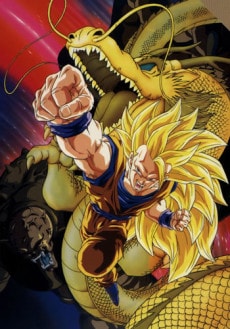
Dragon Ball Z: Wrath of the Dragon
MovieA mysterious warrior named Tapion is freed from an ancient music box, carrying half of a monstrous creature sealed within his body. As the beast Hirudegarn threatens to reassemble and destroy the Earth, young Trunks forms an unlikely bond with Tapion that will end with a sword, a farewell, and one of Dragon Ball's most devastating finishing moves.
The Warrior Inside the Music Box
The film opens on a distant, dying world. A young boy named Minotia searches through ruins, sword drawn, desperately hunting something enormous. The ground shakes. He turns too late. A colossal foot descends, and the boy is gone. Somewhere in the darkness, a villain laughs.
A Deception Wrapped in a Wish
On Earth, life has settled into a comfortable routine after the defeat of Majin Buu. Gohan and Videl, operating as the Great Saiyaman duo, stop a bank robbery and are approached by a strange old man named Hoi. He claims to possess a music box containing a legendary warrior named Tapion, and that only the Dragon Balls can open it. Hoi warns that Earth itself is in danger if Tapion remains sealed.
Gohan, Videl, and the others gather the Dragon Balls and summon Shenron. The music box shatters, and Tapion emerges, but he is not grateful. He is furious. He demands to be resealed immediately, but the box is destroyed beyond repair. Tapion storms off to isolate himself in an abandoned building, refusing food and companionship from everyone except one persistent visitor: young Trunks, who keeps returning with meals and quiet determination. Tapion rebuffs him repeatedly, but the boy's stubborn kindness eventually cracks through the warrior's defensive shell.
The Lower Half Awakens
Shortly after Tapion's release, Hirudegarn's lower half begins attacking West City. The creature is invisible to the naked eye, manifesting only as devastating impacts that demolish buildings and hurl people through the air. Gohan and Videl confront it in their Great Saiyaman identities, and Gohan powers up to his Ultimate state, but even his strength cannot land a decisive blow against something he can barely perceive. Tapion arrives with his Hero's Flute, playing a magical melody that weakens the creature's lower half and forces it to vanish.
Tapion finally opens up to Trunks and, through him, to Bulma. He tells them the full story. Thousands of years ago on the planet Konats, a group of dark sorcerers called the Kashvar used forbidden magic to bring a statue to life, creating the monster Hirudegarn. The creature devastated their world until Tapion and his brother Minotia froze it with their divine ocarinas, allowing a wizard to bisect the monster with a sacred blade. Unable to destroy Hirudegarn permanently, the Konatsians sealed each half inside one of the brothers, then placed each brother in a music box and launched them to opposite ends of the galaxy. The boy from the film's opening, Minotia, was the one whose box was found first. His half was already free. Now, with Tapion released, both halves are active, and the creature is trying to reunite.
Hirudegarn Reborn
Bulma builds a special chamber based on the music box's design, meant to suppress the upper half of Hirudegarn sealed within Tapion's body. But the chamber fails. A nightmare shatters Tapion's concentration, and the upper half forces its way out. With Hoi orchestrating events from the shadows, the two halves merge into the complete Hirudegarn, a towering monstrosity that can teleport, breathe fire, and absorb life energy through its tail.
The Z Fighters mobilize. Goku transforms into Super Saiyan 2. Gohan powers up to his Ultimate state. Goten goes Super Saiyan. All three attack simultaneously, but Hirudegarn can phase out of existence at will, reappearing behind its attackers and countering before they can react. Vegeta joins the fight after Hirudegarn destroys part of Capsule Corporation, driven more by property damage than heroism. He shields innocent bystanders from Hirudegarn's fire breath by creating an energy barrier, burning through his reserves and collapsing.
Goten and Trunks fuse into Super Saiyan 3 Gotenks and unleash their Continuous Die Die Missile barrage. The attack seems to destroy Hirudegarn, but the damage only triggers an evolution. The creature transforms into an even more powerful insect-like form and swats Gotenks apart, defusing the boys instantly.
Dragon Fist
Tapion plays his flute one final time, managing to reseal Hirudegarn inside himself. He begs Trunks to kill him with the sacred sword, destroying the monster permanently. Trunks hesitates. Before he can strike, Hirudegarn breaks free again, destroying the flute in the process. Hoi gloats over his apparent victory, only to be crushed beneath his own creation's foot.
Goku returns as a Super Saiyan 3. He discovers Hirudegarn's weakness: the creature becomes vulnerable immediately after attacking, during the split second it rematerializes. Goku taunts Hirudegarn into striking, dodges at the last instant, and unleashes the Dragon Fist. A golden dragon erupts from Goku's fist, coiling around Hirudegarn and tearing through the monster from the inside out. The creature detonates. The battle is over.
In the aftermath, Tapion prepares to return to his homeworld using Bulma's time machine, traveling to an era before Konats was destroyed. Before he leaves, he gives Trunks his sword. It is a gift between warriors and, in the broader Dragon Ball mythology, an origin story. Future Trunks carries a sword throughout the Cell Saga, and Wrath of the Dragon offers one explanation for how that blade found its way into the family.
A Monster, a Melody, and the Dragon Fist
Wrath of the Dragon distinguishes itself through emotional depth and a villain concept that challenges the heroes in ways raw power alone cannot explain.
Trunks and Tapion
The bond between Trunks and Tapion is the film's emotional backbone. Trunks is a child of privilege, the son of Vegeta and Bulma, raised in comfort at Capsule Corporation. Tapion is a refugee from a dead civilization, carrying a monster inside him, isolated by the knowledge that anyone close to him is in danger. Their friendship develops through small acts of persistence: Trunks bringing food to a man who refuses to eat, sitting in silence outside a door, simply being present when no one else bothers. By the time Tapion asks Trunks to kill him, the request carries devastating weight because the audience has watched the boy fight to earn the warrior's trust.
Hirudegarn's Terror Through Intangibility
What makes Hirudegarn frightening is not his size or his firepower but his ability to phase out of existence. Every other Dragon Ball villain can be challenged through escalating power. Hirudegarn ignores power entirely. He teleports before attacks connect, rematerializes behind his opponents, and strikes before they can turn around. This forces the heroes to think differently, and the solution, exploiting the brief moment of vulnerability after an attack, rewards observation over brute force.
The Dragon Fist
Goku's Dragon Fist is one of the most visually spectacular attacks in the entire franchise. A golden Shenron-like dragon surges from Goku's fist, spirals around the target, and destroys it from within. It is used only once in the film series, which gives it a legendary quality. The attack feels like something pulled from myth rather than martial arts, and its appearance as the final blow against Hirudegarn elevates the climax into something genuinely awe-inspiring.
The Sword's Origin
Tapion's parting gift to Trunks connects the film to the broader franchise in a way few Dragon Ball movies manage. Future Trunks's sword is one of the most iconic weapons in anime, and Wrath of the Dragon provides a satisfying potential origin for it. Whether this is considered canon depends on interpretation, but the emotional resonance is undeniable. A warrior from a destroyed world passes his blade to a boy who, in another timeline, will carry it into war.
The Final Curtain for Dragon Ball Z Films
Wrath of the Dragon premiered on July 15, 1995, at the Toei Anime Fair, directed by Mitsuo Hashimoto with a screenplay by Takao Koyama. It was the thirteenth and final theatrical film produced under the Dragon Ball Z banner, grossing 1.70 billion yen at the Japanese box office. The film runs 51 minutes and features the original Japanese score by Shunsuke Kikuchi.
Tapion's Lasting Impact
Funimation's English dub was released on DVD on September 12, 2006, with an original score by Nathan M. Johnson, who learned to play the ocarina specifically for composing Tapion's theme. The Double Feature Blu-ray release paired with Fusion Reborn followed in May 2009. Despite receiving less attention than the Broly films or Fusion Reborn during its initial Western release, Wrath of the Dragon has steadily grown in fan estimation. Tapion has become one of the most beloved characters to originate from a Dragon Ball film, appearing in video games including Dragon Ball Z: Budokai Tenkaichi 2 and Dragon Ball Heroes.
A Fitting Farewell
As the last Dragon Ball Z theatrical film before the franchise transitioned to Dragon Ball GT and eventually Dragon Ball Super, Wrath of the Dragon carries a sense of finality that elevates its story. The Dragon Fist feels like a capstone technique, something held in reserve for the very end. Tapion's departure through the time machine mirrors the franchise's own journey through eras. And the image of young Trunks holding a warrior's sword, standing at the beginning of a story that the audience already knows the ending of, gives the film a bittersweet quality that few entries in the Dragon Ball catalog can match.
Related Reading
See all
Krillin's on the Tinder: How the Ultimate Short King Survived the Height Filter
Tinder built a height filter. Dragon Ball built a five foot legend. What happened when we sent the ultimate short king into the modern dating hellscape....
Infinite Zeni Glitch: When Yamcha Never Pays and Mr. Popo Always Does
The internet found an infinite money glitch. So did Yamcha. A smooth R&B track about the easiest money in the Dragon Ball world and the one man who keeps paying for it....
Frequently Asked Questions
What is Dragon Ball Z: Wrath of the Dragon?
A mysterious warrior named Tapion is freed from an ancient music box, carrying half of a monstrous creature sealed within his body. As the beast Hirudegarn threatens to reassemble and destroy the Earth, young Trunks forms an unlikely bond with Tapion that will end with a sword, a farewell, and one of Dragon Ball's most devastating finishing moves.
Who is the main villain in Dragon Ball Z: Wrath of the Dragon?
The main antagonist of Dragon Ball Z: Wrath of the Dragon is Hirudegarn. An old man named Hoi manipulates the Z Fighters into freeing Tapion from a mystical music box that has imprisoned him for over a thousand years.
When was Dragon Ball Z: Wrath of the Dragon released?
Dragon Ball Z: Wrath of the Dragon was released on July 15, 1995. It is a theatrical film in the Dragon Ball Z era.
What happens in Dragon Ball Z: Wrath of the Dragon?
An old man named Hoi manipulates the Z Fighters into freeing Tapion from a mystical music box that has imprisoned him for over a thousand years. Tapion is a hero from the planet Konats who, along with his brother Minotia, sealed the two halves of the giant demon Hirudegarn inside their bodies using enchanted ocarinas and Hero's Swords. Tapion desperately tries to stay awake and keep playing his ocarina to suppress the monster within him, but each time he sleeps, the lower half of Hirudegarn escapes and terrorizes the city.
How long is Dragon Ball Z: Wrath of the Dragon?
Dragon Ball Z: Wrath of the Dragon has a runtime of 51 minutes. Its length is typical for a Dragon Ball theatrical film of its era.
Sources & Information
Looking for more on Dragon Ball Z: Wrath of the Dragon? The Dragon Ball Wiki on Fandom has a dedicated page with community notes.
View on FandomThis content is original writing by Daddy Jim Headquarters based on the Dragon Ball anime series, manga, and official materials. Episode and chapter references are cited where applicable.
Character and scene imagery on this site is original artwork by Daddy Jim Headquarters, not screenshots or licensed imagery. Official cover art is used on three types of pages for editorial commentary:
- Movie pages: theatrical posters and key visuals, credited to Toei Animation and Shueisha.
- Game pages: official box art, credited to Bandai Namco, Atari, and other publishers.
- Manga chapter pages: Jump Comics volume covers, credited to Shueisha and Akira Toriyama.
Browse our episode guides:
Official resources:
Help Us Keep This Wiki Accurate
Daddy Jim Headquarters maintains this encyclopedia. If you spot an error, a translation issue, or something that doesn't look right, let us know.