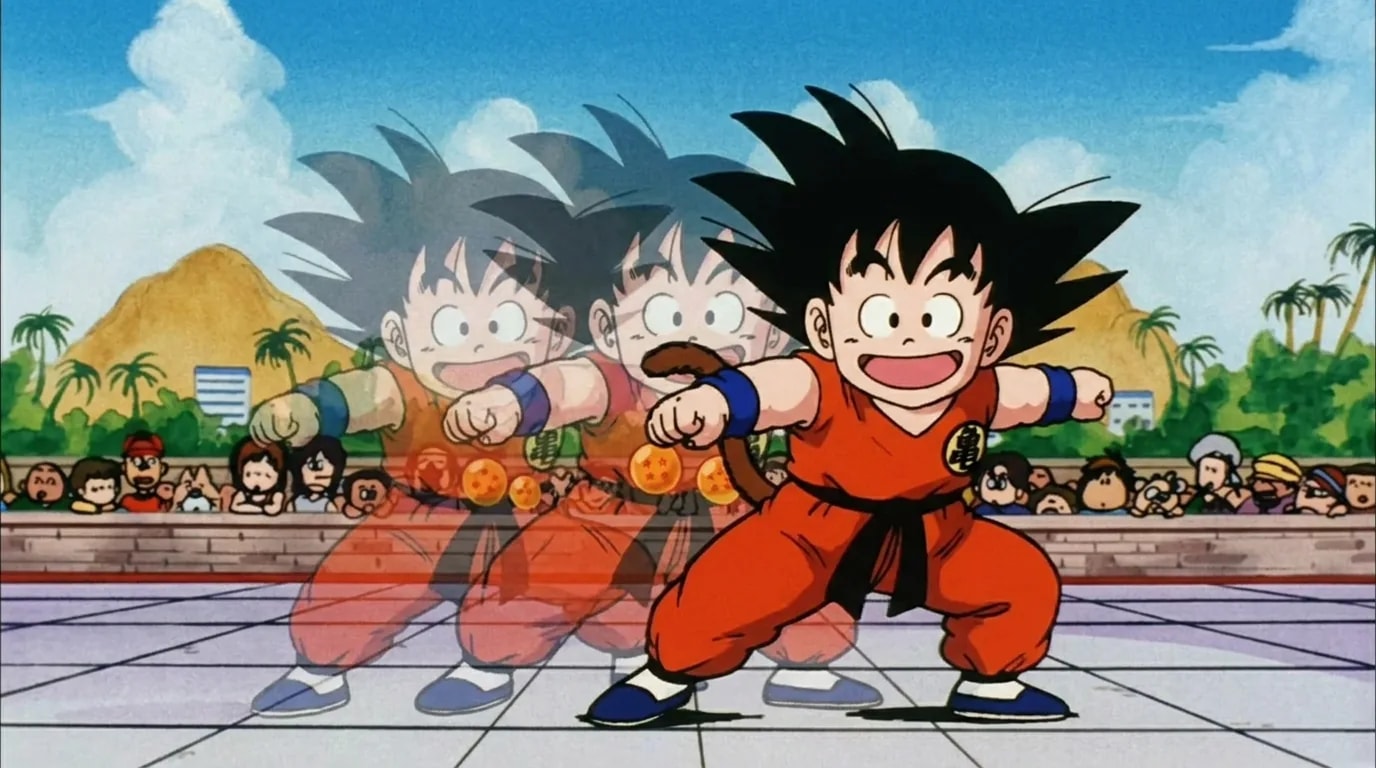
Afterimage Technique
TechniqueA high-speed movement technique where the user moves so quickly they leave behind a visible afterimage in their previous position, causing opponents to attack an empty space while the real fighter has already repositioned.
Mechanics
The Afterimage Technique relies on moving at speeds faster than the opponent's eyes can track. The residual light reflecting off the user's body creates a brief visual imprint that persists for a fraction of a second, long enough to fool an opponent into thinking the user is still standing there. The more skilled the practitioner, the more convincing and longer-lasting the afterimage appears. Advanced users can create multiple afterimages simultaneously, making it nearly impossible to identify the real body among the copies.



Usage Throughout the Series
Goku first demonstrates the technique during the 21st World Martial Arts Tournament against Krillin, establishing it as a staple of his combat repertoire. Jackie Chun (Master Roshi in disguise) counters with his own afterimage, revealing the technique's key weakness: any fighter fast enough can see through it. The technique appears regularly throughout Dragon Ball and into early Dragon Ball Z, used by characters including Goku, Krillin, Tien, Piccolo, and even Frieza.
Declining Relevance
As power levels escalate through DBZ and beyond, the basic Afterimage Technique becomes less effective against top-tier fighters who can sense ki signatures rather than relying on visual tracking. Despite this, it remains a useful tactical tool in the right situation and continues to appear in training sequences and lower-stakes combat.
Variants
Several enhanced versions exist. The Wild Sense technique combines the afterimage with an automatic counterattack. Goku's Instant Transmission achieves a similar visual effect through actual teleportation rather than pure speed, making it functionally superior. In video games, the afterimage often serves as an evasive skill that grants temporary invincibility frames, reflecting its in-universe purpose of making the user untouchable for a brief moment.
Related Reading
See all
Krillin's on the Tinder: How the Ultimate Short King Survived the Height Filter
Tinder built a height filter. Dragon Ball built a five foot legend. What happened when we sent the ultimate short king into the modern dating hellscape....

Infinite Zeni Glitch: When Yamcha Never Pays and Mr. Popo Always Does
The internet found an infinite money glitch. So did Yamcha. A smooth R&B track about the easiest money in the Dragon Ball world and the one man who keeps paying for it....
Frequently Asked Questions
How do afterimages work in Dragon Ball?
The Afterimage Technique relies on moving at speeds faster than the opponent's eyes can track. The residual light reflecting off the user's body creates a brief visual imprint that persists for a fraction of a second, long enough to fool an opponent into thinking the user is still standing there. The more skilled the practitioner, the more convincing and longer-lasting the afterimage appears.
Who made the afterimage technique?
The Afterimage Technique was invented by Unknown (ancient martial arts technique). A high-speed movement technique where the user moves so quickly they leave behind a visible afterimage in their previous position, causing opponents to attack an empty space while the real fighter has already repositioned.
What is the Afterimage Technique in Dragon Ball?
A high-speed movement technique where the user moves so quickly they leave behind a visible afterimage in their previous position, causing opponents to attack an empty space while the real fighter has already repositioned. The Afterimage Technique relies on moving at speeds faster than the opponent's eyes can track.
Who has used the Afterimage Technique?
Goku first demonstrates the technique during the 21st World Martial Arts Tournament against Krillin, establishing it as a staple of his combat repertoire. Jackie Chun (Master Roshi in disguise) counters with his own afterimage, revealing the technique's key weakness: any fighter fast enough can see through it. The technique appears regularly throughout Dragon Ball and into early Dragon Ball Z, used by characters including Goku, Krillin, Tien, Piccolo, and even Frieza.
When does the Afterimage Technique first appear?
The Afterimage Technique first appears in Dragon Ball Episode 32. In the manga, it debuts in the Dragon Ball Chapter 39 arc. A high-speed movement technique where the user moves so quickly they leave behind a visible afterimage in their previous position, causing opponents to attack an empty space while the real fighter has already repositioned.
Sources & Information
Looking for more on Afterimage Technique? The Dragon Ball Wiki on Fandom has a dedicated page with community notes.
View on FandomThis content is original writing by Daddy Jim Headquarters based on the Dragon Ball anime series, manga, and official materials. Episode and chapter references are cited where applicable.
Character and scene imagery on this site is original artwork by Daddy Jim Headquarters, not screenshots or licensed imagery. Official cover art is used on three types of pages for editorial commentary:
- Movie pages: theatrical posters and key visuals, credited to Toei Animation and Shueisha.
- Game pages: official box art, credited to Bandai Namco, Atari, and other publishers.
- Manga chapter pages: Jump Comics volume covers, credited to Shueisha and Akira Toriyama.
Browse our episode guides:
Official resources:
Help Us Keep This Wiki Accurate
Daddy Jim Headquarters maintains this encyclopedia. If you spot an error, a translation issue, or something that doesn't look right, let us know.