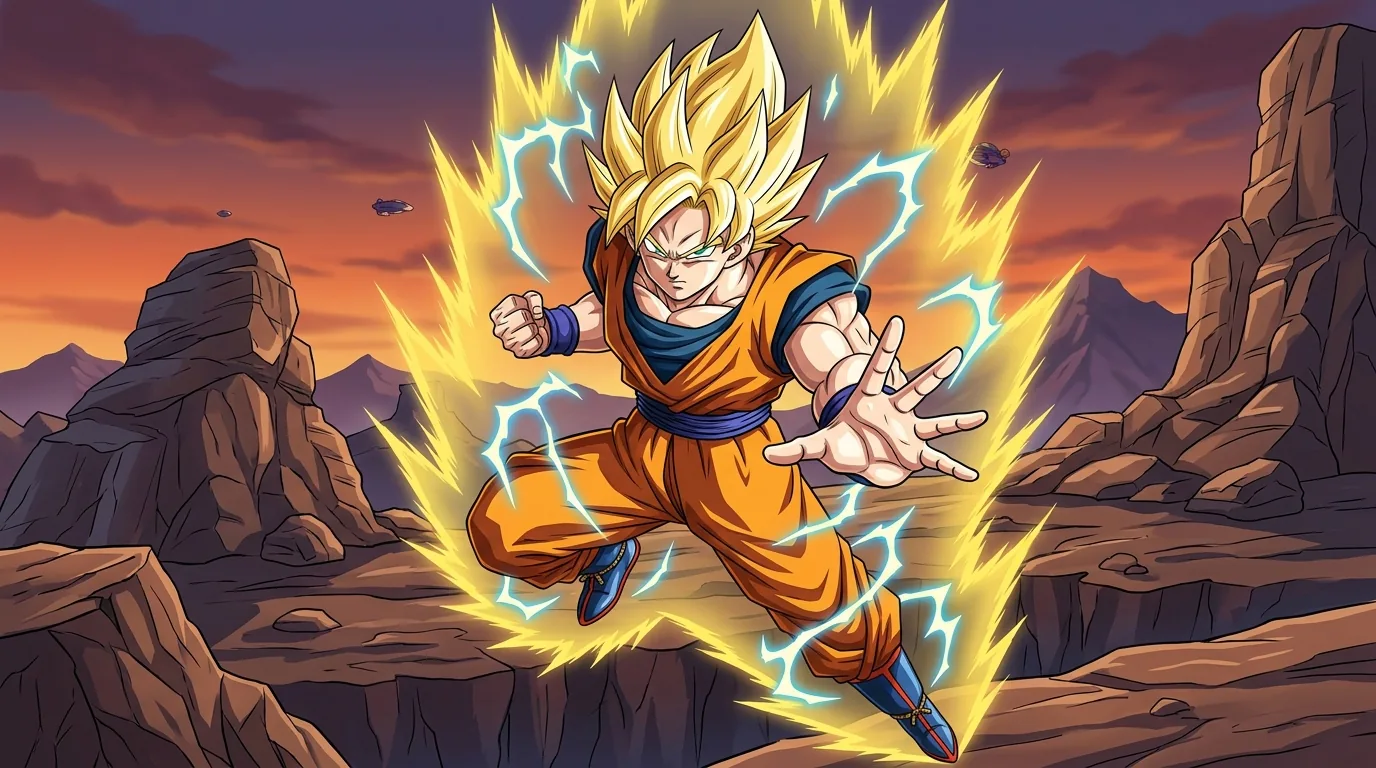
Super Saiyan Full Power
TransformationThe mastered version of the standard Super Saiyan form, achieved by training within the transformation until it becomes the user's natural state. Goku and Gohan developed this approach during their training in the Hyperbolic Time Chamber prior to the Cell Games, choosing to perfect the first Super Saiyan level rather than chase the raw power of the Second and Third Grade stages.
The Mastery Approach
While Vegeta and Future Trunks pursued the graded Super Saiyan stages (Second and Third Grade), seeking more raw power from the transformation, Goku recognized a fundamental problem with that approach. Each grade traded speed for strength, and the Third Grade in particular was so slow that its enormous power became useless against a fast opponent. Rather than climbing higher, Goku chose to dig deeper into the first level.
His strategy was simple in concept but grueling in execution: remain in Super Saiyan constantly, during training, eating, sleeping, and everyday activities, until the form's energy drain disappeared entirely. By doing so, the body would adapt to the transformation to such a degree that maintaining it would require no more effort than breathing. Goku and Gohan spent the majority of their time in the Hyperbolic Time Chamber in Super Saiyan form, enduring the discomfort until it faded.
The Result
When Goku and Gohan emerged from the Time Chamber before the Cell Games, their Super Saiyan forms looked different from what the others expected. Instead of the tense, aggressive appearance of a typical Super Saiyan, they appeared completely relaxed. Their hair was golden but soft, their expressions calm, and their auras barely visible. To an outside observer, it might have seemed like they were weaker, but the reality was the opposite: they had eliminated every weakness the form possessed.


Combat Significance
The Full Power Super Saiyan's greatest advantage is not raw strength but sustainability. A standard Super Saiyan is constantly burning through energy, and even in a fight between equally powerful opponents, the one whose transformation drains less stamina will outlast the other. By reducing that drain to zero, Goku and Gohan could fight at the 50x multiplier indefinitely without worrying about their energy reserves.
This also freed up mental bandwidth for strategy and technique. The aggression and emotional instability of standard Super Saiyan interferes with calm, tactical thinking. In the Full Power state, Goku could fight with the same analytical clarity he brought to his base form, reading opponents, adapting strategies, and timing attacks with precision that the emotional noise of an unmastered transformation would have prevented.
The Cell Games
Goku demonstrated the Full Power Super Saiyan against Cell during their fight at the Cell Games. While he did not match Cell's peak power (Cell had absorbed the Androids and achieved his Perfect Form), Goku's efficiency and composure made the fight far closer than it should have been on paper. He lasted longer and fought more effectively than anyone expected, specifically because his transformation was costing him nothing. When he eventually conceded and passed the fight to Gohan, it was a tactical decision rather than one forced by exhaustion.


Sources & Information
Looking for more on Super Saiyan Full Power? The Dragon Ball Wiki on Fandom has a dedicated page with community notes.
View on FandomThis content is original writing by Daddy Jim Headquarters based on the Dragon Ball anime series, manga, and official materials. Episode and chapter references are cited where applicable.
Character and scene imagery on this site is original artwork by Daddy Jim Headquarters, not screenshots or licensed imagery. Official cover art is used on three types of pages for editorial commentary:
- Movie pages: theatrical posters and key visuals, credited to Toei Animation and Shueisha.
- Game pages: official box art, credited to Bandai Namco, Atari, and other publishers.
- Manga chapter pages: Jump Comics volume covers, credited to Shueisha and Akira Toriyama.
Browse our episode guides:
Official resources:
Dragon Ball Music by Daddy Jim Headquarters
Come listen to some Dragon Ball R&B.
Help Us Keep This Wiki Accurate
Daddy Jim Headquarters maintains this encyclopedia across 13 languages. If you spot an error, a translation issue, or something that doesn't look right, let us know.