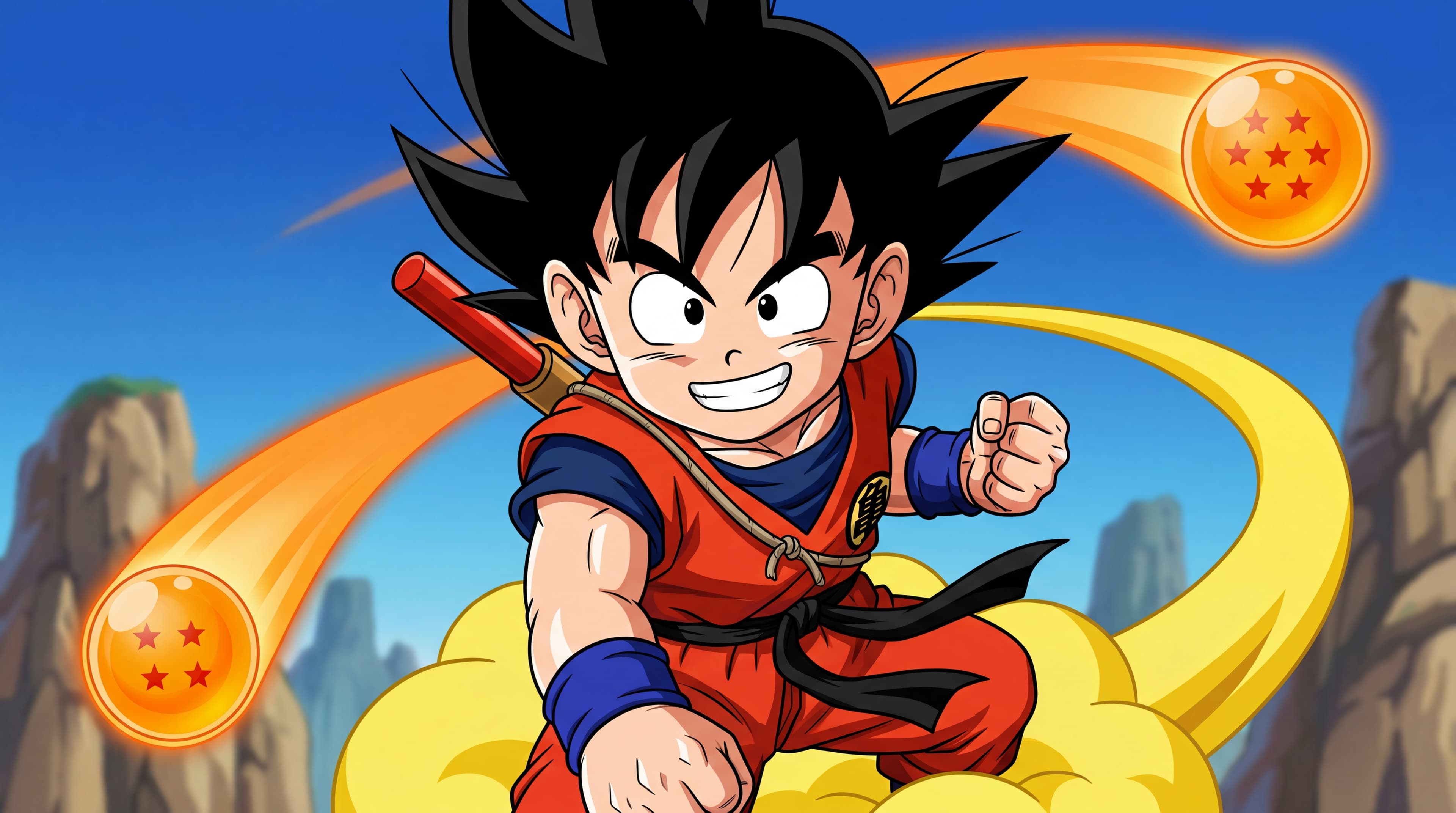
Goku, Krillin, and Bulma navigate deadly pirate traps inside the cave, dodging arrow-filled hallways and a lava pit. General Blue's soldiers are wiped out by the same traps, leaving him to continue alone. The trio finally reaches a port with a giant pirate ship, only to awaken a massive Pirate Robot guarding the treasure.
Arrows, Lava, and Ancient Traps
Deep in the pirate cave, Goku, Krillin, and Bulma reach a room with dot-marked floor tiles and holes lining the walls. When Krillin steps on a dot, an arrow fires inches above his head. They quickly figure out the mechanism: pressure on any dot triggers projectiles from the corresponding wall holes. Goku leaps across easily, and Krillin follows with a running jump that bounces him off the ceiling. Bulma, unable to jump, rides across on the extended Power Pole, complaining the entire way.
The Lava Pit
They enter a room lit through decorative skulls in the walls. The floor gives way beneath them, revealing a pit of boiling lava below. Goku grabs the ledge while Bulma clings to him and Krillin hangs from Bulma's legs. A lava bubble singes Bulma's clothing as Goku uses the Power Pole to swing them back to safety. They creep around the hole and continue deeper into the tunnel system.
Blue Walks Alone
Behind them, General Blue sends his soldiers ahead to scout. They rush through the arrow room and are killed by the trap, leaving Blue as the sole survivor. Rather than risk the same fate, he finds a hidden passage and bypasses the room entirely. He also encounters and strangles a giant electric eel bare-handed. Both groups eventually converge on an underground port housing a massive pirate ship. As Goku's group approaches a stack of crates, two mechanical eyes light up and a colossal Pirate Robot emerges, its claws slashing at anyone in reach.

Dungeons and Dragon Balls
The arrow hallway sequence plays like a video game dungeon, complete with pressure-plate triggers and projectile hazards. Krillin bouncing off the ceiling and accidentally triggering extra arrows is a perfect blend of physical comedy and genuine danger. Bulma's complaints while riding the Power Pole add a layer of absurdity to an already tense scene.
Commander Red's Portrait
At Red Ribbon Headquarters, Commander Red has his portrait painted. The finished work depicts him as tall and imposing, standing over a diminished Staff Officer Black. This moment of vanity foreshadows Red's true wish for the Dragon Balls, planting a seed that will pay off much later in the saga.
Blue's Resourcefulness
General Blue's solo navigation of the cave showcases a different kind of villain. He finds the hidden passage, fights the electric eel with his bare hands, and keeps moving forward without hesitation. While his soldiers fall to traps, Blue adapts and survives, proving he earned his rank through more than just cruelty.
Related Reading
See all
Namek Has No Women, and Piccolo Pulls Anyway
There are no women on Namek. That isn't an oversight, it's the biology. Why we handed Piccolo the one thing his own species rules out, and why it had to be trap soul....
1000 Times Over: Who Is John Dragon Ball Singing To?
Dragon Ball handed us a protagonist with no history and the internet named him John Dragon Ball. So we built him somebody to talk to....


Pirates and Foreshadowing
The lava pit and General Blue's electric eel fight are both anime-exclusive additions that expand the cave's danger beyond what appears in the manga. Commander Red's portrait scene is also anime-only, though it cleverly foreshadows the revelation about Red's selfish wish.
The Pirate Robot that activates at the episode's end is a major set piece that will dominate the next episode. Throughout this episode, Blue's armband is misspelled as "BULE," one of the more noticeable animation errors in the original Dragon Ball series.
Frequently Asked Questions
What happens in the Dragon Ball episode "The Trap is Sprung"?
Goku, Krillin, and Bulma navigate deadly pirate traps inside the cave, dodging arrow-filled hallways and a lava pit. General Blue's soldiers are wiped out by the same traps, leaving him to continue alone. The trio finally reaches a port with a giant pirate ship, only to awaken a massive Pirate Robot guarding the treasure.
Which episode of Dragon Ball is "The Trap is Sprung"?
"The Trap is Sprung" is episode 50 of the original Dragon Ball anime. It is part of the General Blue Saga. Goku, Krillin, and Bulma navigate deadly pirate traps inside the cave, dodging arrow-filled hallways and a lava pit.
What is the most important moment in the Dragon Ball episode "The Trap is Sprung"?
Deep in the pirate cave, Goku, Krillin, and Bulma reach a room with dot-marked floor tiles and holes lining the walls. When Krillin steps on a dot, an arrow fires inches above his head. They rush through the arrow room and are killed by the trap, leaving Blue as the sole survivor.
Who is the main antagonist in the Dragon Ball episode "The Trap is Sprung"?
The episode's primary antagonist is General Blue. Commander Red and Staff Officer Black also feature as threats. Goku, Krillin, and Bulma navigate deadly pirate traps inside the cave, dodging arrow-filled hallways and a lava pit.
How does the Dragon Ball episode "The Trap is Sprung" compare to the manga?
The lava pit and General Blue's electric eel fight are both anime-exclusive additions that expand the cave's danger beyond what appears in the manga. Commander Red's portrait scene is also anime-only, though it cleverly foreshadows the revelation about Red's selfish wish.
Sources & Information
Looking for more on The Trap is Sprung? The Dragon Ball Wiki on Fandom has a dedicated page with community notes.
View on FandomThis content is original writing by Daddy Jim Headquarters based on the Dragon Ball anime series, manga, and official materials. Episode and chapter references are cited where applicable.
Rights holders
- Created byAkira Toriyama
- Published byShueisha
- Animated byToei Animation
All rights belong to their respective owners.
Character and scene imagery on this site is original artwork by Daddy Jim Headquarters, not screenshots or licensed imagery. Official cover art is used on three types of pages for editorial commentary:
- Movie pages: theatrical posters and key visuals, credited to Toei Animation and Shueisha.
- Game pages: official box art, credited to Bandai Namco, Atari, and other publishers.
- Manga chapter pages: Jump Comics volume covers, credited to Shueisha and Akira Toriyama.
Browse our episode guides:
Official resources:
Help Us Keep This Wiki Accurate
Daddy Jim Headquarters maintains this encyclopedia. If you spot an error, a translation issue, or something that doesn't look right, let us know.