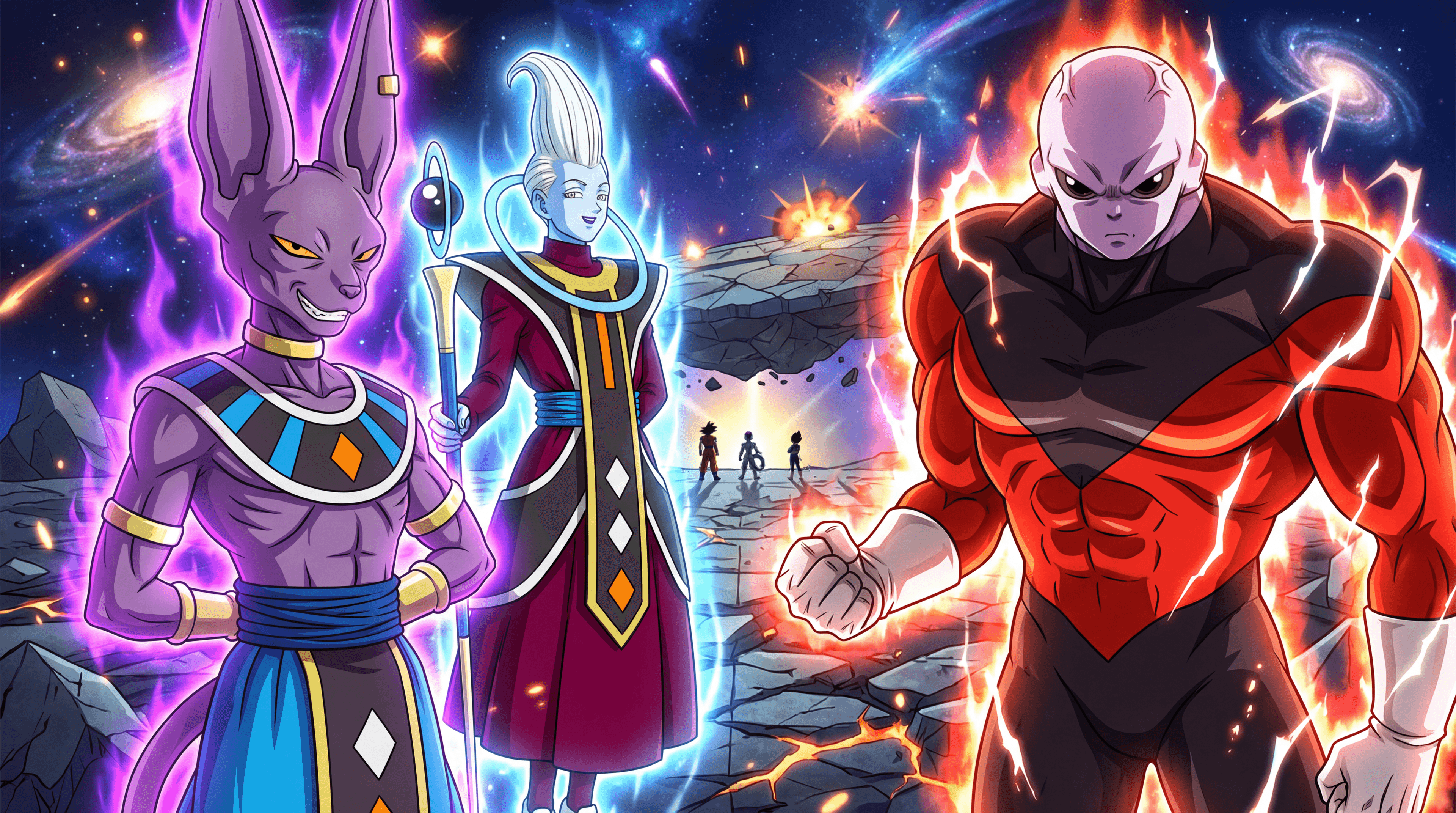
Shenron reveals that a Super Saiyan God requires five righteous Saiyans to pour their hearts into a sixth. With only four available, all hope seems lost until Videl reveals she is carrying Gohan's child. The ritual succeeds, and Goku is reborn in crimson.
Six Hearts, One God, a Miracle in Red
With the Dragon Balls gathered, Shenron erupts from the sea in a pillar of light. The Eternal Dragon immediately spots Beerus among the crowd and visibly cowers, greeting the God of Destruction with trembling reverence. It is a striking image: the wish-granting dragon, a being of immense power in his own right, reduced to nervous formality before Beerus.
Goku asks Shenron to produce the Super Saiyan God. The dragon explains that no such being currently exists. However, ancient Namekian texts describe a ritual: five Saiyans with pure hearts must join hands and channel their spiritual energy into a sixth righteous Saiyan. Only then will the god of the Saiyans be born. With that explanation delivered, Shenron offers an unusually respectful farewell to Beerus and vanishes.
The math does not add up. Goku, Gohan, Goten, Trunks, and Vegeta make five Saiyans total, but one of them must be the recipient. That leaves only four to perform the ritual. Master Roshi defends Vegeta's purity of heart, noting his evolution since the Buu Saga, and Chi-Chi adds that he has become a devoted family man. Still, they need six.
The first attempt fails. The five Saiyans hold hands and channel their ki into Goku, but Whis points out that Shenron said 'hearts,' not 'ki.' Even with the correction, they are still one Saiyan short. As Beerus begins charging a planet-destroying attack, Videl steps forward with earth-shaking news: she is pregnant with Gohan's child. The room erupts in celebration before refocusing on the task.
With Videl joining the circle, carrying her quarter-Saiyan baby within her, the ritual begins again. Golden energy flows from the five Saiyans, causing Videl's hair to shimmer with a blonde hue. The ocean churns into a violent whirlpool. A colossal beam of light pierces the clouds. When the glow fades, Goku stands transformed: thinner, younger-looking, radiating crimson energy, with bright red hair. Dende confirms it. Goku has become a Super Saiyan God.
The Collective Power of Connection
The Super Saiyan God ritual introduces a fundamentally different philosophy of power to Dragon Ball. Previous transformations were achieved through individual effort, suffering, or rage. Super Saiyan God requires community. It demands that warriors set aside their egos and literally pour their hearts into someone else. For a franchise built on solo training arcs and personal breakthroughs, this is revolutionary.
Vegeta agreeing to participate, actively empowering Goku rather than competing with him, represents one of the saga's quietest but most significant character beats. His complaint about Goku getting the honor feels perfunctory. He does it anyway because Earth's survival matters more than his rivalry.
Videl's pregnancy reveal serves double narrative duty. It solves the immediate mathematical problem of needing six Saiyans, but it also announces the arrival of Pan, the next generation of Saiyan heritage. In a single scene, the story resolves its present crisis and plants a seed for the future.
The Birth of a New Transformation
Super Saiyan God's debut marks the first entirely new transformation tier since Super Saiyan 3 was introduced during the Buu Saga. Its design, a leaner build with vivid red hair and a fiery aura, was a deliberate departure from the increasingly bulky and dramatic forms that preceded it. The message is clear: divine power does not need to look aggressive to be overwhelming.
The manga condensed this entire episode into a single page, glossing over Shenron's explanation and skipping the failed first attempt entirely. The anime's extended treatment gives the ritual proper weight, letting the audience feel both the desperation of the failed attempt and the triumph of the successful one.
Shenron's fear of Beerus is a wonderful worldbuilding detail. The Eternal Dragon exists to grant any wish within his power, yet even he recognizes a hierarchy that places the God of Destruction far above himself. It quietly reinforces just how extraordinary the being Goku is about to fight truly is.
Related Reading
See all
Krillin's on the Tinder: How the Ultimate Short King Survived the Height Filter
Tinder built a height filter. Dragon Ball built a five foot legend. What happened when we sent the ultimate short king into the modern dating hellscape....
Infinite Zeni Glitch: When Yamcha Never Pays and Mr. Popo Always Does
The internet found an infinite money glitch. So did Yamcha. A smooth R&B track about the easiest money in the Dragon Ball world and the one man who keeps paying for it....
Frequently Asked Questions
What happens in "Thanks for Waiting, Lord Beerus! A Super Saiyan God Is Born at Last!"?
Shenron reveals that a Super Saiyan God requires five righteous Saiyans to pour their hearts into a sixth. With only four available, all hope seems lost until Videl reveals she is carrying Gohan's child. The ritual succeeds, and Goku is reborn in crimson.
Which Dragon Ball series is "Thanks for Waiting, Lord Beerus! A Super Saiyan God Is Born at Last!" from?
"Thanks for Waiting, Lord Beerus! A Super Saiyan God Is Born at Last!" is episode 9 of Dragon Ball Super. Shenron reveals that a Super Saiyan God requires five righteous Saiyans to pour their hearts into a sixth.
How does "Thanks for Waiting, Lord Beerus! A Super Saiyan God Is Born at Last!" begin?
With the Dragon Balls gathered, Shenron erupts from the sea in a pillar of light. The Eternal Dragon immediately spots Beerus among the crowd and visibly cowers, greeting the God of Destruction with trembling reverence. It is a striking image: the wish-granting dragon, a being of immense power in his own right, reduced to nervous formality before Beerus.
What is the middle act of "Thanks for Waiting, Lord Beerus! A Super Saiyan God Is Born at Last!"?
The Super Saiyan God ritual introduces a fundamentally different philosophy of power to Dragon Ball. Previous transformations were achieved through individual effort, suffering, or rage. Super Saiyan God requires community.
How does "Thanks for Waiting, Lord Beerus! A Super Saiyan God Is Born at Last!" end?
Super Saiyan God's debut marks the first entirely new transformation tier since Super Saiyan 3 was introduced during the Buu Saga. Its design, a leaner build with vivid red hair and a fiery aura, was a deliberate departure from the increasingly bulky and dramatic forms that preceded it. The message is clear: divine power does not need to look aggressive to be overwhelming.
Sources & Information
Looking for more on Thanks for Waiting, Lord Beerus! A Super Saiyan God Is Born at Last!? The Dragon Ball Wiki on Fandom has a dedicated page with community notes.
View on FandomThis content is original writing by Daddy Jim Headquarters based on the Dragon Ball anime series, manga, and official materials. Episode and chapter references are cited where applicable.
Character and scene imagery on this site is original artwork by Daddy Jim Headquarters, not screenshots or licensed imagery. Official cover art is used on three types of pages for editorial commentary:
- Movie pages: theatrical posters and key visuals, credited to Toei Animation and Shueisha.
- Game pages: official box art, credited to Bandai Namco, Atari, and other publishers.
- Manga chapter pages: Jump Comics volume covers, credited to Shueisha and Akira Toriyama.
Browse our episode guides:
Official resources:
Help Us Keep This Wiki Accurate
Daddy Jim Headquarters maintains this encyclopedia. If you spot an error, a translation issue, or something that doesn't look right, let us know.