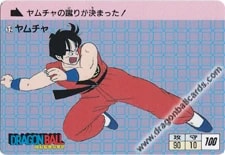
Dragon Ball Carddass
GameDragon Ball Carddass is a trading card series made by Bandai in 1991. They were made in Japan and only released in Japan, and could be obtained through putting money in a card machine. In addition to characters from the Dragon Ball franchise, the game features Diora, the main character in Akira Toriyama's Saving Soldier Cashman manga, which was published around the time the Dragon Ball Carddass started. The Dragon Ball Carddass spawned the Data Carddass Dragon Ball Z arcade games in 2005.
Card System
Dragon Ball Carddass is a vending machine trading card series produced by Bandai, first launched in Japan in 1991. Cards were sold through dedicated card vending machines that dispensed random cards in exchange for coins, a format that was enormously popular in Japan throughout the 1990s. The series ran for 30 parts total, spanning content from the original Dragon Ball series through Dragon Ball Z and Dragon Ball GT, making it one of the longest-running Dragon Ball collectible series of its era.
The cards themselves are primarily collector items featuring art drawn from the anime, covering characters, locations, battles, and iconic moments across all three series. Rare prism cards, distinguished by their reflective foil finish, were distributed in limited quantities per part, driving competitive collecting behavior among fans. Parts 1 and 2 covered Dragon Ball with six rare prism cards each, while the bulk of the series from Parts 3 through 25 was dedicated to Dragon Ball Z. Parts 26 through 30 concluded the run with Dragon Ball GT content. Binders branded for both the Z and GT card sets were also released to help collectors organize their cards.



Series Content
The Dragon Ball Carddass series covers an extraordinary breadth of content across its 30 parts. The earliest Dragon Ball parts draw from the full original series, from the Emperor Pilaf Saga through the Piccolo Jr. Saga, with prism cards highlighting iconic moments like Kid Goku and Teen Goku firing the Kamehameha and the confrontation with King Piccolo. The Z-era cards, comprising the majority of the series, document the Saiyan Saga, Frieza Saga, Android and Cell Sagas, and the Buu Saga with the depth and variety those story arcs deserve.
The series also features a notable inclusion outside the Dragon Ball universe: Diora, the protagonist of Akira Toriyama's Saving Soldier Cashman manga, which was serialized at the same time the Carddass series began. This crossover reflects the close alignment between Bandai's merchandise strategy and Toriyama's active creative output during the period. Dragon Ball GT cards in the final five parts extend the collectible timeline through the end of that continuation series, completing a document of the entire Dragon Ball franchise up to that point.
Legacy & Impact
Dragon Ball Carddass is historically significant as the origin of what would eventually become the Data Carddass Dragon Ball Z arcade game series. The Carddass format's integration of collecting with interactive play, first explored in the original vending machine cards, was developed further into full arcade game systems when Dimps and Bandai launched the Data Carddass arcade titles in 2005. The lineage from a simple vending machine card in 1991 to a sophisticated arcade fighting game in 2005 represents one of the more interesting product evolution stories in Dragon Ball merchandise history.
Original Carddass cards from the early 1990s have become genuine collector's items, particularly the rare prism variants. Complete Part collections in good condition are sought after by fans who associate the series with the formative years of Dragon Ball Z's Japanese broadcast, making them as much a piece of cultural memory as merchandise.
Related Reading
See all
Chiaotzu is Chi-Chi's Boo: Why the Guy Who Never Wins Finally Wins
The least likely man in Dragon Ball just took the biggest win in our catalog. The story behind our R&B record about Chiaotzu, Chi-Chi, and a house Goku is never in....

Krillin's on the Tinder: How the Ultimate Short King Survived the Height Filter
Tinder built a height filter. Dragon Ball built a five foot legend. What happened when we sent the ultimate short king into the modern dating hellscape....

Frequently Asked Questions
What is Dragon Ball Carddass?
Dragon Ball Carddass is a trading card series made by Bandai in 1991. They were made in Japan and only released in Japan, and could be obtained through putting money in a card machine. In addition to characters from the Dragon Ball franchise, the game features Diora, the main character in Akira Toriyama's Saving Soldier Cashman manga, which was published around the time the Dragon Ball Carddass started.
What is Dragon Ball Carddass about?
Dragon Ball Carddass is a vending machine trading card series produced by Bandai, first launched in Japan in 1991. Cards were sold through dedicated card vending machines that dispensed random cards in exchange for coins, a format that was enormously popular in Japan throughout the 1990s. The series ran for 30 parts total, spanning content from the original Dragon Ball series through Dragon Ball Z and Dragon Ball GT, making it one of the longest-running Dragon Ball collectible series of its era.
When was Dragon Ball Carddass released?
Dragon Ball Carddass was released in 1991. Dragon Ball Carddass is a trading card series made by Bandai in 1991.
What platforms is Dragon Ball Carddass available on?
Dragon Ball Carddass was released on Android. The game first launched in 1991.
Which Dragon Ball era does Dragon Ball Carddass tie into?
Dragon Ball Carddass ties into the Carddass era of the franchise. Dragon Ball Carddass is a trading card series made by Bandai in 1991.
Sources & Information
Looking for more on Dragon Ball Carddass? The Dragon Ball Wiki on Fandom has a dedicated page with community notes.
View on FandomThis content is original writing by Daddy Jim Headquarters based on the Dragon Ball anime series, manga, and official materials. Episode and chapter references are cited where applicable.
Character and scene imagery on this site is original artwork by Daddy Jim Headquarters, not screenshots or licensed imagery. Official cover art is used on three types of pages for editorial commentary:
- Movie pages: theatrical posters and key visuals, credited to Toei Animation and Shueisha.
- Game pages: official box art, credited to Bandai Namco, Atari, and other publishers.
- Manga chapter pages: Jump Comics volume covers, credited to Shueisha and Akira Toriyama.
Browse our episode guides:
Official resources:
Help Us Keep This Wiki Accurate
Daddy Jim Headquarters maintains this encyclopedia. If you spot an error, a translation issue, or something that doesn't look right, let us know.