Gameplay
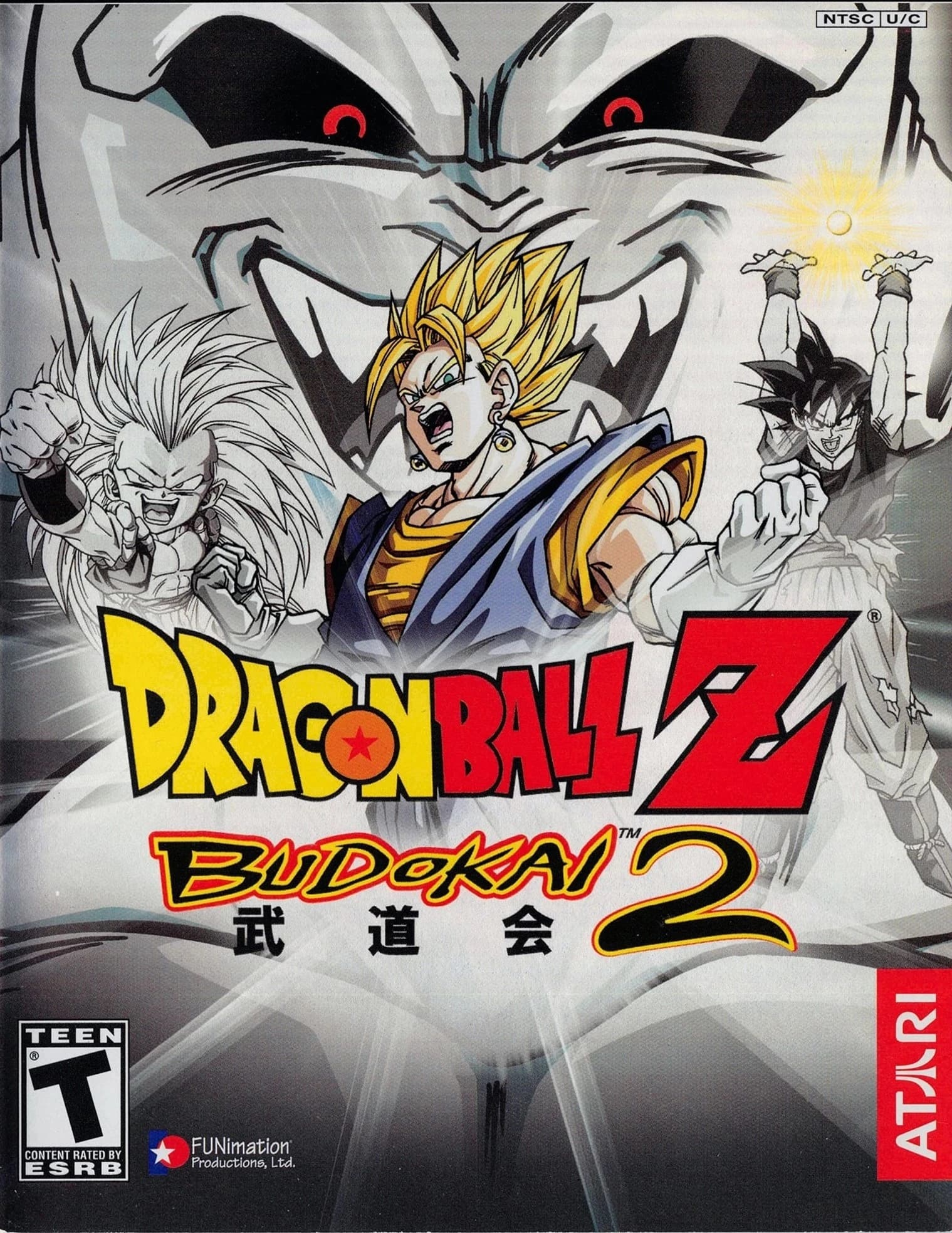
Dragon Ball Z: Budokai 2 is a 2.5D fighting game developed by Dimps and published by Atari for PlayStation 2 and GameCube. Battles take place on a plane where characters move, dodge, guard, and execute combos by chaining punch, kick, and energy button inputs together with directional commands. The Ki gauge governs special and ultimate attacks; specials consume a modest number of Ki bars while ultimate attacks require more complex button sequences and often demand additional timing input, stick rotation to build power, or a struggle mechanic in which both players rotate their sticks to outperform each other. Budokai 2 is the first game in the series to introduce button sequences for executing certain attacks, including continuous ki blasts and ultimate moves.
Each character can be customized using a seven-slot skill tray. Three categories of skills are available: Special Moves covering techniques like the Kamehameha and Super Saiyan transformation, Physical abilities including advanced strike techniques, and Equipment items such as the Senzu Bean. Collecting all seven Dragon Balls during Story mode allows the player to summon Shenron and choose from special capsule rewards including Breakthrough Capsules that unlock every move and ability for a single character simultaneously.
Story mode takes the form of an interactive game board called Dragon World, where the player navigates nine different saga boards as Goku alongside a roster of unlockable allies. Enemies, items, capsules, and Dragon Balls are scattered across each board. Dueling mode supports human-versus-human competition or player versus computer matches at adjustable skill levels, and allows computer-controlled fighters to face each other for spectator play.

Story and New Features
Budokai 2 extends the narrative coverage of its predecessor by carrying the story from the beginning of Dragon Ball Z all the way through the Kid Buu Saga. Where Budokai concluded with the Android Saga, Budokai 2 introduces characters and transformations from the Majin Buu arc, including Adult Gohan, Majin Buu, and the highest Super Saiyan levels seen in the series. Several characters present in Budokai, including Kid Gohan, Zarbon, Dodoria, and Android 19, are absent from this entry, while Frieza and Cell appear in their final forms by default rather than progressing through transformations mid-fight.
A major addition is the introduction of fusion characters. Vegito and Gotenks are not selected from the character roster in the traditional way; instead, fusions are performed mid-fight using either Potara earrings or the Fusion Dance, depending on the characters involved. What-if fusions also appear, including Tiencha, the combination of Yamcha and Tien Shinhan, and Gokule, the fusion of Goku and Hercule. Super Buu gains several additional absorption forms beyond those seen in the anime, including versions with Vegeta, Cell, Frieza, and Tien and Yamcha absorbed. Story mode introduces original enemies such as Majin Frieza and Majin Cell as boss encounters.
The game board structure of Dragon World represents a meaningful departure from the chapter-based layout of the original Budokai, giving the story mode a more exploratory quality. Players move pieces across saga-specific boards, encountering enemies and collecting resources while pursuing the narrative toward each saga's conclusion.
Related Reading
See all
Namek Has No Women, and Piccolo Pulls Anyway
There are no women on Namek. That isn't an oversight, it's the biology. Why we handed Piccolo the one thing his own species rules out, and why it had to be trap soul....
1000 Times Over: Who Is John Dragon Ball Singing To?
Dragon Ball handed us a protagonist with no history and the internet named him John Dragon Ball. So we built him somebody to talk to....

Reception and Legacy
Budokai 2 arrived as the Dragon Ball Z fighting game series was building commercial momentum in Western markets. The expanded story coverage, fusion mechanics, and what-if content gave it greater breadth than its predecessor, and the game board structure of Dragon World offered a mode that felt meaningfully different from a conventional fighting game story presentation. The GameCube version, released more than a year after the PlayStation 2 version, used the additional development time to improve graphics, add difficulty settings, and introduce new costumes.
The game is regarded as a competent expansion of the Budokai framework, though it is most often discussed in the context of what Budokai 3 would subsequently accomplish. Its introduction of mid-fight fusion as a mechanical system was a notable innovation within the series, establishing a precedent that later entries would refine. Both Budokai 2 and its sequel were included in the 2012 Dragon Ball Z: Budokai HD Collection, which updated their graphics and replaced their soundtracks following the plagiarism controversy surrounding composer Kenji Yamamoto.
Frequently Asked Questions
When did DBZ Budokai 2 come out?
Dragon Ball Z: Budokai 2 was released in 2012. It was developed by Dimps and published by Bandai / Atari.
What is Dragon Ball Z: Budokai 2?
Dragon Ball Z: Budokai 2 is a video game based upon Dragon Ball Z. Budokai 2 is a sequel to Dragon Ball Z: Budokai and was developed by Dimps and published by Atari for the and.
Which characters appear in Dragon Ball Z: Budokai 2?
Budokai 2 extends the narrative coverage of its predecessor by carrying the story from the beginning of Dragon Ball Z all the way through the Kid Buu Saga. Where Budokai concluded with the Android Saga, Budokai 2 introduces characters and transformations from the Majin Buu arc, including Adult Gohan, Majin Buu, and the highest Super Saiyan levels seen in the series. Several characters present in Budokai, including Kid Gohan, Zarbon, Dodoria, and Android 19, are absent from this entry, while Frieza and Cell appear in their final forms by default rather than progressing through transformations mid-fight.
What is Dragon Ball Z: Budokai 2 about?
Dragon Ball Z: Budokai 2 is a 2.5D fighting game developed by Dimps and published by Atari for PlayStation 2 and GameCube. Battles take place on a plane where characters move, dodge, guard, and execute combos by chaining punch, kick, and energy button inputs together with directional commands. The Ki gauge governs special and ultimate attacks; specials consume a modest number of Ki bars while ultimate attacks require more complex button sequences and often demand additional timing input, stick rotation to build power, or a struggle mechanic in which both players rotate their sticks to outperform each other.
Who developed Dragon Ball Z: Budokai 2?
Dragon Ball Z: Budokai 2 was developed by Dimps. The game was published by Bandai / Atari in 2012.
Sources & Information
Looking for more on Dragon Ball Z: Budokai 2? The Dragon Ball Wiki on Fandom has a dedicated page with community notes.
View on FandomThis content is original writing by Daddy Jim Headquarters based on the Dragon Ball anime series, manga, and official materials. Episode and chapter references are cited where applicable.
Rights holders
- Created byAkira Toriyama
- Published byShueisha
- Animated byToei Animation
All rights belong to their respective owners.
Character and scene imagery on this site is original artwork by Daddy Jim Headquarters, not screenshots or licensed imagery. Official cover art is used on three types of pages for editorial commentary:
- Movie pages: theatrical posters and key visuals, credited to Toei Animation and Shueisha.
- Game pages: official box art, credited to Bandai Namco, Atari, and other publishers.
- Manga chapter pages: Jump Comics volume covers, credited to Shueisha and Akira Toriyama.
Browse our episode guides:
Official resources:
Help Us Keep This Wiki Accurate
Daddy Jim Headquarters maintains this encyclopedia. If you spot an error, a translation issue, or something that doesn't look right, let us know.