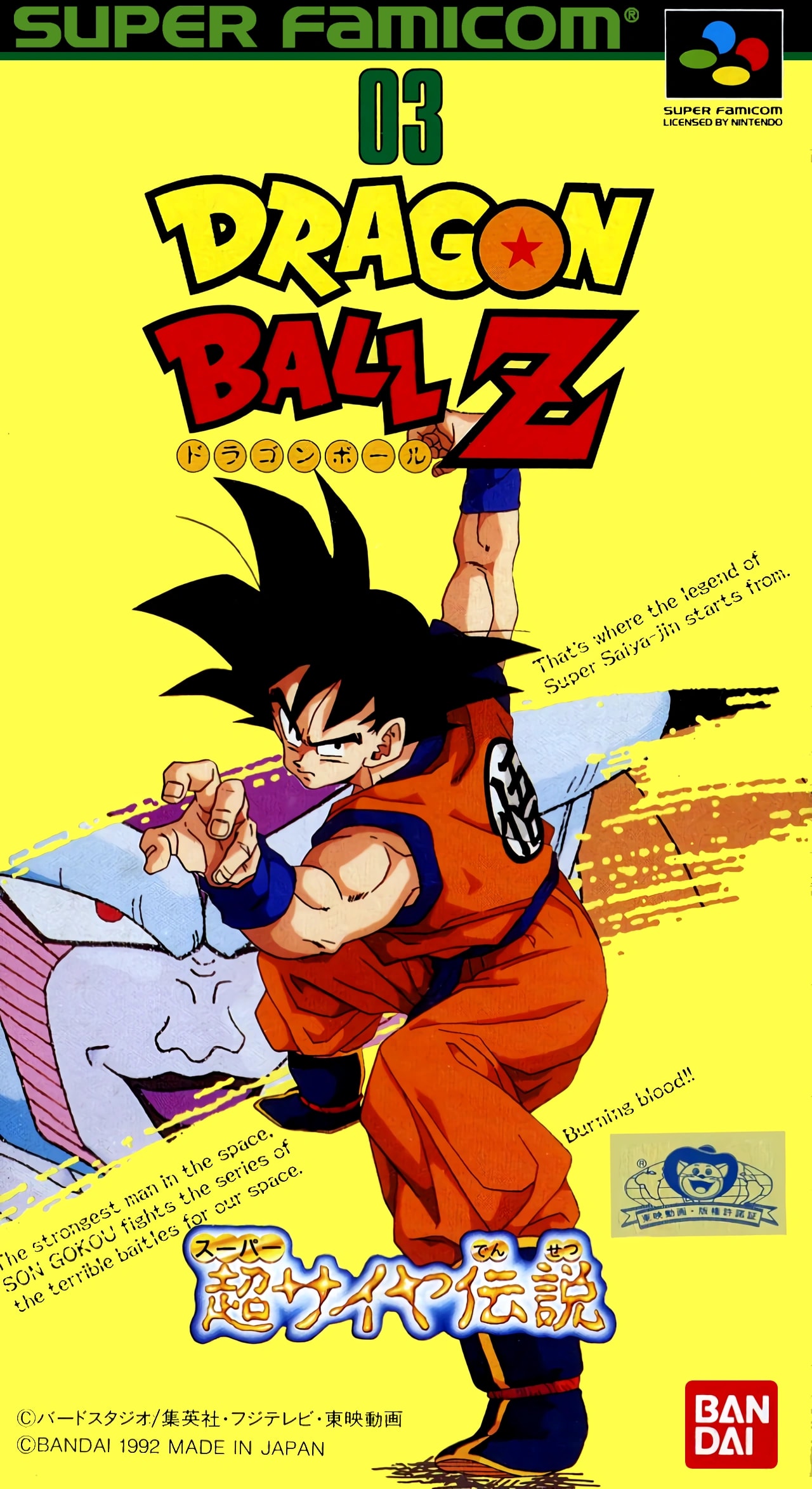
Dragon Ball Z: Super Saiya Densetsu
GameDragon Ball Z: Super Saiya Densetsuサイヤ伝説|Doragon Bōru Zetto Sūpā Saiya Densetsu|lit. Dragon Ball Z: Super Saiya Legend}} is a role playing video game and the first Dragon Ball game for the Super Famicom. It was released only in Japan on January 25, 1992.
Gameplay
Dragon Ball Z: Super Saiya Densetsu is a role-playing game released exclusively in Japan on January 25, 1992, as the first Dragon Ball game for the Super Famicom. It is a remake that combines two earlier Famicom titles, Dragon Ball Z: Kyoshu! Saiyan and Dragon Ball Z II: Gekishin Freeza, reworked without the movie characters and anime filler content from those games. The story covers the Vegeta, Namek, and Frieza Sagas with edits to fit the RPG framework, including the introduction of multi-colored Saibamen and recolored versions of Frieza's soldiers as recurring enemies.
The combat system is built around a card-based mechanic in which each combatant draws five randomly generated cards per turn. Cards fall into four categories: Normal Attack (white), Strong Attack (yellow), Ginyu Attack (black), and Ki Attack (blue). Each card type carries an attack power value and a defense value, and attack order within a turn is determined first by attack power, then by defense power, and finally by character Power Level when both stats are equal. Ki Attack cards consume one Ki use per play and are ranked by the number of stars on a Dragon Ball icon in the corner, with Z-ranked cards being the most powerful.
Items and upgrade opportunities are available at Fortuneteller Baba's store and a Namekian merchant who replaces her once the story advances to Namek. A training center allows characters to increase their Ki rating by destroying a rock, and players can fight optional enemy waves for zeni. Scouters can be purchased and used to check enemy strength numerically, though they may explode when used against enemies with power levels too high to register. Captain Ginyu's body-swap ability allows players to temporarily take the body of any character, though the exchange reverts after each battle.
Story
Super Saiya Densetsu follows the Saiyan invasion of Earth, the journey to Namek, and the extended confrontation with Frieza and the Ginyu Force. The playable cast includes Goku, Piccolo, Gohan, Krillin, Yamcha, Tien Shinhan, Chiaotzu, Dende, two Namekian warriors named Maima and Tsumuri, Vegeta, Nail, and Captain Ginyu via body exchange. Bulma accompanies the party throughout much of the game, serving as a rest point on both Earth and Namek. Grand Elder Guru empowers all party members when visited on Namek, providing a crucial stat boost tied to the story.
Frieza is encountered multiple times in escalating forms, with recolored versions of defeated enemies recycled as intermediate threats between major confrontations. The inclusion of a secret post-credits battle against Super Saiyan Vegeta, accessible only if the player sacrifices an ally to trigger Goku's Super Saiyan transformation and keeps Goku alive through the final fight, rewards players who follow specific conditions with a hidden encounter not present in the source anime.
Context and Legacy
Super Saiya Densetsu holds the distinction of being the first Dragon Ball game on the Super Famicom, establishing the franchise's presence on Nintendo's 16-bit hardware early in the console's lifespan. As a compilation remake of two Famicom RPGs, it gave Super Famicom owners access to the Dragon Ball Z RPG formula without requiring ownership of the older hardware. The removal of movie and filler content in favor of manga-accurate events reflected a design philosophy that prioritized the canonical story over expanded universe material.
The card-based combat system distinguishes Super Saiya Densetsu from both the action RPGs and fighting games that made up most of the Dragon Ball game library, giving it a strategic identity that remains unique in the franchise. The secret Super Saiyan Vegeta battle after the credits is an early example of a post-game challenge hidden behind specific play conditions, anticipating design trends that would become common in RPGs years later. Super Saiya Densetsu is regarded as a technically ambitious and creatively distinct starting point for the Dragon Ball franchise on Super Famicom hardware.
Related Reading
See all
Chiaotzu is Chi-Chi's Boo: Why the Guy Who Never Wins Finally Wins
The least likely man in Dragon Ball just took the biggest win in our catalog. The story behind our R&B record about Chiaotzu, Chi-Chi, and a house Goku is never in....
Krillin's on the Tinder: How the Ultimate Short King Survived the Height Filter
Tinder built a height filter. Dragon Ball built a five foot legend. What happened when we sent the ultimate short king into the modern dating hellscape....
Frequently Asked Questions
What is Dragon Ball Z: Super Saiya Densetsu?
Dragon Ball Z: Super Saiya Densetsu is a role-playing game released exclusively in Japan on January 25, 1992, as the first Dragon Ball game for the Super Famicom. It is a remake that combines two earlier Famicom titles, Dragon Ball Z: Kyoshu! Saiyan and Dragon Ball Z II: Gekishin Freeza, reworked without the movie characters and anime filler content from those games.
When was Dragon Ball Z: Super Saiya Densetsu released?
Dragon Ball Z: Super Saiya Densetsu was released in 1992. Bandai published it as part of the Dragon Ball Z game series.
Who published Dragon Ball Z: Super Saiya Densetsu?
Dragon Ball Z: Super Saiya Densetsu was published by Bandai. The release came in 1992.
What genre is Dragon Ball Z: Super Saiya Densetsu?
Dragon Ball Z: Super Saiya Densetsu is an rpg/card battle. It belongs to the Dragon Ball Z game series and launched in 1992.
What Dragon Ball series does Dragon Ball Z: Super Saiya Densetsu belong to?
Dragon Ball Z: Super Saiya Densetsu is part of the Dragon Ball Z game series. It is an rpg/card battle that launched in 1992.
Sources & Information
Looking for more on Dragon Ball Z: Super Saiya Densetsu? The Dragon Ball Wiki on Fandom has a dedicated page with community notes.
View on FandomThis content is original writing by Daddy Jim Headquarters based on the Dragon Ball anime series, manga, and official materials. Episode and chapter references are cited where applicable.
Character and scene imagery on this site is original artwork by Daddy Jim Headquarters, not screenshots or licensed imagery. Official cover art is used on three types of pages for editorial commentary:
- Movie pages: theatrical posters and key visuals, credited to Toei Animation and Shueisha.
- Game pages: official box art, credited to Bandai Namco, Atari, and other publishers.
- Manga chapter pages: Jump Comics volume covers, credited to Shueisha and Akira Toriyama.
Browse our episode guides:
Official resources:
Help Us Keep This Wiki Accurate
Daddy Jim Headquarters maintains this encyclopedia. If you spot an error, a translation issue, or something that doesn't look right, let us know.