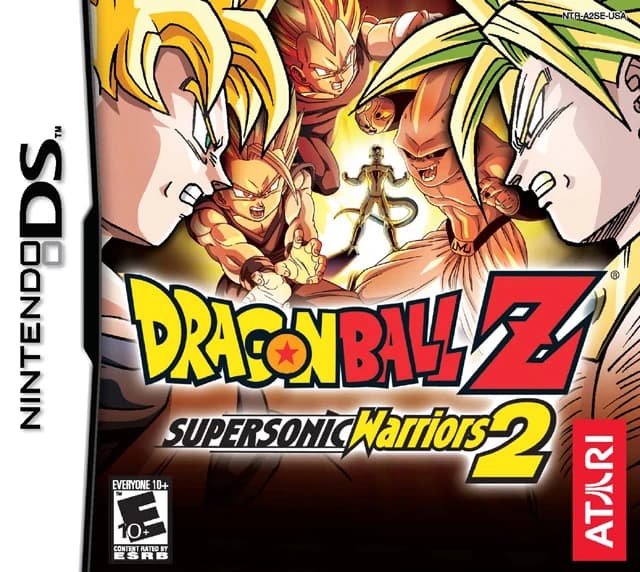
Dragon Ball Z: Supersonic Warriors 2
GameDragon Ball Z: Supersonic Warriors 2 is a fighting video game based upon the popular anime series Dragon Ball Z. Supersonic Warriors 2 is the sequel to Dragon Ball Z: Supersonic Warriors, and was developed by Cavia and published by Atari for the Nintendo DS. It was released in 2005.
Gameplay
Dragon Ball Z: Supersonic Warriors 2 is a 2D fighting game developed by Cavia and published by Atari for the Nintendo DS, released in 2005 as the sequel to Dragon Ball Z: Supersonic Warriors. Players assemble a team of three characters to fight against enemy teams or a second player. The Nintendo DS touch screen is used to summon support characters and execute team attacks, integrating the handheld's dual-screen capabilities into the combat framework. The ki gauge has been expanded from 100 to 200 compared to the first game, providing more resource to spend on advanced techniques.
Several new combat mechanics distinguish Supersonic Warriors 2 from its predecessor. An energy barrier defense usable by any character grants brief invulnerability, giving players a reliable defensive tool against relentless pressure. Beam battles trigger as a mini-game in which both players must repeatedly press A, B, X, and Y to push the opposing energy attack back, turning direct beam clashes into a rapid-fire button contest. In-game transformations allow characters to shift to more powerful forms during a fight, and tag team attacks enable coordinated strikes between active and support fighters.
The game offers six modes: Z Battle Mode, Story Mode, Versus Mode, Maximum Mode, Free Battle Mode, and Practice Mode. Maximum Mode is a hard difficulty option unlocked after completing Z Battle Mode, offering increased Dragon Power rewards. Practice Mode includes both a Training sub-mode using a stationary opponent and a Tutorial mode where Piccolo and others teach controls to the player as Gotenks.

Story and Characters
The Story Mode allows players to guide one of fifteen playable characters through their individual scenario, mixing events from the Dragon Ball Z canon with original what-if storylines. Notable alternate scenarios include Meta-Cooler going to Earth and fighting Cell, Gotenks defeating Super Buu and traveling to Namek, and Piccolo becoming Majin instead of Vegeta. These what-if branches give the Story Mode creative range that extends beyond a standard retelling of familiar Dragon Ball Z events.
The roster is one of the largest in the portable Dragon Ball Z game library for its era, encompassing Goku, Vegeta, Gohan, Piccolo, Krillin, Future Trunks, Captain Ginyu, Frieza, Mecha Frieza, Dr. Gero, Android 18, Cell, Gotenks, Majin Buu, Super Buu, Cooler, Meta-Cooler, and Broly, among others. Many characters have multiple versions representing their base and transformed states, and several fighters possess Ultimate K.O. techniques that showcase more powerful forms not used during standard combat. The breadth of the character selection ensures wide coverage of Dragon Ball Z's most significant fighters across all major story arcs.
Related Reading
See all
Namek Has No Women, and Piccolo Pulls Anyway
There are no women on Namek. That isn't an oversight, it's the biology. Why we handed Piccolo the one thing his own species rules out, and why it had to be trap soul....
1000 Times Over: Who Is John Dragon Ball Singing To?
Dragon Ball handed us a protagonist with no history and the internet named him John Dragon Ball. So we built him somebody to talk to....
Context and Legacy
Supersonic Warriors 2 arrived during a period of active Dragon Ball Z game development for Nintendo handhelds, and its Nintendo DS-specific features such as the touch screen summons and dual-screen layout made it a technically current release for the platform at the time. Cavia's development work built on the foundation of the first Supersonic Warriors game while making substantive additions to the combat system that justified the sequel's existence rather than merely expanding the roster.
The what-if story scenarios in Story Mode contributed to the game's reputation as one of the more creatively adventurous Dragon Ball Z portable titles of its generation. By allowing players to experience alternate outcomes for familiar characters, the mode offered engagement beyond the standard anime retelling format. Supersonic Warriors 2 is remembered as a solid portable fighting game that made effective use of the Nintendo DS hardware while delivering a rich roster and varied single-player content for Dragon Ball Z fans.
Frequently Asked Questions
Is there a sequel to Supersonic Warriors?
Dragon Ball Z: Supersonic Warriors 2 is part of the Supersonic Warriors game series. The game launched in 2005.
How many characters are in DBz Supersonic Warriors 2?
The game offers six modes: Z Battle Mode, Story Mode, Versus Mode, Maximum Mode, Free Battle Mode, and Practice Mode. Maximum Mode is a hard difficulty option unlocked after completing Z Battle Mode, offering increased Dragon Power rewards. Practice Mode includes both a Training sub-mode using a stationary opponent and a Tutorial mode where Piccolo and others teach controls to the player as Gotenks.
What is Dragon Ball Z: Supersonic Warriors 2?
Dragon Ball Z: Supersonic Warriors 2 is a fighting video game based upon the popular anime series Dragon Ball Z. Supersonic Warriors 2 is the sequel to Dragon Ball Z: Supersonic Warriors, and was developed by Cavia and published by Atari for the Nintendo DS. It was released in 2005.
Which characters appear in Dragon Ball Z: Supersonic Warriors 2?
Players assemble a team of three characters to fight against enemy teams or a second player. The Nintendo DS touch screen is used to summon support characters and execute team attacks, integrating the handheld's dual-screen capabilities into the combat framework. An energy barrier defense usable by any character grants brief invulnerability, giving players a reliable defensive tool against relentless pressure.
When was Dragon Ball Z: Supersonic Warriors 2 released?
Dragon Ball Z: Supersonic Warriors 2 was released in 2005. Bandai / Atari published it as part of the Supersonic Warriors game series.
Sources & Information
Looking for more on Dragon Ball Z: Supersonic Warriors 2? The Dragon Ball Wiki on Fandom has a dedicated page with community notes.
View on FandomThis content is original writing by Daddy Jim Headquarters based on the Dragon Ball anime series, manga, and official materials. Episode and chapter references are cited where applicable.
Rights holders
- Created byAkira Toriyama
- Published byShueisha
- Animated byToei Animation
All rights belong to their respective owners.
Character and scene imagery on this site is original artwork by Daddy Jim Headquarters, not screenshots or licensed imagery. Official cover art is used on three types of pages for editorial commentary:
- Movie pages: theatrical posters and key visuals, credited to Toei Animation and Shueisha.
- Game pages: official box art, credited to Bandai Namco, Atari, and other publishers.
- Manga chapter pages: Jump Comics volume covers, credited to Shueisha and Akira Toriyama.
Browse our episode guides:
Official resources:
Help Us Keep This Wiki Accurate
Daddy Jim Headquarters maintains this encyclopedia. If you spot an error, a translation issue, or something that doesn't look right, let us know.