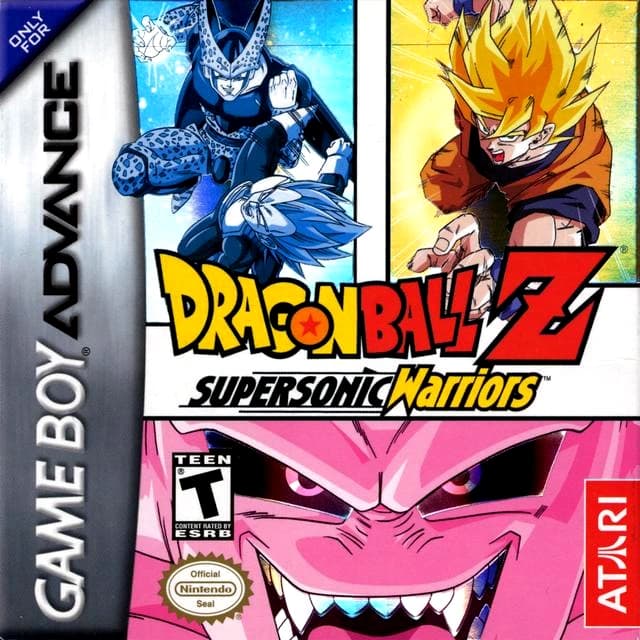
Dragon Ball Z: Supersonic Warriors
GameDragon Ball Z: Supersonic Warriors is a fighting video game based on the popular anime series Dragon Ball Z. It was developed by Banpresto and released for the Game Boy Advance on June 22, 2004. The game features a Story Mode, which covers all of Dragon Ball Z from the start of the Saiyan Saga to the end of the Kid Buu Saga. There is also an extra scenario for certain characters.
Gameplay
Dragon Ball Z: Supersonic Warriors is a fighting game for the Game Boy Advance that pits two characters against each other in large open arenas, with most combat taking place in the air. Players can execute light and heavy melee attacks, charge their ki gauge to fire standard Ki Blasts, or expend half or all of their ki to unleash one of three signature Certain Kill techniques. The direction from which the player approaches an opponent determines which Certain Kill activates, giving each fighter a distinct offensive toolkit that rewards spatial awareness. When a character uses their full ki for a finishing technique, the camera zooms in on a portrait still, lending a cinematic weight to each decisive blow.
Each character operates across three strength levels that alter stats, sprite artwork, and available abilities. This tiered system simulates power disparities in Story Mode, making it possible for weaker characters to face stronger opponents without the outcome feeling predetermined. Some fighters can activate a special power-up by charging ki to maximum and pressing both shoulder buttons simultaneously. Super Saiyan 2 Gohan gains a flashing blue sprite and heightened speed if he is the last surviving team member, reflecting his role in the source anime. The team system allows two or three fighters to share a roster slot, each with their own health bar, and players swap between them with a single button press to extend engagements and build tactical depth.

Story and Modes
Story Mode is the core single-player experience, offering each character an eight-battle campaign that covers the Dragon Ball Z narrative from the Saiyan Saga through the Kid Buu Saga. Most campaigns include a "What If" scenario that diverges from canon events, providing alternative outcomes for beloved characters. Piccolo, for example, can be revived and spar with Gohan in a special ninth battle that is only accessible when the player clears all preceding fights without using a continue. These optional final chapters reward mastery and add replay incentive beyond simply completing a standard run.
Outside of Story Mode, the game offers Z Battle Mode and Challenge Mode. Z Battle Mode tasks the player with defeating eight consecutive opponents either solo or with a team and assigns a letter rank based on performance. Challenge Mode presents the player with a succession of preset character teams, unlocking new and progressively harder squads as victories accumulate. Points earned in both modes scale with difficulty, encouraging players to tackle demanding matchups for higher scores.
Related Reading
See all
Namek Has No Women, and Piccolo Pulls Anyway
There are no women on Namek. That isn't an oversight, it's the biology. Why we handed Piccolo the one thing his own species rules out, and why it had to be trap soul....
1000 Times Over: Who Is John Dragon Ball Singing To?
Dragon Ball handed us a protagonist with no history and the internet named him John Dragon Ball. So we built him somebody to talk to....
Release and Legacy
Supersonic Warriors was developed by Banpresto and published for the Game Boy Advance on June 22, 2004. The game earned positive attention for translating the aerial, ki-heavy combat of the Dragon Ball Z anime into the constraints of a portable cartridge system, demonstrating that the franchise could work on handheld hardware without sacrificing the sense of scale associated with the series. Its roster covers all major story arcs, giving it broader narrative scope than many contemporaries.
The game performed well enough to justify a sequel, Dragon Ball Z: Supersonic Warriors 2, released in 2005 also for the Game Boy Advance. That follow-up expanded the roster and added new What If scenarios. Together the two entries represent one of the more complete portable Dragon Ball Z fighting game experiences of the mid-2000s era.
Frequently Asked Questions
What is Dragon Ball Z: Supersonic Warriors?
Dragon Ball Z: Supersonic Warriors is a fighting video game based on the popular anime series Dragon Ball Z. It was developed by Banpresto and released for the Game Boy Advance on June 22, 2004. The game features a Story Mode, which covers all of Dragon Ball Z from the start of the Saiyan Saga to the end of the Kid Buu Saga.
Which characters appear in Dragon Ball Z: Supersonic Warriors?
Dragon Ball Z: Supersonic Warriors is a fighting game for the Game Boy Advance that pits two characters against each other in large open arenas, with most combat taking place in the air. The direction from which the player approaches an opponent determines which Certain Kill activates, giving each fighter a distinct offensive toolkit that rewards spatial awareness. When a character uses their full ki for a finishing technique, the camera zooms in on a portrait still, lending a cinematic weight to each decisive blow.
When was Dragon Ball Z: Supersonic Warriors released?
Dragon Ball Z: Supersonic Warriors was released in 2004. Bandai / Atari published it as part of the Supersonic Warriors game series.
Who published Dragon Ball Z: Supersonic Warriors?
Dragon Ball Z: Supersonic Warriors was published by Bandai / Atari. The release came in 2004.
What genre is Dragon Ball Z: Supersonic Warriors?
Dragon Ball Z: Supersonic Warriors is a fighting. It belongs to the Supersonic Warriors game series and launched in 2004.
Sources & Information
Looking for more on Dragon Ball Z: Supersonic Warriors? The Dragon Ball Wiki on Fandom has a dedicated page with community notes.
View on FandomThis content is original writing by Daddy Jim Headquarters based on the Dragon Ball anime series, manga, and official materials. Episode and chapter references are cited where applicable.
Rights holders
- Created byAkira Toriyama
- Published byShueisha
- Animated byToei Animation
All rights belong to their respective owners.
Character and scene imagery on this site is original artwork by Daddy Jim Headquarters, not screenshots or licensed imagery. Official cover art is used on three types of pages for editorial commentary:
- Movie pages: theatrical posters and key visuals, credited to Toei Animation and Shueisha.
- Game pages: official box art, credited to Bandai Namco, Atari, and other publishers.
- Manga chapter pages: Jump Comics volume covers, credited to Shueisha and Akira Toriyama.
Browse our episode guides:
Official resources:
Help Us Keep This Wiki Accurate
Daddy Jim Headquarters maintains this encyclopedia. If you spot an error, a translation issue, or something that doesn't look right, let us know.
