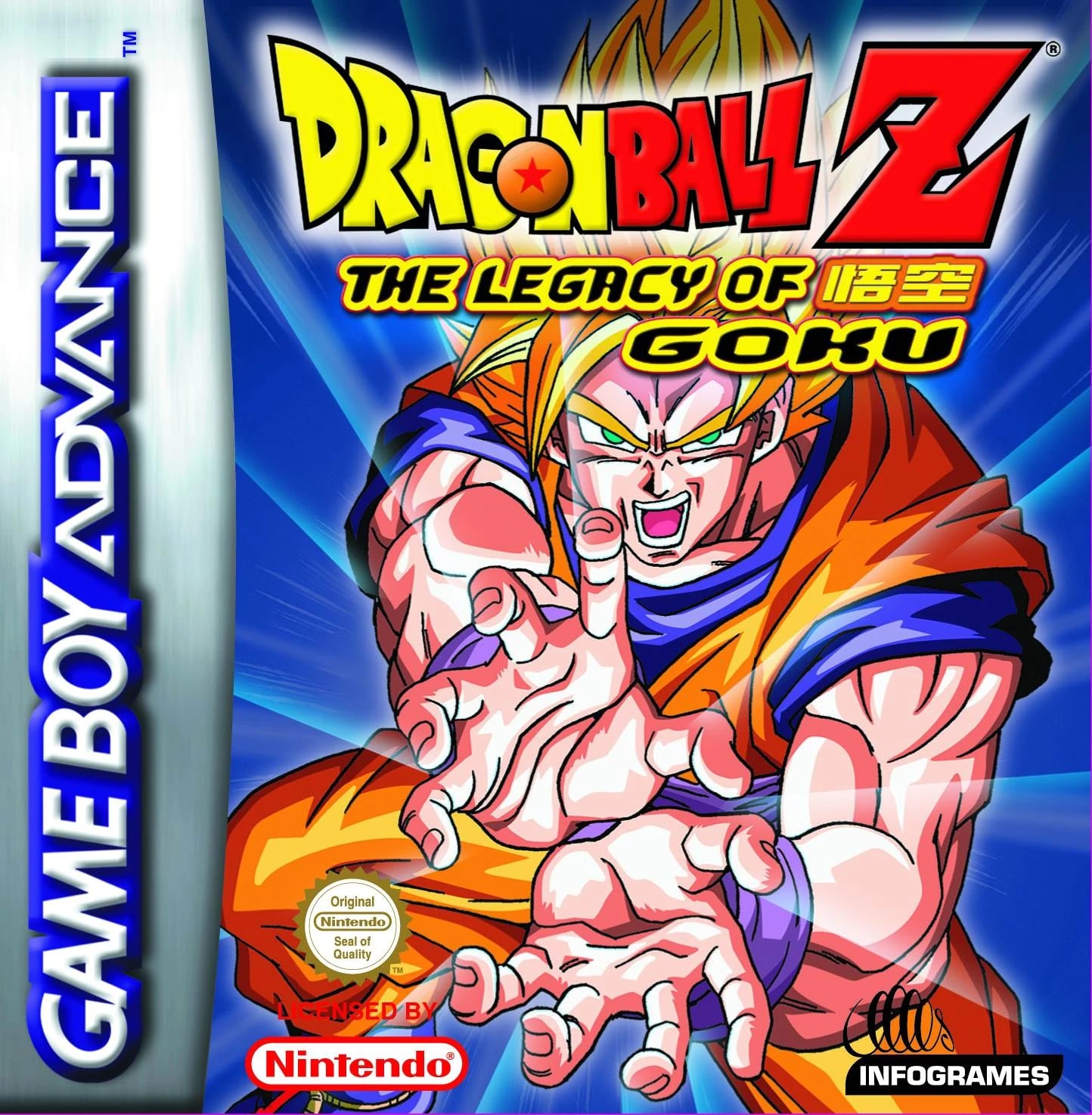
Dragon Ball Z: The Legacy of Goku
GameDragon Ball Z: The Legacy of Goku is an action/adventure RPG based on Dragon Ball Z. The game was developed by , the first American company to make a Dragon Ball Z video game for the .
Gameplay
Dragon Ball Z: The Legacy of Goku is a 2D action-adventure RPG in which the player controls Goku across environments drawn from the Saiyan and Namekian sagas. The A button delivers physical strikes while the B button cycles through and fires energy-based attacks, which drain a recharging energy meter. Additional energy attacks are learned as Goku progresses through the story, expanding the offensive options available over the course of the game. Defeating enemies yields experience points that accumulate toward level-ups, increasing Goku's overall strength.
Players navigate interconnected outdoor environments and interact with characters and objects using a single button press. Many areas require completing tasks for non-player characters before progress is possible, blending light fetch and quest mechanics into the action-RPG structure. Bosses from the source anime appear as distinct encounters with specific attack patterns, and at certain moments the narrative requires the player to engage with side events before the main confrontation becomes accessible. The game uses environments, enemies, attacks, and music drawn directly from the anime's Bruce Faulconer Funimation soundtrack.



Story
The Legacy of Goku opens at Kame House as Goku visits with Gohan, Bulma, Krillin, Master Roshi, and Turtle, before Raditz arrives and kidnaps Gohan. Goku must solve a series of problems in the surrounding areas, including helping a trapped old man, returning a pterodactyl egg, and finding a missing girl, before confronting Raditz. After sacrificing himself alongside Piccolo to defeat his brother, Goku travels the Snake Way to King Kai's Planet, where he catches Bubbles and strikes Gregory before learning the Kamehameha. He then returns to Earth, fights Nappa and Vegeta, and eventually recovers from his injuries before heading to Namek.
On Namek, Goku plants saplings at a local elder's request, recovers three artifacts for a Namekian temple, and battles the Ginyu Force before pushing into Frieza's spaceship to heal in a rejuvenation chamber. He then fights all four of Frieza's forms, with Frieza's killing of Krillin triggering Goku's Super Saiyan transformation. The game ends after Frieza's defeat, with Goku escaping the planet in a Ginyu Force pod. The remaining Dragon Ball Z sagas are reserved for the two sequels.
Release and Legacy
The Legacy of Goku was developed by Webfoot Technologies, the first American studio to produce a Dragon Ball Z video game for a portable platform, and was published by Infogrames for the Game Boy Advance. Its cover art was an original illustration commissioned specifically from Toei Animation, and the retail package included an original poster. The game launched as the franchise was building mainstream momentum in North America.
Despite receiving mixed reviews at launch, with critics noting a lack of polish in areas like enemy behavior and stage design, the game established a template for handheld Dragon Ball Z action-RPGs that its sequels would refine. The Legacy of Goku II and Dragon Ball Z: Buu's Fury are both widely regarded as improvements on the foundation laid here. The trilogy as a whole holds a significant place in the Game Boy Advance library as one of the more narratively ambitious licensed RPG series of that generation.
Related Reading
See all
Krillin's on the Tinder: How the Ultimate Short King Survived the Height Filter
Tinder built a height filter. Dragon Ball built a five foot legend. What happened when we sent the ultimate short king into the modern dating hellscape....
Infinite Zeni Glitch: When Yamcha Never Pays and Mr. Popo Always Does
The internet found an infinite money glitch. So did Yamcha. A smooth R&B track about the easiest money in the Dragon Ball world and the one man who keeps paying for it....
Frequently Asked Questions
What is Dragon Ball Z: The Legacy of Goku?
Dragon Ball Z: The Legacy of Goku is an action/adventure RPG based on Dragon Ball Z. The game was developed by , the first American company to make a Dragon Ball Z video game for the .
What game modes does Dragon Ball Z: The Legacy of Goku have?
Dragon Ball Z: The Legacy of Goku is a 2D action-adventure RPG in which the player controls Goku across environments drawn from the Saiyan and Namekian sagas. The A button delivers physical strikes while the B button cycles through and fires energy-based attacks, which drain a recharging energy meter. Additional energy attacks are learned as Goku progresses through the story, expanding the offensive options available over the course of the game.
Who published Dragon Ball Z: The Legacy of Goku?
Dragon Ball Z: The Legacy of Goku was published by Infogrames. Dragon Ball Z: The Legacy of Goku is an action/adventure RPG based on Dragon Ball Z.
What genre is Dragon Ball Z: The Legacy of Goku?
Dragon Ball Z: The Legacy of Goku is an action/rpg. It belongs to the Legacy of Goku game series.
What Dragon Ball series does Dragon Ball Z: The Legacy of Goku belong to?
Dragon Ball Z: The Legacy of Goku is part of the Legacy of Goku game series. It is an action/rpg.
Sources & Information
Looking for more on Dragon Ball Z: The Legacy of Goku? The Dragon Ball Wiki on Fandom has a dedicated page with community notes.
View on FandomThis content is original writing by Daddy Jim Headquarters based on the Dragon Ball anime series, manga, and official materials. Episode and chapter references are cited where applicable.
Character and scene imagery on this site is original artwork by Daddy Jim Headquarters, not screenshots or licensed imagery. Official cover art is used on three types of pages for editorial commentary:
- Movie pages: theatrical posters and key visuals, credited to Toei Animation and Shueisha.
- Game pages: official box art, credited to Bandai Namco, Atari, and other publishers.
- Manga chapter pages: Jump Comics volume covers, credited to Shueisha and Akira Toriyama.
Browse our episode guides:
Official resources:
Help Us Keep This Wiki Accurate
Daddy Jim Headquarters maintains this encyclopedia. If you spot an error, a translation issue, or something that doesn't look right, let us know.