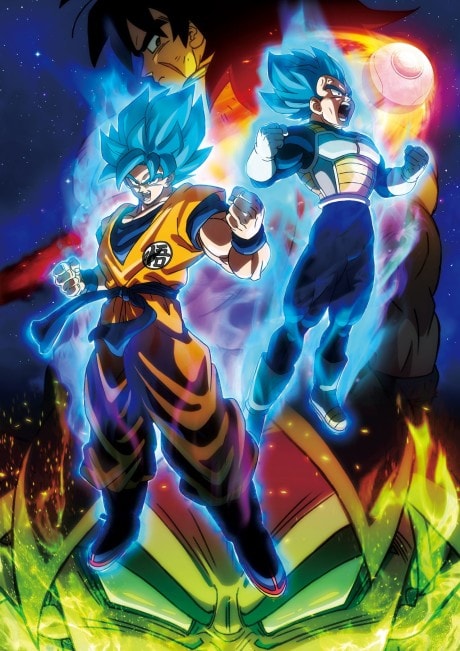
Dragon Ball Super: Broly
MovieThe highest-grossing Dragon Ball film ever made brings Broly into official canon with a completely reimagined origin story. Written by Akira Toriyama and featuring groundbreaking animation by Naohiro Shintani, the film spans from the destruction of Planet Vegeta to a cataclysmic three-way battle between Goku, Vegeta, and the legendary Saiyan berserker.
Three Saiyans, One Destiny
The Fall of Planet Vegeta
Forty-one years before the present day, the Cold Force arrives on Planet Vegeta to announce a changing of the guard. King Cold introduces his son Frieza to the assembled Saiyans, and the young tyrant wastes no time establishing his authority, casually executing snipers who take aim at him from the castle battlements while distributing new scouter technology as a patronizing gift. The message is clear: the Saiyans serve Frieza now, and Frieza is crueler than his father ever was.
In the royal nursery, King Vegeta discovers that an infant named Broly, son of the mid-class warrior Paragus, has been placed among the elite children. Broly's power readings are erratic but staggeringly high, potentially surpassing even the young Prince Vegeta. Unwilling to tolerate a rival to his son's destiny, the king orders Broly shipped to Vampa, a barren planetoid with no humanoid life and no strategic value. When Paragus storms the throne room to protest, the king coldly informs him the pod has already launched. Paragus crashes through the palace window, steals a ship, and races after his son with a reluctant crew member named Beets in tow.
On Vampa, Paragus and Beets endure a hostile ecosystem of armored beetles and massive serpentine predators. They find Broly alive in a cave, his battle power already at 920 despite being an infant. But the ship's main floater is damaged beyond repair. Stranded and facing starvation with only ten days of rations, Paragus makes a cold calculation and shoots Beets to preserve supplies. From that moment forward, his entire existence becomes devoted to a single goal: train Broly into a weapon of revenge against King Vegeta's bloodline.
Five years later, the Saiyan warrior Bardock grows suspicious of Frieza's order for all Saiyans to return home. He and his wife Gine make the wrenching decision to steal a space pod and send their infant son Kakarot to a distant planet called Earth. They say goodbye through the glass of the pod window, Gine calling out to her child not to forget them as the pod vanishes into the stars. Hours later, Frieza destroys Planet Vegeta with a single Supernova, killing Bardock and nearly every Saiyan in existence. Out in the void, the young Prince Vegeta learns his homeworld is gone. On Vampa, Broly watches Kakarot's pod streak across the sky. Three Saiyan babies, born in the same era, scattered across the universe by the cruelty of kings and tyrants.
Forty-One Years Later
In the present day, Goku and Vegeta are sparring near Bulma's summer home, both still processing the Tournament of Power. When Bulma discovers that Frieza's soldiers have stolen six of her seven Dragon Balls, the group races to the Ice Continent to secure the last one before Frieza can complete the set. Frieza, meanwhile, has abandoned his old wish for immortality. His time in Hell taught him that eternal life without freedom is meaningless. His new wish, kept secret from all but his closest attendants, is to become five centimeters taller.
Deep in space, two low-ranking Frieza Force recruits named Cheelai and Lemo intercept a distress signal from Vampa. They discover Paragus and Broly, who have survived on the planetoid for over four decades. Broly's power is so high their scouters cannot register it. Excited by the potential bounty, they bring the two Saiyans to Frieza's flagship. Frieza immediately recognizes the opportunity: a Saiyan weapon he did not create, carrying a grudge against the Vegeta bloodline. He feeds Paragus the information that Prince Vegeta still lives, knowing the old man's rage will do the rest.
Aboard the ship, Cheelai and Lemo befriend Broly and discover the truth behind his character. He is not a mindless brute; he is a gentle, isolated man who wears a tattered pelt from a creature named Ba, the only friend he ever had on Vampa, before Paragus shot off Ba's ear to teach Broly that attachments are weaknesses. Paragus controls Broly through an electrified collar that shocks him into submission whenever his rage threatens to overflow. Disgusted, Cheelai steals the remote from Paragus's belt.
The Arctic Collision
On the Ice Continent, Frieza's advance team secures the final Dragon Ball just as Goku, Vegeta, Bulma, and Whis arrive. Frieza appears personally, and he has brought guests: Paragus and Broly. Paragus locks eyes with Vegeta and sees the face of the king who exiled his son. He orders Broly to attack.
What follows is the longest sustained battle sequence in Dragon Ball film history. Vegeta engages Broly first, confident in his experience and technique. But Broly adapts at a terrifying rate, growing stronger with every exchange. Vegeta escalates through Super Saiyan and Super Saiyan God, but Broly matches each transformation with a raw power increase of his own. When Broly accesses his Wrathful form, channeling the power of the Great Ape without transforming, the arctic landscape begins to disintegrate around them.
Goku takes over, pushing to Super Saiyan Blue, and for a brief window he holds the advantage. But Frieza, watching from the sidelines, decides to accelerate events. He murders Paragus with a Death Beam, then calls out to Broly with feigned panic, pointing to his father's body. The grief and rage shatter something inside Broly. He erupts into a Super Saiyan transformation for the first time, his power exploding so violently that the landscape for miles around is reduced to rubble. Neither Goku nor Vegeta can touch him alone. Their combined Galick Kamehameha barely slows him down.
With no Senzu Beans available and Broly bearing down on Frieza in their absence, Goku grabs Vegeta and teleports to Piccolo via Instant Transmission. There is only one option left: the Fusion Dance.
The Birth of Gogeta
Two Failed Fusions and One Perfect Dance
On Piccolo's remote spire, Goku demonstrates the Fusion Dance while Vegeta watches in visible mortification. The prince of all Saiyans flatly refuses to perform what he considers an undignified ritual. Goku reminds him the fusion only lasts thirty minutes; Vegeta counters that he would rather die. Goku plays his trump card: would Vegeta really be okay with Bulma dying? Vegeta tells Goku he should not say such embarrassing things, but he walks forward as if dragged against his will.
Their first attempt produces a chubby, overconfident fusion who claims to be the strongest warrior alive. Piccolo identifies the error immediately: their fingertips did not touch precisely. They wait thirty agonizing minutes to defuse while Golden Frieza endures a savage beating from Broly on the battlefield. The second attempt produces an emaciated, skeletal fusion because their poses were not perfectly symmetrical. Another thirty minutes of Frieza serving as an involuntary punching bag. On the third attempt, they finally synchronize perfectly. The resulting warrior stands tall with jet-black hair and tremendous power radiating from his body. Recalling that their Potara fusion was named Vegito, he struggles to name this new form until inspiration strikes: Gogeta.
Shattering Dimensions
Gogeta teleports to the battlefield, where Broly has grown bored of pummeling Frieza and begun fighting Whis, who dodges his attacks with lazy amusement. Gogeta announces himself and attacks immediately. In his base form, he holds his own. As Super Saiyan, he matches Broly blow for blow. When their Kamehameha and Gigantic Omegastorm collide, the sheer force cracks the fabric of reality itself, shattering space like glass and dropping both fighters into a surreal dimension of swirling colors.
Broly pushes into his Legendary Super Saiyan form, landing hits that force Gogeta to escalate to Super Saiyan Blue. The gap in power becomes decisive. Gogeta crashes through multiple dimensional barriers before blasting back into the real world, where he dismantles Broly with a sequence of devastating techniques: Stardust Breaker, Meteor Explosion, and finally the Limit Ultra Kamehameha. Broly, partially shocked back to sanity by the damage, can only stare and scream as the killing blow approaches.
But Cheelai and Lemo have gathered Frieza's Dragon Balls and summoned Shenron. At the last possible moment, Cheelai wishes for Broly to be sent back to the planet where they found him. The Kamehameha shoots off harmlessly into space as Broly vanishes, deposited back on Vampa in his base form, terrified and disoriented but alive. Gogeta laughs, grabs Frieza's hand when the tyrant tries to shoot down Cheelai's escape vessel, and watches him retreat with a promise to return.
Call Me Kakarot
Three days later, Goku uses Instant Transmission to visit Broly on Vampa, where Cheelai and Lemo have already arrived. Rather than finishing the fight, Goku brings supplies: capsule shelters, a lifetime supply of food, and two Senzu Beans. He tells them Broly might be stronger than Beerus, the God of Destruction. Before leaving, he introduces himself. "It's Goku," he says. Then, after a pause, looking directly at Broly: "But Broly, call me Kakarot." It is a moment of profound significance. For the first time, Goku voluntarily claims his Saiyan name, acknowledging the shared heritage that connects them. The three Saiyans born in the same era, separated by exile and genocide and the vast emptiness of space, have finally met. And one of them chose mercy.
Rewriting the Legend
Toriyama Takes the Pen
Dragon Ball Super: Broly represents an unprecedented level of involvement from series creator Akira Toriyama. While previous films received outlines or character designs from Toriyama, this was the first where he wrote the complete screenplay, including all dialogue and the full backstory of the Saiyan race. The Dragon Ball Minus chapter from Jaco the Galactic Patrolman was adapted directly into the film's prologue, canonizing Bardock and Gine's decision to send Kakarot to Earth as an act of parental love rather than Saiyan conquest.
The decision to reimagine Broly came at the suggestion of Toriyama's editor, Akio Iyoku, who recognized the character's overwhelming popularity despite never having been part of the official continuity. After watching the original Broly trilogy, Toriyama saw potential in the concept but fundamentally reworked the character. The old Broly was defined by his hatred of Goku; the new Broly is defined by his isolation, his gentleness, and the tragedy of a father who turned his own son into a weapon. Paragus in this version is not a scenery-chewing villain but a broken man consumed by revenge, and his death at Frieza's hands is engineered specifically to weaponize Broly's grief.
The Shintani Revolution
Animation director Naohiro Shintani's character designs and animation philosophy represent a seismic shift from the Tadayoshi Yamamuro style that had defined Dragon Ball's visual identity since the late 1990s. Shintani's designs are looser, with thinner lines, rounder faces, and more dynamic proportions that allowed animators unprecedented freedom of movement. The result is a film where every frame crackles with kinetic energy. Characters stretch, squash, and deform in ways that traditional Dragon Ball animation rarely permitted, and the battles feel genuinely dangerous because of it.
The one-hour battle sequence that dominates the film's second half was directed by Tatsuya Nagamine, who coordinated dozens of key animators to maintain visual coherence across what amounts to one continuous escalation. The dimension-shattering sequence, where Gogeta and Broly fight across planes of pure color, became one of the most talked-about animation sequences in modern anime. The film's score by Norihito Sumitomo incorporates chanting and orchestral swells that complement the escalating chaos, culminating in the track "Gogeta vs. Broly" becoming a fan-favorite piece of Dragon Ball music.
Box Office and Legacy
Released on December 14, 2018, in Japan and January 16, 2019, in the United States, the film earned 4 billion yen domestically and over $131 million worldwide, making it the highest-grossing Dragon Ball film in history by a significant margin. It was distributed by Toei Animation and 20th Century Fox in Japan, and by Funimation in the United States.
Beyond the numbers, the film's lasting impact is threefold. First, it brought Broly permanently into canon, establishing him as a sympathetic figure who could recur in future stories, as evidenced by his appearance training on Beerus's planet in Dragon Ball Super: Super Hero. Second, it set a new visual standard for the franchise, with the Shintani style influencing subsequent Dragon Ball productions. Third, it proved that Dragon Ball theatrical films could compete at the global box office on par with major anime releases, paving the way for the franchise's continued theatrical ambitions. For many fans, DBS: Broly is not just the best Dragon Ball movie; it is the proof that the franchise can still redefine itself nearly four decades after its creation.
Related Reading
See all
Krillin's on the Tinder: How the Ultimate Short King Survived the Height Filter
Tinder built a height filter. Dragon Ball built a five foot legend. What happened when we sent the ultimate short king into the modern dating hellscape....
Infinite Zeni Glitch: When Yamcha Never Pays and Mr. Popo Always Does
The internet found an infinite money glitch. So did Yamcha. A smooth R&B track about the easiest money in the Dragon Ball world and the one man who keeps paying for it....
Frequently Asked Questions
Is Dragon Ball Super: Broly canon?
Dragon Ball Super: Broly is a theatrical film from the Dragon Ball Super era. It was released on December 14, 2018.
What is Dragon Ball Super: Broly?
The highest-grossing Dragon Ball film ever made brings Broly into official canon with a completely reimagined origin story. Written by Akira Toriyama and featuring groundbreaking animation by Naohiro Shintani, the film spans from the destruction of Planet Vegeta to a cataclysmic three-way battle between Goku, Vegeta, and the legendary Saiyan berserker.
When was Dragon Ball Super: Broly released?
Dragon Ball Super: Broly was released on December 14, 2018. It is a theatrical film in the Dragon Ball Super era.
What happens in Dragon Ball Super: Broly?
Forty-one years before the present, King Cold hands control of the Saiyan army to his son Frieza. On Planet Vegeta, King Vegeta discovers that a low-born Saiyan child named Broly possesses extraordinary latent power surpassing even Prince Vegeta, and banishes him to the desolate planet Vampa out of jealousy. Broly's father Paragus follows to rescue his son, but both end up stranded for decades.
Who is the main villain in Dragon Ball Super: Broly?
The main antagonist of Dragon Ball Super: Broly is Broly. Forty-one years before the present, King Cold hands control of the Saiyan army to his son Frieza.
Sources & Information
Looking for more on Dragon Ball Super: Broly? The Dragon Ball Wiki on Fandom has a dedicated page with community notes.
View on FandomThis content is original writing by Daddy Jim Headquarters based on the Dragon Ball anime series, manga, and official materials. Episode and chapter references are cited where applicable.
Character and scene imagery on this site is original artwork by Daddy Jim Headquarters, not screenshots or licensed imagery. Official cover art is used on three types of pages for editorial commentary:
- Movie pages: theatrical posters and key visuals, credited to Toei Animation and Shueisha.
- Game pages: official box art, credited to Bandai Namco, Atari, and other publishers.
- Manga chapter pages: Jump Comics volume covers, credited to Shueisha and Akira Toriyama.
Browse our episode guides:
Official resources:
Help Us Keep This Wiki Accurate
Daddy Jim Headquarters maintains this encyclopedia. If you spot an error, a translation issue, or something that doesn't look right, let us know.