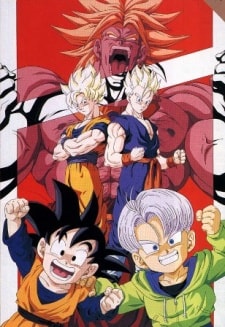
Dragon Ball Z: Broly - Second Coming
MovieSeven years after his defeat, the Legendary Super Saiyan Broly awakens from an icy prison on Earth, driven to madness by the crying of Goten, who reminds him of the infant Goku. Gohan, Goten, Trunks, and Videl must survive his rampage, culminating in the legendary Family Kamehameha.
The Monster in the Ice
The film opens in the vacuum of space. A Saiyan Attack Ball hurtles through the cosmos and crash-lands on Earth, carving a small crater into the mountainous landscape. From the wreckage, a battered and barely conscious Broly crawls free. He is alive, but only just. As the temperature drops, his power fades, and he reverts from his Super Saiyan state to his base form, screaming "Kakarot" until his voice finally gives out. Water flows over his motionless body and freezes solid, entombing the Legendary Super Saiyan in a prison of ice.
Dragon Ball Hunting with Goten, Trunks, and Videl
Seven years pass. Goten, Trunks, and Videl are searching for the Dragon Balls because Videl wants to see Shenron with her own eyes. Their quest takes them to Natade Village, a remote settlement terrorized by a monster and dominated by a self-important priest named Maloja. The trio concocts a plan to lure the monster with food, and after an encounter with what turns out to be an oversized dinosaur, they dispatch it easily and cook it for dinner. With the village saved, the disgraced Maloja is rejected by the villagers, and the three young adventurers continue their Dragon Ball hunt.
The Crying That Broke the Ice
During the village visit, Videl slaps Goten across the face for trying to sneak food, causing him to erupt in loud, exaggerated wailing. The crying carries across the mountains and reaches the glacier where Broly lies frozen. The sound triggers something deep in Broly's fractured mind: it sounds exactly like the crying of infant Goku, the baby whose wails drove him to madness in the crib decades ago. The ice cracks. Broly transforms. The glacier shatters, and the Legendary Super Saiyan is free again, burning with a singular, incoherent rage directed at anything that reminds him of Kakarot.
A Nightmare Returns
Early the next morning, Videl investigates explosions near a lake and is confronted by Broly in his Super Saiyan form. When Goten and Trunks arrive, Broly's eyes lock onto Goten, and his deteriorating mind sees the boy as Goku himself. The fight erupts. Broly batters both children with terrifying ease, hurling them through mountainsides and shrugging off their combined attacks. Trunks attempts to distract Broly by mooning him while Goten searches for the last Dragon Ball among a pile of look-alike crystal balls. But there is no time to summon Shenron. Just as Broly is about to finish the boys, Gohan arrives at the last possible second, kicking his old enemy away from his brother.
Gohan vs. the Legendary Super Saiyan
Gohan transforms into Super Saiyan 2 and meets Broly head-on. The two Saiyans trade blows with devastating force, and for a time, they appear evenly matched. But Broly powers up to his Legendary Super Saiyan form, and the balance shifts decisively. Gohan lures Broly into a pit of molten lava, which briefly swallows the behemoth. When Broly emerges unharmed, protected by an energy shield, he begins systematically torturing Gohan. He catches the young fighter in a bone-crushing hold, squeezing the life out of him while everyone else lies too battered to intervene.
Videl breaks Broly's concentration by hurling a crystal at his face, giving Gohan enough of an opening to kick free. Exhausted but furious, Gohan drops to Super Saiyan and fires a Super Kamehameha at Broly. The Legendary Super Saiyan responds with an Omega Blaster, a massive sphere of green energy that begins pushing Gohan's beam back.
The Family Kamehameha
Goten, awakened by the glow of the nearby Dragon Balls, transforms into a Super Saiyan and adds his own Kamehameha to his brother's. The combined beam pushes back against Broly's attack, but the monster is too strong, firing additional ki blasts to power his sphere forward. In desperation, Goten wishes their father were there.
The Dragon Balls respond. The sky darkens. And from somewhere beyond the veil of death, a familiar voice calls out. Goku appears beside his sons, transformed into a Super Saiyan, and adds his own Kamehameha to theirs. He coaches them through the beam struggle, pushing the combined wave forward inch by inch. But Broly's raw power continues to hold. At the critical moment, Trunks, barely conscious, fires one last charged energy ball that creates a barrier between Broly and his Omega Blaster, cutting off his ability to feed it more power. The opening is enough. Goku urges his sons to give everything they have. The Family Kamehameha breaks through, consuming Broly and launching him into the sun. His chest ruptures, his final scream of "Kakarot!" echoes through space, and the Legendary Super Saiyan disintegrates.
The Dragon Balls scatter. Goku vanishes. Videl chases Gohan for arriving late. Trunks, still wearing the priest's necklace, announces he would like a snack. And Krillin, embedded in a rock wall from an earlier blast, addresses the audience directly: "That's all fine and everything, but what happens to me?"
Three Kamehameha Waves and a Sunset
Broly: Second Coming is built around a single premise: what if the most terrifying villain in Dragon Ball Z came back, and the heroes had to face him without Goku? The answer plays out across several memorable set pieces that range from comedic to genuinely intense.
Goten's Crying: The Stupidest, Most Brilliant Trigger
The idea that Broly, a being of nearly limitless power, is awakened by a child's crying is both absurd and perfectly in character. Broly's entire psychology is built on an irrational, primal hatred of Goku that traces back to their shared infancy. Goten's crying sounds like baby Goku's crying because Goten looks and sounds almost exactly like his father. The connection is instinctive, not logical, and the film does not waste time trying to make it logical. It simply lets the trigger fire and moves on. The result is one of the more unsettling awakenings in DBZ movie history: a glacier cracking apart as a screaming Super Saiyan erupts from the ice.
Gohan vs. Broly: Round Two
Gohan's fight against Broly is the film's longest and most grueling sequence. The two Saiyans cycle through multiple stages of escalation: Gohan's initial Super Saiyan 2 assault, Broly's transformation into Legendary Super Saiyan, the lava trap gambit, and the crushing bear hold that nearly ends Gohan's life. The fight has a genuine sense of exhaustion to it. Gohan is not losing because he is weak; he is losing because Broly simply does not stop. Every time Gohan finds an advantage, Broly absorbs the punishment and comes back harder.
The Family Kamehameha
The climactic beam struggle is the most iconic moment in the Broly trilogy. Three generations of the Son family (Goku from beyond death, Gohan in his prime, and Goten as a child) firing their Kamehameha waves together is an image that has become one of the most recognizable in all of Dragon Ball. The sequence works because each addition feels earned: Gohan starts alone and is losing, Goten joins and the tide stabilizes, and Goku's arrival from the afterlife provides both the emotional catharsis and the tactical coaching needed to push through. Trunks' last-second energy ball, which blocks Broly's ability to feed more power into his Omega Blaster, is the unsung mechanical detail that makes the victory possible.
Broly's Death in the Sun
Broly's final moments are appropriately operatic. The combined Kamehameha launches him through the atmosphere, his chest splits open, he screams "Kakarot!" one last time, and he burns away in the sun. It is a death that matches the character's excessive nature: nothing less than a star could put him down for good.
The Sequel Nobody Expected to Work
Dragon Ball Z: Broly, Second Coming is the thirteenth Dragon Ball film and the tenth under the Dragon Ball Z banner. Released in Japanese theaters on March 12, 1994, it was directed by Shigeyasu Yamauchi, written by Takao Koyama, and scored by Shunsuke Kikuchi. With a runtime of 53 minutes, it earned approximately 2.47 billion yen at the Japanese box office, making it one of the higher-grossing entries in the DBZ film catalog.
Continuing the Broly Saga
The film is a direct sequel to Broly: The Legendary Super Saiyan and was itself followed just four months later by Bio-Broly, completing the original Broly trilogy. Second Coming shifts the focus from the adult Z Fighters to the next generation: Gohan as the primary combatant, with Goten, Trunks, and Videl in supporting roles. This generational shift mirrors the main anime's own transition during the Buu Saga and gives the film a noticeably different energy than its predecessor.
Home Video and Dub
Funimation released the English dub on DVD on April 5, 2005. The film was later bundled with its predecessor and successor in the "Broly Triple Threat" DVD box set (September 12, 2006) and again in a remastered Triple Feature Blu-ray on March 31, 2009. The remastered set included a new widescreen transfer and dual audio options with both the Shunsuke Kikuchi score and the Mark Menza English dub score.
Reception and Legacy
Second Coming received a warmer reception than its sequel Bio-Broly, largely on the strength of the Family Kamehameha sequence and the film's willingness to let Gohan carry the protagonist role. The Family Kamehameha itself has become one of the most frequently referenced techniques in Dragon Ball games, appearing as a signature attack in titles across the Budokai, Tenkaichi, Xenoverse, and Sparking series. While the film does not reach the dramatic heights of the original Legendary Super Saiyan, it stands as a solid, action-heavy entry that gives the next generation of Saiyans their first real trial by fire.
Related Reading
See all
Krillin's on the Tinder: How the Ultimate Short King Survived the Height Filter
Tinder built a height filter. Dragon Ball built a five foot legend. What happened when we sent the ultimate short king into the modern dating hellscape....
Infinite Zeni Glitch: When Yamcha Never Pays and Mr. Popo Always Does
The internet found an infinite money glitch. So did Yamcha. A smooth R&B track about the easiest money in the Dragon Ball world and the one man who keeps paying for it....
Frequently Asked Questions
What is Broly's second coming about?
Years after his defeat, Broly survived and crash-landed on Earth in his attack pod. Critically injured, he was frozen in ice as winter set in. During the Buu Saga era, Goten, Trunks, and Videl are searching for the Dragon Balls in a mountainous region.
Is DBZ Broly second coming canon?
Dragon Ball Z: Broly, Second Coming is a theatrical film from the Dragon Ball Z era. It was released on March 12, 1994.
Who killed Broly in Second Coming?
The main antagonist of Dragon Ball Z: Broly, Second Coming is Broly. Years after his defeat, Broly survived and crash-landed on Earth in his attack pod.
What is Dragon Ball Z: Broly - Second Coming?
Seven years after his defeat, the Legendary Super Saiyan Broly awakens from an icy prison on Earth, driven to madness by the crying of Goten, who reminds him of the infant Goku. Gohan, Goten, Trunks, and Videl must survive his rampage, culminating in the legendary Family Kamehameha.
When was Dragon Ball Z: Broly - Second Coming released?
Dragon Ball Z: Broly, Second Coming was released on March 12, 1994. It is a theatrical film in the Dragon Ball Z era.
Sources & Information
Looking for more on Dragon Ball Z: Broly - Second Coming? The Dragon Ball Wiki on Fandom has a dedicated page with community notes.
View on FandomThis content is original writing by Daddy Jim Headquarters based on the Dragon Ball anime series, manga, and official materials. Episode and chapter references are cited where applicable.
Character and scene imagery on this site is original artwork by Daddy Jim Headquarters, not screenshots or licensed imagery. Official cover art is used on three types of pages for editorial commentary:
- Movie pages: theatrical posters and key visuals, credited to Toei Animation and Shueisha.
- Game pages: official box art, credited to Bandai Namco, Atari, and other publishers.
- Manga chapter pages: Jump Comics volume covers, credited to Shueisha and Akira Toriyama.
Browse our episode guides:
Official resources:
Help Us Keep This Wiki Accurate
Daddy Jim Headquarters maintains this encyclopedia. If you spot an error, a translation issue, or something that doesn't look right, let us know.