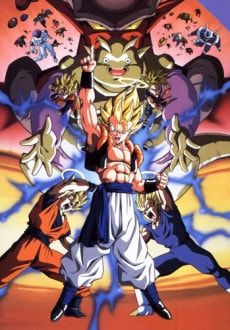
Dragon Ball Z: Fusion Reborn
MovieA catastrophic explosion at the Other World soul-cleansing facility births Janemba, a reality-warping demon who traps King Yemma and unleashes the dead back onto Earth. With Goku stranded in a twisted version of Hell and Vegeta refusing to cooperate, the only hope lies in the Fusion Dance and the debut of the ultimate warrior: Gogeta.
When the Barrier Between Worlds Breaks
The film opens on a festive note in Other World. The Other World Tournament is in full swing, with Goku having just dispatched Froug while Pikkon made short work of Arqua. The two rivals are on a collision course toward the finals, and the assembled Kais are watching with keen interest. But far from the tournament arena, at the Check-In Station where King Yemma processes the souls of the departed, something is going terribly wrong.
The Birth of Janemba
A young ogre named Saike Demon has been assigned to monitor the Soul Cleansing Machine, a massive apparatus that purifies the evil energy from deceased souls before they can be properly sorted into the afterlife. Saike, however, is far more interested in his heavy metal music than his duties. While he headbangs away, the machine overloads with accumulated evil energy and violently explodes. The blast engulfs Saike and transforms him into Janemba, a colossal, childlike monster of staggering power. Janemba's first act is to erect an impenetrable crystalline barrier around the Check-In Station, trapping King Yemma inside and severing his control over the boundary between the living world and the afterlife.
The consequences are immediate and catastrophic. Without Yemma to maintain order, the souls of the dead begin flooding back into the realm of the living. On Earth, zombies claw their way out of the ground. Videl receives a distress call and she and the Great Saiyaman, Gohan, rush off to deal with the undead invasion. But the returning dead are not limited to mindless zombies. Frieza himself materializes on Earth with an army of deceased villains at his back, clearly delighted to be breathing again.
Chaos on Two Fronts
Gohan confronts Frieza with a confidence that borders on theatrical. When Frieza recognizes him as Goku's son and sends his legion of villains charging forward, Gohan simply flies through the entire army and silences the tyrant with a punch to the stomach followed by a point-blank energy blast. Frieza's terrified minions scatter. Meanwhile, in a different part of the city, Mr. Satan is having the time of his life, finally facing opponents he can actually defeat: shuffling, harmless zombies.
In Other World, Goku and Pikkon abandon the tournament to investigate the crisis. They find King Yemma trapped behind the barrier and the enormous Janemba perched atop the Check-In Station. Pikkon begins working on the barrier while Goku, excited by the monster's tremendous power, lures Janemba down into Hell for a proper fight. What he finds there is deeply unsettling: Hell has been transformed into a surreal, psychedelic landscape of colorful jellybean-like stones, its familiar geography twisted beyond recognition by Janemba's reality-warping abilities.
The Demon Evolves
The initial battle with Janemba is bizarre and disorienting. The creature fights using abilities that defy conventional combat logic. He punches through interdimensional portals, striking Goku from impossible angles. He creates a perfect miniature clone of Goku in his palm, complete with its own functional Kamehameha. Even as a Super Saiyan 2, Goku struggles to land meaningful blows. Recognizing the severity of the threat, Goku pushes himself to Super Saiyan 3, and the massive power surge tears through Janemba's defenses. The monster begins to crumble.
But destruction only serves as a catalyst. Janemba sheds his oversized, playful form and reconstitutes as Super Janemba: a sleek, armored humanoid warrior wielding reality itself as a weapon. He picks up a discarded ogre club from the ground and transmutes it into the Dimension Sword, a blade so sharp it can slice through the fabric of space with every swing. Super Janemba is faster, smarter, and exponentially more dangerous than his previous incarnation. He overwhelms Super Saiyan 3 Goku with brutal efficiency, trapping him in a cage constructed from the Blood Pond and cutting it down around him.
On Earth, the subplot takes a memorably absurd turn. Goten and Trunks encounter a mustachioed dictator and his army, a thinly veiled historical reference that was censored or altered in several international releases of the film. The two boys go Super Saiyan and dispatch the dictator's forces with casual ease.
Back in Hell, Vegeta arrives. Having somehow maintained enough of his spirit form to manifest physically, the Saiyan prince throws himself at Super Janemba in his Super Saiyan 2 form. His pride demands nothing less. But pride alone cannot bridge the gap in power. Vegeta is beaten soundly, thrown into a cage of spikes, and saved from impalement only by Goku catching him at the last moment.

The Dance That Created Gogeta
Cornered, battered, and out of options, Goku proposes the one strategy that might work: the Fusion Dance. Vegeta's reaction is immediate and visceral. The pose is humiliating. The concept of merging his body and soul with a low-class Saiyan is an insult to everything he stands for. "I'd rather die," he declares. Goku, with perfect deadpan timing, reminds him that he is already dead. The logic is airtight, the delivery is flawless, and the moment encapsulates everything that makes Goku and Vegeta's relationship work: mutual respect buried under layers of rivalry, frustration, and reluctant admiration.
Veku: The Fusion That Went Wrong
The first attempt at fusion goes catastrophically wrong. Vegeta fails to extend his index finger at the critical moment, and instead of a supreme warrior, the fusion produces Veku: a grotesquely overweight, comically inept fighter who can barely move under his own weight. South Kai coins the name with visible disappointment. Veku's combat repertoire consists entirely of flatulence-based attacks and a panicked running technique. Super Janemba nearly destroys Veku before the fusion timer mercifully runs out, splitting Goku and Vegeta apart.
Vegeta curses the entire concept, declaring fusion worthless. King Kai telepathically intervenes to point out that the failure was entirely Vegeta's fault, specifically his clenched fist where an extended finger was required. The correction stings, but time is running out. They need to perform the dance again, correctly this time, but Super Janemba is not about to give them thirty uninterrupted seconds.
Pikkon's Profane Discovery
This is where Pikkon makes his crucial contribution. While working on the barrier around the Check-In Station, Pikkon discovered something unexpected: cursing at it caused it to crack. He theorizes that Janemba, being composed of the same concentrated evil energy as the barrier, might share this vulnerability. Pikkon arrives in Hell just as Goku and Vegeta need the distraction most. He unleashes a torrent of insults at Super Janemba, and the demon recoils in genuine pain and confusion, buying the precious seconds needed.
Goku and Vegeta perform the Fusion Dance perfectly. Light explodes outward. When it fades, Gogeta stands in their place: the fused warrior with Goku's combat genius and Vegeta's ruthless precision combined into a single, supremely confident entity. His vest is unmistakable, his aura radiates with calm authority, and his power dwarfs everything that has come before.
Stardust Breaker
The fight with Super Janemba is barely a fight at all. Gogeta moves with fluid, almost leisurely grace, effortlessly dodging every attack and responding with strikes that land with devastating precision. The Dimension Sword that carved through Super Saiyan 3 Goku is meaningless against Gogeta. The reality-warping portals are casually avoided. When Gogeta has seen enough, he gathers a sphere of rainbow-colored energy in his palm and launches the Stardust Breaker directly into Super Janemba. The attack does not merely defeat him; it purifies him, dissolving the evil energy that constitutes his being. The monstrous demon dissolves, and in his place stands a terrified teenage ogre, Saike Demon, back to his original form and running for his life at the sight of Gogeta.
On Earth, the parallel fusion plays out with equal flair. Goten and Trunks, having sensed their fathers merging, perform their own Fusion Dance to become Gotenks. The fused child warrior dispatches the dictator's remaining forces with a single Super Ghost Kamikaze Attack, reducing the army to rubble in one spectacular volley.
With Janemba destroyed, the barrier around the Check-In Station shatters. King Yemma is freed, the dead are recalled to their proper resting places, and Hell returns to its standard, non-psychedelic configuration. Gogeta's fusion wears off, and Goku and Vegeta share a rare moment of mutual acknowledgment before Vegeta's physical form fades and he returns to his spirit state. On Earth, Shenron remains summoned and waits impatiently, his wishes unclaimed, as Gohan chases Goten and Trunks home after catching them spying on him and Videl.
The Film That Gave Us Gogeta
Released on March 4, 1995 as the twelfth Dragon Ball Z theatrical film, Fusion Reborn was directed by Shigeyasu Yamauchi with a screenplay by Takao Koyama and music by Shunsuke Kikuchi. At 51 minutes, it is longer than most entries in the Z film catalog, and it uses every minute. The film's timeline placement falls during the Buu Saga, after Goku's death and return to Other World but before the conflict with Super Buu reaches its climax.
Gogeta's Debut and Lasting Impact
Fusion Reborn holds a singular place in Dragon Ball history as the film that introduced Gogeta, the Fusion Dance counterpart to the Potara-fused Vegito who would appear later in the Buu Saga of the main series. While Vegito was technically the "canon" fusion, Gogeta captured fan imagination in a way that his counterpart struggled to match. Where Vegito was playful and taunting during his fight with Super Buu, Gogeta was efficient, devastating, and almost surgically precise. His brief screen time worked in his favor; fans were left wanting more, and that hunger persisted for decades.
Gogeta's design became instantly iconic. The orange-and-blue vest, the widow's peak hairstyle that combined elements of both Saiyans, and the confident, arms-crossed pose entered the visual vocabulary of Dragon Ball fandom permanently. His signature technique, the Stardust Breaker (known in some translations as the Soul Punisher), remains one of the most visually distinctive finishing moves in the franchise. The attack's rainbow-hued energy and its unique property of purifying evil rather than simply destroying it set it apart from the typical beam struggles that dominate Dragon Ball combat.
Veku, the Dictator, and Tonal Range
The film's willingness to be genuinely funny sets it apart from many of its peers. Veku is one of the franchise's best visual gags, a living embodiment of what happens when Vegeta's stubborn imprecision meets the exacting requirements of the Fusion Dance. The failed fusion serves a narrative purpose beyond comedy; it establishes real stakes for the second attempt and makes Gogeta's perfect emergence feel earned rather than inevitable.
The Dictator subplot, featuring a mustachioed military figure bearing an unmistakable resemblance to Adolf Hitler, is one of the most unusual sequences in Dragon Ball film history. In the Japanese version, the character is played relatively straight as a returning historical villain. International releases handled the scene differently, with some versions altering dialogue and others removing or downplaying the reference entirely. Regardless of the edit, the sequence of Goten and Trunks casually demolishing a tank battalion as Super Saiyans delivers satisfying action.
Box Office and Legacy
Fusion Reborn grossed approximately 2.16 billion yen at the Japanese box office. It received a limited U.S. theatrical run on March 17, 2006, paired as a double feature with The Return of Cooler, making it one of the first Dragon Ball films to screen in American cinemas. Funimation's DVD release followed on March 28, 2006, featuring an English dub with an original score by Nathan Johnson and Dave Moran. The 2009 "Double Feature" Blu-ray paired it with Wrath of the Dragon and included a remastered widescreen transfer with the option of the original Japanese score by Kikuchi.
Gogeta went on to become one of the most requested characters in Dragon Ball media. He appeared as a transformation in numerous video games, from the Budokai Tenkaichi series to Dragon Ball FighterZ, where his addition as DLC was met with enormous fan celebration. In 2018, Gogeta received his canonical debut in Dragon Ball Super: Broly, rendered in spectacular modern animation as a Super Saiyan Blue fusion who battled the reimagined Broly. That a character who originally appeared for approximately two minutes of screen time in a 1995 theatrical film could generate enough demand to warrant a full canonical introduction over two decades later is a testament to how perfectly Fusion Reborn executed its central concept.
Related Reading
See all
Krillin's on the Tinder: How the Ultimate Short King Survived the Height Filter
Tinder built a height filter. Dragon Ball built a five foot legend. What happened when we sent the ultimate short king into the modern dating hellscape....
Infinite Zeni Glitch: When Yamcha Never Pays and Mr. Popo Always Does
The internet found an infinite money glitch. So did Yamcha. A smooth R&B track about the easiest money in the Dragon Ball world and the one man who keeps paying for it....
Frequently Asked Questions
Why is Fusion Reborn not canon?
Dragon Ball Z: Fusion Reborn is a theatrical film from the Dragon Ball Z era. It was released on March 4, 1995.
What is Dragon Ball Fusion Reborn?
A catastrophic explosion at the Other World soul-cleansing facility births Janemba, a reality-warping demon who traps King Yemma and unleashes the dead back onto Earth. With Goku stranded in a twisted version of Hell and Vegeta refusing to cooperate, the only hope lies in the Fusion Dance and the debut of the ultimate warrior: Gogeta.
When was Dragon Ball Z: Fusion Reborn released?
Dragon Ball Z: Fusion Reborn was released on March 4, 1995. It is a theatrical film in the Dragon Ball Z era.
Who is the main villain in Dragon Ball Z: Fusion Reborn?
The main antagonist of Dragon Ball Z: Fusion Reborn is Janemba. At the Check-In Station in Other World, a careless young ogre allows the Soul Cleansing Machine to overflow.
What happens in Dragon Ball Z: Fusion Reborn?
At the Check-In Station in Other World, a careless young ogre allows the Soul Cleansing Machine to overflow. The resulting explosion transforms the ogre into Janemba, an immensely powerful entity made of concentrated evil energy. Janemba encases the Check-In Station in a crystal barrier, trapping King Yemma inside and causing the boundary between the living and dead worlds to collapse.
Sources & Information
Looking for more on Dragon Ball Z: Fusion Reborn? The Dragon Ball Wiki on Fandom has a dedicated page with community notes.
View on FandomThis content is original writing by Daddy Jim Headquarters based on the Dragon Ball anime series, manga, and official materials. Episode and chapter references are cited where applicable.
Character and scene imagery on this site is original artwork by Daddy Jim Headquarters, not screenshots or licensed imagery. Official cover art is used on three types of pages for editorial commentary:
- Movie pages: theatrical posters and key visuals, credited to Toei Animation and Shueisha.
- Game pages: official box art, credited to Bandai Namco, Atari, and other publishers.
- Manga chapter pages: Jump Comics volume covers, credited to Shueisha and Akira Toriyama.
Browse our episode guides:
Official resources:
Help Us Keep This Wiki Accurate
Daddy Jim Headquarters maintains this encyclopedia. If you spot an error, a translation issue, or something that doesn't look right, let us know.