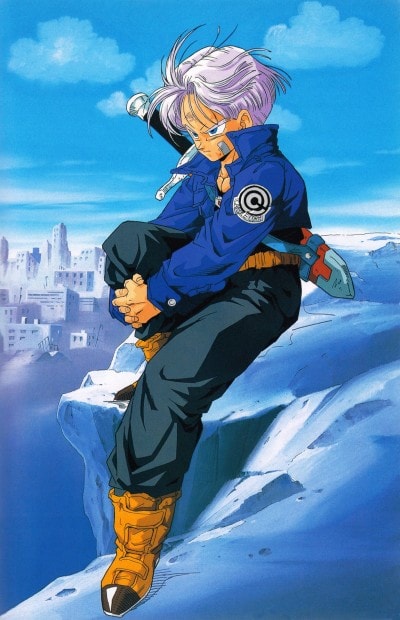
Dragon Ball Z: The History of Trunks
MovieIn a future where Goku died of heart disease and the Androids slaughtered Earth's greatest fighters, teenage Trunks trains under the last warrior alive: a one-armed Gohan fighting a war he cannot win. This is the story of how grief became power, and how a boy became a Super Saiyan.
The World After the Warriors Fell
The History of Trunks opens with the worst possible outcome. Son Goku, the strongest fighter Earth has ever known, dies not in battle but in bed, consumed by a heart virus that no Senzu Bean or Dragon Ball can cure. Six months later, on May 12 of Age 767, Androids 17 and 18 appear and systematically execute the Z Fighters. Vegeta. Piccolo. Krillin. Yamcha. Tien. Chiaotzu. One by one, Earth's defenders fall. With Piccolo dead, Kami dies as well, and the Dragon Balls turn to stone. There will be no wishes. No resurrections. No second chances.
Only one warrior survives the massacre: Son Gohan, barely a teenager when his father dies, left to carry the burden of an entire planet's survival on his shoulders.
Thirteen Years of Ruin
The story jumps forward to Age 780. The world is unrecognizable. Cities exist as skeletal ruins. Two thirds of the human population has been killed. Androids 17 and 18 roam freely, destroying whatever catches their attention, treating mass murder as entertainment. They have no grand plan, no ideology, no demands. They kill because they can, and because nothing on Earth has the power to make them stop.
In this wasteland, twenty-three-year-old Gohan has become something remarkable: a Super Saiyan forged not through ambition but through witnessing the deaths of everyone he loved. He is the last line of defense, and he knows it. He is also a teacher. Fourteen-year-old Trunks, the son of the fallen Vegeta, trains under Gohan with fierce determination. The boy has Saiyan blood and Saiyan pride, but the Super Saiyan transformation remains beyond his reach. Gohan pushes him relentlessly, knowing that Trunks may be humanity's only hope if Gohan himself falls.
The Battle at Super World
When the Androids attack an amusement park called Super World, Gohan and Trunks respond together. Gohan transforms into a Super Saiyan and engages Android 17, initially holding his own with skill and ferocity. But Android 18 enters the fight, and the two-on-one advantage proves insurmountable. Trunks, far too weak to challenge either Android, throws himself into the battle anyway, managing to trade blows with 18 for a brief moment before being swatted aside.
Gohan shields Trunks from death, and the two hide among the destroyed rides and attractions. Unable to find them, the Androids bomb the entire park. Gohan and Trunks survive, but the cost is devastating: Gohan's left arm is blown clean off. He gives his last Senzu Bean to the unconscious Trunks, choosing his student's recovery over his own.
The One-Armed Warrior's Last Stand
Back at Capsule Corporation, Gohan recovers and resumes training Trunks with one arm. He shows no self-pity, no hesitation. If anything, the loss has hardened his resolve. But when the Androids attack Pepper Town, Gohan makes a decision that defines the entire special. He knocks Trunks unconscious with a precise strike to the neck, preventing the boy from following him into a fight that Gohan knows he will not survive.
The one-armed Super Saiyan ambushes Android 17 in the rain-soaked streets. Despite his handicap, Gohan fights brilliantly, forcing 17 to take him seriously. The choreography is deliberate and painful to watch; every blow Gohan lands costs him more than it costs his opponent. When 18 joins, the outcome becomes inevitable. The Androids overwhelm him, knock him to the ground, and execute him with their combined Accel Dance technique. Gohan's body lies face down in a puddle, rain falling on a warrior who never stopped fighting, not for victory, but for time.
Born from Grief
Trunks wakes to a terrible silence. The energy signature he has felt his entire life, the one constant in a world of loss, is gone. He flies to Pepper Town and finds Gohan's body in the wreckage. What follows is one of the most emotionally charged moments in Dragon Ball history. Trunks falls to his knees beside his mentor, his teacher, the closest thing to a father figure he has ever known. The grief tears through him like a physical force. His screams fill the empty city. And in that anguish, the barrier finally breaks. Golden light erupts around Trunks as he transforms into a Super Saiyan for the first time, not through triumph or training, but through pure, unfiltered loss.
Three Years Later
Age 783. Trunks is seventeen now, a Super Saiyan, and he carries himself with quiet intensity. He discovers his mother Bulma building a time machine and dismisses the idea, arguing that as a Super Saiyan, he can handle the Androids alone. Bulma reminds him, gently and firmly, that Gohan was a Super Saiyan too.
When a radio bulletin announces the Androids are attacking Bridgetown, Trunks flies out to confront them despite Bulma's protests. The battle is devastating in its brevity. Trunks, for all his power and determination, is completely outclassed. The Androids toy with him, beating him nearly to death. Android 18 fires a massive blast that should have killed him, but Trunks survives through sheer Saiyan resilience.
He wakes in his bed with Bulma at his side. The humiliation of defeat has given way to clarity. He agrees to use the time machine once it is finished, to travel to the past and deliver heart medicine to Goku before the virus can claim him. Bulma watches her son climb into the machine, knowing she may never see him again, and Trunks vanishes into the timestream. His destination: a past where the warriors still live, where Goku still fights, and where the future might still be saved.

Rain, Ruin, and the Weight of Survival
The History of Trunks contains some of the most emotionally devastating sequences in the entire Dragon Ball franchise, and the power of those scenes comes from restraint as much as spectacle.
Gohan's Final Battle
Future Gohan's last stand in Pepper Town is remarkable for what it refuses to do. There is no dramatic power-up, no hidden reserve of strength, no last-second rescue. Gohan fights with one arm in pouring rain against two opponents who are simply stronger than he is. The animation lingers on the physical toll: the way he guards his missing arm's side, the way each blow staggers him a little more than the last. Director Yoshihiro Ueda understood that the fight needed to feel hopeless, because Gohan's heroism exists precisely in his refusal to stop fighting when hope is gone.
The Transformation
Trunks's Super Saiyan awakening inverts every previous transformation in Dragon Ball. When Goku first turned Super Saiyan on Namek, it was driven by rage at Krillin's death, but it was also triumphant; he became stronger than Frieza, and the audience knew it. Trunks's transformation carries no such promise. He becomes a Super Saiyan, and he is still not strong enough. The golden aura flares around him as he screams over Gohan's corpse, and the audience knows that this power will not be enough to avenge his mentor. It is a moment of becoming that is simultaneously a moment of utter defeat.
The Androids as Forces of Nature
Unlike most Dragon Ball villains, Androids 17 and 18 in this timeline have no ambition, no endgame, and no philosophy. They destroy because it amuses them. This makes them more terrifying than any power-hungry tyrant. You cannot reason with them. You cannot appeal to their ego. You cannot even provoke them into making mistakes, because they have nothing at stake. The special presents them almost like a natural disaster with human faces: beautiful, casual, and completely indifferent to the suffering they cause.
Bulma's Quiet Courage
While the battles steal focus, Bulma's role deserves recognition. She lost her partner Vegeta, watched civilization collapse, and raised a son in a world that could end any day. Her response was not to despair but to build. The time machine represents years of solitary engineering genius, driven by the stubborn belief that the past could fix what the present could not. When she watches Trunks disappear into the timestream, it is one of the bravest moments in the special, a mother sending her only child into the unknown because staying means certain doom.
The Special That Transcended Its Format
The History of Trunks originally aired as a television special on February 24, 1993, directed by Yoshihiro Ueda with a screenplay by Hiroshi Toda. Unlike the theatrical Dragon Ball Z films, which typically ran 45 to 50 minutes, this 48-minute special carried the weight of a feature film through its narrative depth and emotional complexity. It was adapted from a brief manga chapter by Akira Toriyama titled "Trunks The History: The Lone Warrior," though the special significantly expanded the source material and made key dramatic changes, most notably making Trunks unable to transform into a Super Saiyan until after Gohan's death.
Manga Versus Anime
In Toriyama's original manga chapter, Trunks could already transform before Gohan fell. The anime special deliberately altered this detail to create a stronger emotional arc: the transformation becomes a direct consequence of loss rather than a pre-existing ability. This change is widely regarded as an improvement, giving the Super Saiyan awakening a dramatic weight that the brief manga chapter could not achieve in its limited page count.
Cultural Impact
Funimation dubbed the special into English and released it on October 25, 2000, introducing it to Western audiences who had followed Future Trunks's story in the Cell Saga without understanding the full horror of his origin. The special was later remastered and bundled with Bardock: The Father of Goku in May 2008, and received a standalone remastered release on September 15, 2009.
The History of Trunks is consistently ranked among the best entries in the Dragon Ball animated catalog, often cited alongside the Bardock special as proof that the franchise can deliver genuine dramatic storytelling when it chooses to. Future Gohan's one-armed last stand has become one of the most iconic images in anime, referenced in countless fan works and frequently cited by viewers as the moment that elevated Dragon Ball Z beyond simple action entertainment. The special proved that Dragon Ball's universe could sustain real tragedy, and that its characters were capable of inspiring not just excitement, but genuine grief.
Related Reading
See all
Krillin's on the Tinder: How the Ultimate Short King Survived the Height Filter
Tinder built a height filter. Dragon Ball built a five foot legend. What happened when we sent the ultimate short king into the modern dating hellscape....
Infinite Zeni Glitch: When Yamcha Never Pays and Mr. Popo Always Does
The internet found an infinite money glitch. So did Yamcha. A smooth R&B track about the easiest money in the Dragon Ball world and the one man who keeps paying for it....
Frequently Asked Questions
Is DBZ History of Trunks a movie?
In an alternate timeline, Goku succumbs to a deadly heart virus, and six months later, Androids 17 and 18 appear and kill Vegeta, Piccolo, Yamcha, Tien, Krillin, and the others. With Piccolo dead, the Dragon Balls cease to exist, making resurrection impossible. Thirteen years later, the world lies in ruins under the androids' merciless attacks.
When should I watch DBZ history of trunks?
In a future where Goku died of heart disease and the Androids slaughtered Earth's greatest fighters, teenage Trunks trains under the last warrior alive: a one-armed Gohan fighting a war he cannot win. This is the story of how grief became power, and how a boy became a Super Saiyan.
When was Dragon Ball Z: The History of Trunks released?
Dragon Ball Z: The History of Trunks was released on February 24, 1993. It is a TV special in the Dragon Ball Z era.
Who is the main villain in Dragon Ball Z: The History of Trunks?
The main antagonist of Dragon Ball Z: The History of Trunks is Android 17 and Android 18. In an alternate timeline, Goku succumbs to a deadly heart virus, and six months later, Androids 17 and 18 appear and kill Vegeta, Piccolo, Yamcha, Tien, Krillin, and the others.
How long is Dragon Ball Z: The History of Trunks?
Dragon Ball Z: The History of Trunks has a runtime of 48 minutes. Its length is typical for a Dragon Ball TV special of its era.
Sources & Information
Looking for more on Dragon Ball Z: The History of Trunks? The Dragon Ball Wiki on Fandom has a dedicated page with community notes.
View on FandomThis content is original writing by Daddy Jim Headquarters based on the Dragon Ball anime series, manga, and official materials. Episode and chapter references are cited where applicable.
Character and scene imagery on this site is original artwork by Daddy Jim Headquarters, not screenshots or licensed imagery. Official cover art is used on three types of pages for editorial commentary:
- Movie pages: theatrical posters and key visuals, credited to Toei Animation and Shueisha.
- Game pages: official box art, credited to Bandai Namco, Atari, and other publishers.
- Manga chapter pages: Jump Comics volume covers, credited to Shueisha and Akira Toriyama.
Browse our episode guides:
Official resources:
Help Us Keep This Wiki Accurate
Daddy Jim Headquarters maintains this encyclopedia. If you spot an error, a translation issue, or something that doesn't look right, let us know.