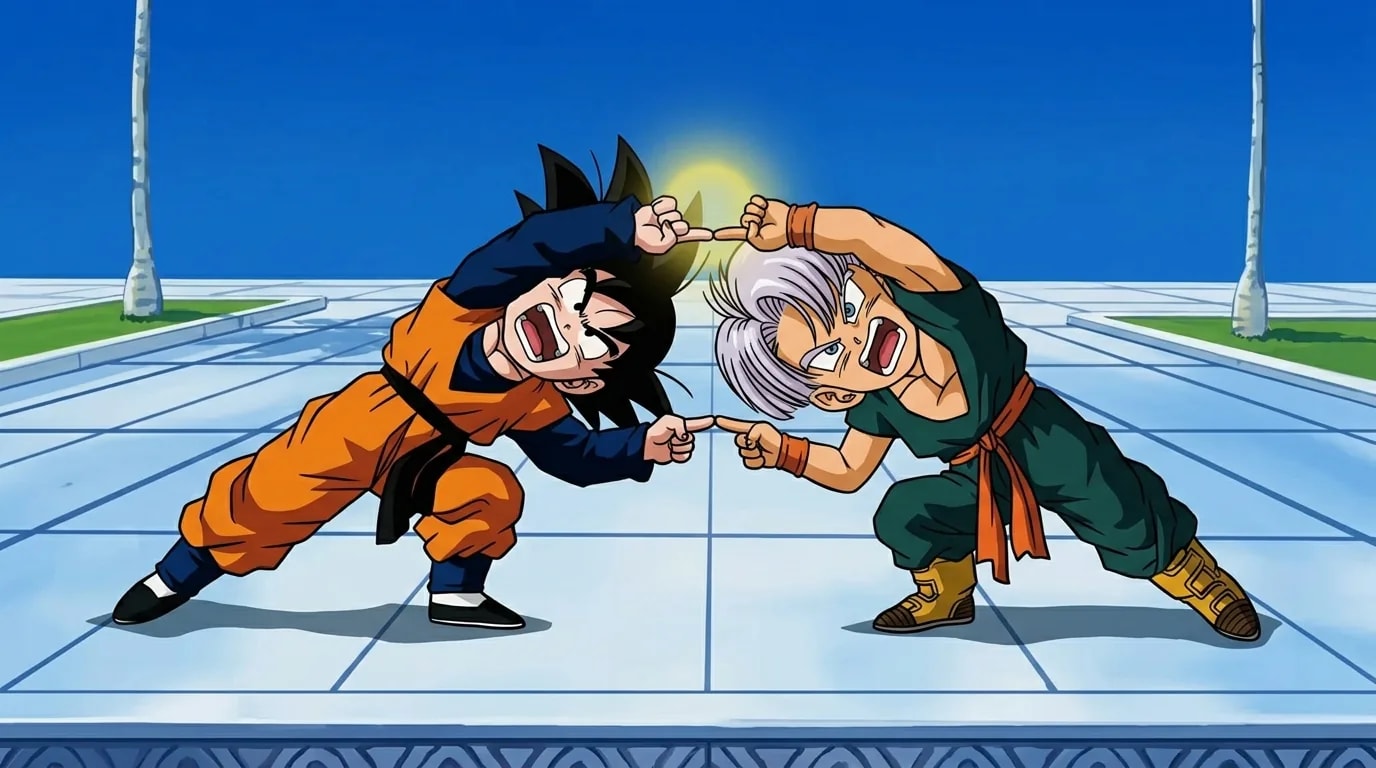
Fusion Dance
TechniqueThe Fusion Dance is a technique developed by the Metamoran race that allows two fighters to temporarily merge into a single, vastly more powerful warrior. Goku learned it while training in Other World and introduced it to Earth's defenders as a countermeasure against Majin Buu.
Origins and Mechanics
The Fusion Dance originates from Planet Metamor, homeworld of the Metamoran people. Goku encountered this civilization during his time in Other World following his sacrifice against Cell, and he spent part of his afterlife training period learning their techniques. When the threat of Majin Buu demanded a power beyond what any single fighter could achieve, Goku returned to Earth with the knowledge of fusion as a potential solution.
The technique itself is deceptively simple in concept but demanding in execution. Two fighters stand six paces apart, side by side, and perform a synchronized sequence of movements while chanting "Fu...sion...HA!" Each participant must perfectly mirror the other, moving with identical timing, arm angles, and leg positions. The routine draws from elements of traditional martial arts stances and, according to Goku, even water ballet. The key mental component involves visualizing two rivers flowing toward each other, converging at a single point, and merging into one stream.
Both participants must equalize their power levels before beginning the dance. While early guidance suggested the fusees also needed similar body sizes, Akira Toriyama later clarified that fusion can succeed regardless of physical differences as long as the technique is performed correctly. The mental synchronization matters far more than physical proportions.
Upon successful completion, a brilliant flash of light engulfs both fighters, and from it emerges a single warrior dressed in the distinctive Metamoran outfit. This new being possesses a blended appearance drawing physical traits from both participants, along with a combined personality that can lean toward one fusee or the other depending on the pairing.

Iconic Fusions and Battle History
The most frequently seen Fusion Dance pairing is Goten and Trunks, whose combined form, Gotenks, became a critical weapon during the Buu Saga. Their youth and competitive friendship made them natural candidates for the technique, though their first two attempts ended in spectacular failure, producing a bloated and then emaciated version of themselves before finally achieving a proper fusion on the third try. As Gotenks, they demonstrated remarkable power, eventually reaching Super Saiyan 3 and challenging Super Buu directly in the Hyperbolic Time Chamber.
The second landmark use of the Fusion Dance came when Goku and Vegeta combined to form Gogeta. Their first fusion attempt in the movie Dragon Ball Z: Fusion Reborn also resulted in failure, creating the obese and helpless Veku after Vegeta botched his finger position. On their second attempt, they successfully formed Gogeta, who obliterated the villain Janemba with almost casual ease. Gogeta would appear again in Dragon Ball GT against Omega Shenron as a Super Saiyan 4, though the immense power drain of that form reduced the fusion timer to roughly ten minutes.
In Dragon Ball Super: Broly, Goku and Vegeta failed twice more before nailing the dance on their third attempt. The resulting Super Saiyan Blue Gogeta engaged the Legendary Super Saiyan Broly in one of the franchise's most visually spectacular battles, demonstrating that the Fusion Dance remained relevant even in the era of godly power.
Comparison with Potara and Legacy
The relative strength of Fusion Dance versus Potara fusion has been debated across multiple official sources. The Daizenshuu guidebooks originally stated that Potara produces a stronger result, while Weekly Shonen Jump claimed the Fusion Dance creates a more balanced warrior who can draw out power more effectively. The most current official position is that Gogeta and Vegito represent equally matched trump cards, meaning the two methods yield comparable power output. The practical differences come down to mechanics: Potara requires the earrings but no choreography, while the Fusion Dance needs perfect synchronization but no equipment.
The Fusion Dance carries a base time limit of 30 minutes, which is half of Potara's one-hour window for mortals. However, the dance also produces a mandatory one-hour cooldown before the participants can fuse again, making timing a critical strategic factor. On the other hand, failed Fusion Dance attempts allow immediate retries, whereas Potara fusion has no failure state since the earrings handle everything automatically.
One notable vulnerability shared by both methods is susceptibility to the Forced Spirit Fission technique, which can forcibly separate any fused warrior by splitting their individual spirits apart. Vegeta demonstrated this ability during the Moro arc, noting he could theoretically undo even Piccolo's Namekian fusions with it.
Despite the emergence of divine transformations and more convenient fusion methods, the Fusion Dance retains its place as one of the most iconic techniques in Dragon Ball. Its dramatic choreography, the tension of whether the participants will execute it properly, and the explosive results of a successful fusion have made it a defining element of the franchise's combat vocabulary.
Related Reading
See all
Krillin's on the Tinder: How the Ultimate Short King Survived the Height Filter
Tinder built a height filter. Dragon Ball built a five foot legend. What happened when we sent the ultimate short king into the modern dating hellscape....
Infinite Zeni Glitch: When Yamcha Never Pays and Mr. Popo Always Does
The internet found an infinite money glitch. So did Yamcha. A smooth R&B track about the easiest money in the Dragon Ball world and the one man who keeps paying for it....
Frequently Asked Questions
What is the Dragon Ball Fusion dance?
The Fusion Dance is a technique developed by the Metamoran race that allows two fighters to temporarily merge into a single, vastly more powerful warrior. Goku learned it while training in Other World and introduced it to Earth's defenders as a countermeasure against Majin Buu.
How to do fusion dance dbz?
The Fusion Dance originates from Planet Metamor, homeworld of the Metamoran people. Goku encountered this civilization during his time in Other World following his sacrifice against Cell, and he spent part of his afterlife training period learning their techniques. When the threat of Majin Buu demanded a power beyond what any single fighter could achieve, Goku returned to Earth with the knowledge of fusion as a potential solution.
Can anyone do the fusion dance in Dragon Ball?
The most frequently seen Fusion Dance pairing is Goten and Trunks, whose combined form, Gotenks, became a critical weapon during the Buu Saga. Their youth and competitive friendship made them natural candidates for the technique, though their first two attempts ended in spectacular failure, producing a bloated and then emaciated version of themselves before finally achieving a proper fusion on the third try. As Gotenks, they demonstrated remarkable power, eventually reaching Super Saiyan 3 and challenging Super Buu directly in the Hyperbolic Time Chamber.
Who invented the Fusion Dance?
The Fusion Dance was invented by Metamorans. The Fusion Dance is a technique developed by the Metamoran race that allows two fighters to temporarily merge into a single, vastly more powerful warrior.
When does the Fusion Dance first appear?
The Fusion Dance first appears in Revival (DBZ Episode 251). In the manga, it debuts in the A Slim Hope arc. The Fusion Dance is a technique developed by the Metamoran race that allows two fighters to temporarily merge into a single, vastly more powerful warrior.
Sources & Information
Looking for more on Fusion Dance? The Dragon Ball Wiki on Fandom has a dedicated page with community notes.
View on FandomThis content is original writing by Daddy Jim Headquarters based on the Dragon Ball anime series, manga, and official materials. Episode and chapter references are cited where applicable.
Character and scene imagery on this site is original artwork by Daddy Jim Headquarters, not screenshots or licensed imagery. Official cover art is used on three types of pages for editorial commentary:
- Movie pages: theatrical posters and key visuals, credited to Toei Animation and Shueisha.
- Game pages: official box art, credited to Bandai Namco, Atari, and other publishers.
- Manga chapter pages: Jump Comics volume covers, credited to Shueisha and Akira Toriyama.
Browse our episode guides:
Official resources:
Help Us Keep This Wiki Accurate
Daddy Jim Headquarters maintains this encyclopedia. If you spot an error, a translation issue, or something that doesn't look right, let us know.