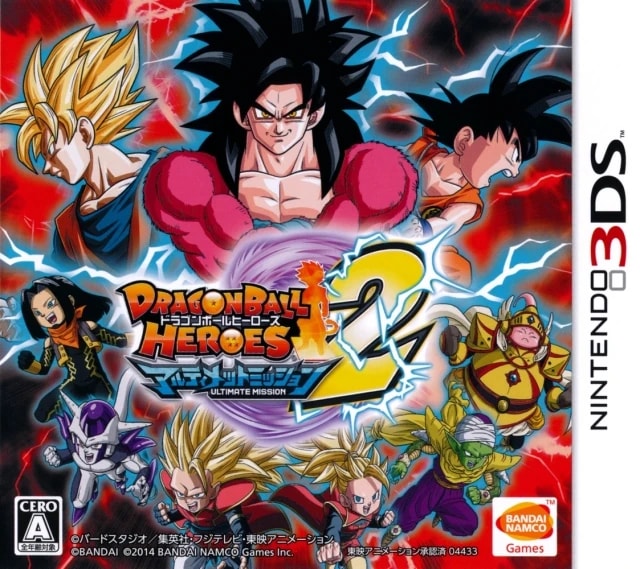
Dragon Ball Heroes: Ultimate Mission 2
Gameis a card-based fighting game that is a portable-port of the arcade game Dragon Ball Heroes, and the sequel to Dragon Ball Heroes: Ultimate Mission. The game was released in Japan for the handheld gaming console on August 7, 2014. Its sequel, Dragon Ball Heroes: Ultimate Mission X, was released in 2017.
Gameplay & Card System
Dragon Ball Heroes: Ultimate Mission 2 is a card-based fighting game for the Nintendo 3DS that reproduces the Dragon Ball Heroes arcade experience in a portable format. The game dramatically expands on its predecessor by including over 2,008 digital cards spanning all 21 Dragon Ball Heroes iterations released up through the Jaaku Mission 3 set, representing more than twice the content available in the original Ultimate Mission. Players assemble decks and engage in battle through a touch-screen interface that mirrors the physical card placement mechanics of the arcade cabinet.
Ultimate Mission 2 introduces several new gameplay modes absent from the first entry. The brand-new Ultimate Universe Mode serves as the sequel's primary adventure offering, while an Arcade Mode and the Burst Limit Mission Mode provide additional structured challenges. In Burst Limit, players work through battles with a finite card pool and cannot reuse the same card twice within a run, adding a strategic layer of resource management that distinguishes it from the game's other modes. Cards obtained in the original Ultimate Mission can be carried forward into Ultimate Mission 2, preserving progress across the two portable entries.
Content updates expanded the game after its initial release on August 7, 2014. A post-Resurrection F update introduced Super Saiyan Blue Goku, Super Saiyan Blue Vegeta, and Golden Frieza cards. A late 2015 update added Super Saiyan 4 Broly, Super Saiyan 4 GT Gogeta, Super Saiyan 4 GT Gohan, and the Masked Saiyan. A third update in April 2016 brought in characters from the Dark Makai arc including Xeno Trunks, the Supreme Kai of Time, Mira, and Towa. First-print physical copies of the game include a bonus set of arcade-compatible cards for use in the Dragon Ball Heroes arcade machines.



Characters & Content
The roster in Dragon Ball Heroes: Ultimate Mission 2 is among the most expansive in any Dragon Ball game released up to its time. Characters span the full timeline of the franchise, from classic Dragon Ball figures such as young Goku and Emperor Pilaf's forces to Dragon Ball Z villains including Frieza, Cell, Majin Buu, and Broly in multiple transformations, through Dragon Ball GT antagonists such as Baby Vegeta, Super 17, and the Shadow Dragons. The game also incorporates Dragon Ball Heroes-exclusive characters such as Mira, Towa, and Xeno variants of established fighters who exist in the game's own continuity.
Player avatars are fully customizable through a class and race selection system, with Saiyan, Majin, Frieza's Race, Namekian, and Android avatar types available, each subdivided into Hero, Elite, and Berserker subtypes with their own transformation paths. Giant-form boss characters such as Golden Great Ape Baby Vegeta and Great Ape Vegeta serve as powerful adversaries in the game's battle modes, challenging players to coordinate their deck strategies against oversized opponents.
Reception & Legacy
Dragon Ball Heroes: Ultimate Mission 2 continued the portable Dragon Ball Heroes series at a time when the arcade game was at peak popularity in Japan. Its release in 2014 coincided with the franchise's expanded push into Dragon Ball Battle of Gods-era content, and its post-launch updates kept it current with the Resurrection F and Universe Survival-era story developments. The game's sequels, Dragon Ball Heroes: Ultimate Mission X released in 2017, carried the portable series to its logical conclusion before the arcade game was eventually rebranded as Super Dragon Ball Heroes.
As a Japan-exclusive title, Ultimate Mission 2 did not reach Western audiences directly, but it remains an important artifact of the Dragon Ball Heroes ecosystem that contributed to the franchise's enormous card game legacy, which distributed over 1.2 billion physical cards by October 2022.
Related Reading
See all
Krillin's on the Tinder: How the Ultimate Short King Survived the Height Filter
Tinder built a height filter. Dragon Ball built a five foot legend. What happened when we sent the ultimate short king into the modern dating hellscape....
Infinite Zeni Glitch: When Yamcha Never Pays and Mr. Popo Always Does
The internet found an infinite money glitch. So did Yamcha. A smooth R&B track about the easiest money in the Dragon Ball world and the one man who keeps paying for it....
Frequently Asked Questions
What is Dragon Ball Heroes: Ultimate Mission 2?
is a card-based fighting game that is a portable-port of the arcade game Dragon Ball Heroes, and the sequel to Dragon Ball Heroes: Ultimate Mission. The game was released in Japan for the handheld gaming console on August 7, 2014. Its sequel, Dragon Ball Heroes: Ultimate Mission X, was released in 2017.
What is Dragon Ball Heroes: Ultimate Mission 2 about?
Dragon Ball Heroes: Ultimate Mission 2 is a card-based fighting game for the Nintendo 3DS that reproduces the Dragon Ball Heroes arcade experience in a portable format. The game dramatically expands on its predecessor by including over 2,008 digital cards spanning all 21 Dragon Ball Heroes iterations released up through the Jaaku Mission 3 set, representing more than twice the content available in the original Ultimate Mission. Players assemble decks and engage in battle through a touch-screen interface that mirrors the physical card placement mechanics of the arcade cabinet.
When was Dragon Ball Heroes: Ultimate Mission 2 released?
Dragon Ball Heroes: Ultimate Mission 2 was released in 2014. It was developed by Dimps and published by Bandai Namco.
Who developed Dragon Ball Heroes: Ultimate Mission 2?
Dragon Ball Heroes: Ultimate Mission 2 was developed by Dimps. The game was published by Bandai Namco in 2014.
Who published Dragon Ball Heroes: Ultimate Mission 2?
Dragon Ball Heroes: Ultimate Mission 2 was published by Bandai Namco. The game was developed by Dimps and released in 2014.
Sources & Information
Looking for more on Dragon Ball Heroes: Ultimate Mission 2? The Dragon Ball Wiki on Fandom has a dedicated page with community notes.
View on FandomThis content is original writing by Daddy Jim Headquarters based on the Dragon Ball anime series, manga, and official materials. Episode and chapter references are cited where applicable.
Character and scene imagery on this site is original artwork by Daddy Jim Headquarters, not screenshots or licensed imagery. Official cover art is used on three types of pages for editorial commentary:
- Movie pages: theatrical posters and key visuals, credited to Toei Animation and Shueisha.
- Game pages: official box art, credited to Bandai Namco, Atari, and other publishers.
- Manga chapter pages: Jump Comics volume covers, credited to Shueisha and Akira Toriyama.
Browse our episode guides:
Official resources:
Help Us Keep This Wiki Accurate
Daddy Jim Headquarters maintains this encyclopedia. If you spot an error, a translation issue, or something that doesn't look right, let us know.