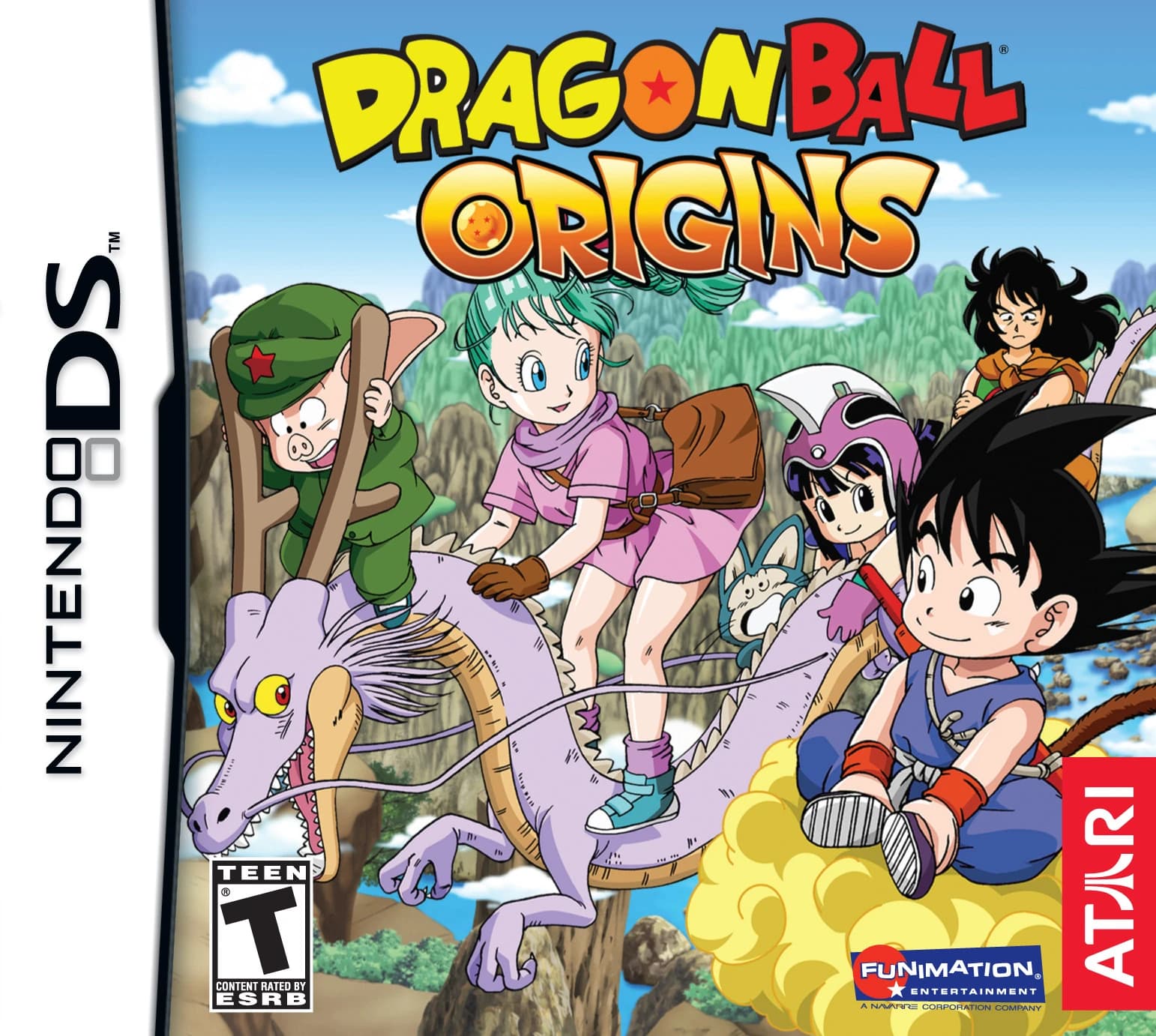
Dragon Ball: Origins
GameDragon Ball: Origins, originally published as in Japan, is a video game for the based on Dragon Ball. It was developed by and published by Atari and Namco Bandai under the Bandai label. It was released on September 18, 2008 in Japan, on November 4, 2008 in America, on December 5, 2008 in Europe and on December 16, 2008 in Australia.
Gameplay
Dragon Ball: Origins is an action-adventure game for the Nintendo DS that presents the entire game from an overhead perspective, with Goku as the sole fully playable character controlled via the stylus. Goku operates in two modes: a bare-handed combat stance and one employing his Power Pole for extended reach. Over the course of the game he learns additional techniques including the Kamehameha, Spin Attack, and Afterimage Technique, each governed by a ki meter that depletes with special attack use and refills over time. A separate life meter tracks health, and losing either Goku's or Bulma's health results in a game-over screen with Bulma humorously penalizing Goku for the failure.
Bulma accompanies Goku across many stages, navigating via the simplest available path while dealing with enemies she encounters. She possesses her own life and ki meters, with her ki gauge not depleting during normal attacks. Players can trigger Bulma's special attack by tapping her when her ki is full, and her special attack loadout is customizable from the game menu. Creating a clear path for Bulma to advance safely becomes a secondary objective in stages where terrain or enemy placement threatens her route.
The game features 200 collectable figurines obtainable through store purchases, discovery in the environment, and mission speed completion rewards. Figurines depict characters performing iconic actions from the game and can be rotated and zoomed in the viewer. Two players can trade figurines wirelessly between copies of the game, adding a social dimension to collection completion. Defeating enemies yields Zeni for the store and skill orbs that fund Goku's attack upgrades.

Story & Changes from Source Material
Dragon Ball: Origins covers the Emperor Pilaf Saga and the 21st World Martial Arts Tournament Saga with a number of deliberate alterations to the source material. The game introduces extended sequences and new encounters not present in the manga or anime, such as Goku and Oolong infiltrating the Rabbit Gang's hideout to rescue Bulma, Pilaf fielding a giant robot modeled after himself, and Goku confronting Oolong in his mansion after chasing him while still transformed. Side stories accessible by completing certain story chapters add further original content, including rescuing a lost villager, recovering the Ox-King's treasure, escorting Bulma to Kame House, and training with Krillin.
The game also modifies the sequencing and nature of several iconic encounters from the source material, including repositioning the Goku versus Giran match to open the 21st World Martial Arts Tournament rather than appearing fourth, and having Goku fight Chi-Chi in person after she defeats a T-Rex rather than the anime's version of events. These adjustments give the game its own narrative identity while remaining faithful to the spirit of the original story.
Related Reading
See all
Namek Has No Women, and Piccolo Pulls Anyway
There are no women on Namek. That isn't an oversight, it's the biology. Why we handed Piccolo the one thing his own species rules out, and why it had to be trap soul....
1000 Times Over: Who Is John Dragon Ball Singing To?
Dragon Ball handed us a protagonist with no history and the internet named him John Dragon Ball. So we built him somebody to talk to....

Release & Legacy
Dragon Ball: Origins released in Japan on September 18, 2008, followed by North America on November 4, 2008, Europe on December 5, 2008, and Australia on December 16, 2008. Published by Atari and Namco Bandai under the Bandai label in their respective regions, the game marked one of the earlier Dragon Ball titles to receive simultaneous international distribution across multiple major markets. Its sequel, Dragon Ball: Origins 2, followed in 2010 and expanded the concept with a broader playable cast and co-op support.
The game is regarded as one of the stronger portable Dragon Ball titles for its faithful visual recreation of the original manga art style and its thoughtful translation of the early Dragon Ball adventure structure into handheld gameplay. By adapting the pre-Z era of the franchise, Origins served an audience interested in the classic Dragon Ball storyline that received less dedicated game coverage than the later Dragon Ball Z material.
Frequently Asked Questions
What is the Dragon Ball: Origins series?
Dragon Ball: Origins ties into the Dragon Ball era of the franchise. Dragon Ball: Origins, originally published as in Japan, is a video game for the based on Dragon Ball.
What are Dragon Ball: Origins?
Dragon Ball: Origins, originally published as in Japan, is a video game for the based on Dragon Ball. It was developed by and published by Atari and Namco Bandai under the Bandai label. It was released on September 18, 2008 in Japan, on November 4, 2008 in America, on December 5, 2008 in Europe and on December 16, 2008 in Australia.
How does Dragon Ball: Origins play?
Dragon Ball: Origins is an action-adventure game for the Nintendo DS that presents the entire game from an overhead perspective, with Goku as the sole fully playable character controlled via the stylus. Goku operates in two modes: a bare-handed combat stance and one employing his Power Pole for extended reach. Over the course of the game he learns additional techniques including the Kamehameha, Spin Attack, and Afterimage Technique, each governed by a ki meter that depletes with special attack use and refills over time.
Which characters appear in Dragon Ball: Origins?
Dragon Ball: Origins covers the Emperor Pilaf Saga and the 21st World Martial Arts Tournament Saga with a number of deliberate alterations to the source material. The game introduces extended sequences and new encounters not present in the manga or anime, such as Goku and Oolong infiltrating the Rabbit Gang's hideout to rescue Bulma, Pilaf fielding a giant robot modeled after himself, and Goku confronting Oolong in his mansion after chasing him while still transformed. Side stories accessible by completing certain story chapters add further original content, including rescuing a lost villager, recovering the Ox-King's treasure, escorting Bulma to Kame House, and training with Krillin.
When was Dragon Ball: Origins released?
Dragon Ball: Origins was released in 2008. It was published by Namco Bandai / Atari.
Sources & Information
Looking for more on Dragon Ball: Origins? The Dragon Ball Wiki on Fandom has a dedicated page with community notes.
View on FandomThis content is original writing by Daddy Jim Headquarters based on the Dragon Ball anime series, manga, and official materials. Episode and chapter references are cited where applicable.
Rights holders
- Created byAkira Toriyama
- Published byShueisha
- Animated byToei Animation
All rights belong to their respective owners.
Character and scene imagery on this site is original artwork by Daddy Jim Headquarters, not screenshots or licensed imagery. Official cover art is used on three types of pages for editorial commentary:
- Movie pages: theatrical posters and key visuals, credited to Toei Animation and Shueisha.
- Game pages: official box art, credited to Bandai Namco, Atari, and other publishers.
- Manga chapter pages: Jump Comics volume covers, credited to Shueisha and Akira Toriyama.
Browse our episode guides:
Official resources:
Help Us Keep This Wiki Accurate
Daddy Jim Headquarters maintains this encyclopedia. If you spot an error, a translation issue, or something that doesn't look right, let us know.