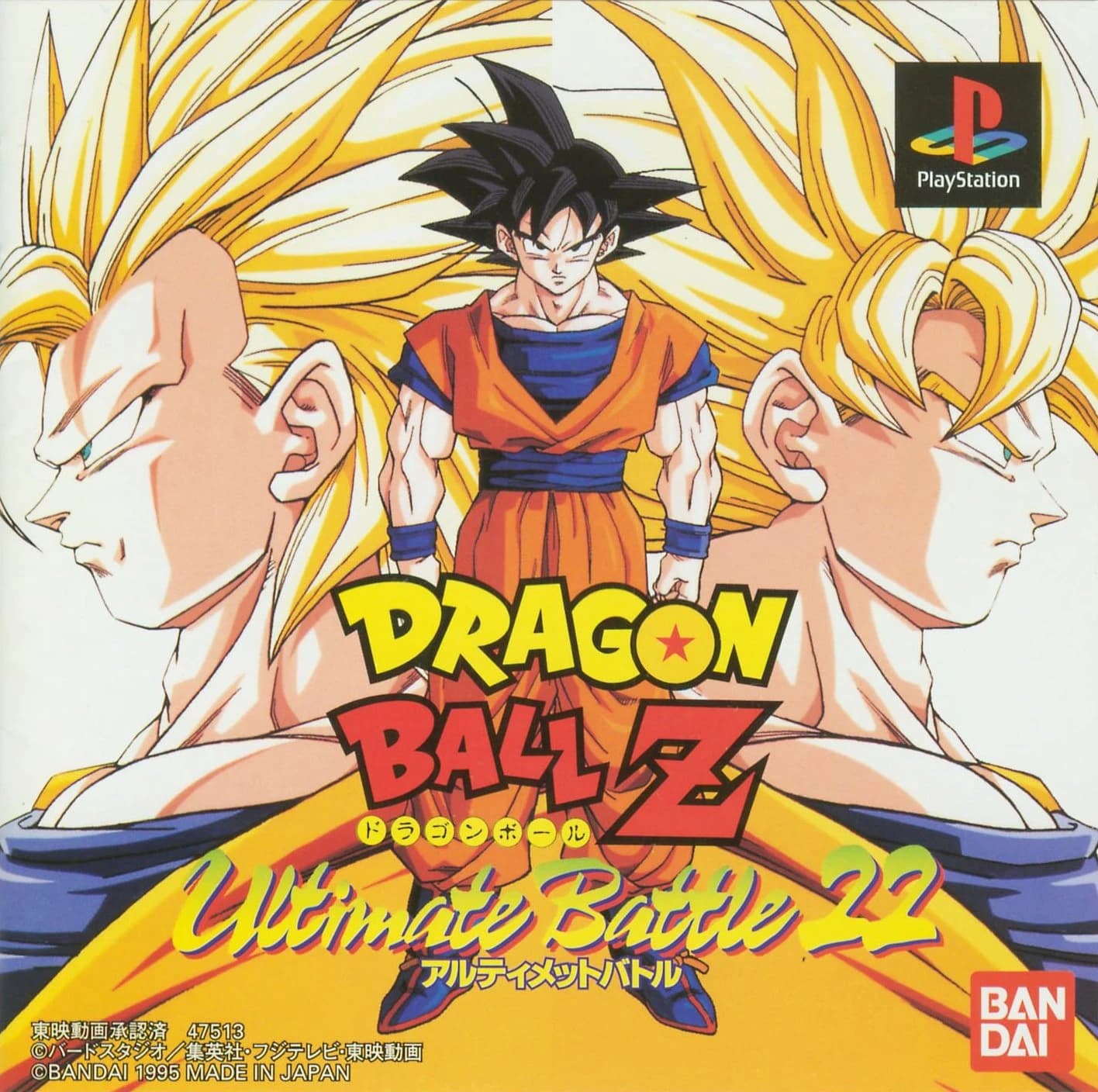
Dragon Ball Z: Ultimate Battle 22
GameDragon Ball Z: Ultimate Battle 2222|Doragonbōru Zetto Arutimetto Batoru To~uentītsū}} is a 2D/3D fighting video game based on the Dragon Ball Z anime series. It was released for the PlayStation in 1995 in Japan and 1996 in Europe. It was later released in the US in 2003.
Gameplay
Dragon Ball Z: Ultimate Battle 22 is a 2D fighting game that incorporates three-dimensional camera work into its combat presentation. All matches begin on the ground but can shift to an aerial perspective when both players choose to rise and levitate. In the air, the camera transitions to a dynamic overhead angle, and characters struck by heavy attacks while airborne plummet downward and receive additional damage, mirroring the physics of anime combat sequences. Close combat moves, a range of Ki Blast attacks, and character-specific hypermoves triggered by directional inputs form the core offensive toolkit.
Each character maintains both a health bar and a strength meter. Special attacks draw from the strength meter, and if it empties completely the character becomes temporarily exhausted and unable to act. Strength recharges by holding the assigned buttons and performing the signature aura charge pose. Players can also generate a brief energy shield that blocks energy-based attacks entirely, though it offers no protection against melee strikes. The game's notable visual distinction is its use of actual cel drawings from the animation staff as character sprites, a novelty at the time of its original Japanese release in 1995.

Roster and Modes
The game ships with twenty-two selectable fighters drawn from across Dragon Ball Z, covering characters from the Saiyan Saga villains through the Buu Saga roster. Five additional characters are accessible via cheat codes printed in the manual, expanding the total to twenty-seven and triggering a change in the title screen text from "Ultimate Battle 22" to "Ultimate Battle 27." The five hidden fighters are Kid Goku, Master Roshi, Mr. Satan, Super Saiyan 3 Goku, and Gogeta, with Gogeta mistakenly labeled as Vegito in the North American release published by Atari in 2003.
Pre-battle cutscenes featuring cel-animated sequences appeared in the original Japanese version but were removed for both the European and North American releases, reducing the presentation value for Western audiences. The North American release also arrived without an English dub track, meaning all voice lines remained in Japanese eight years after the game's original launch. Battle arenas include locations such as Namek, the Cell Games Arena, Kami's Lookout, the Hyperbolic Time Chamber, and the World Martial Arts Tournament stage.
Related Reading
See all
Namek Has No Women, and Piccolo Pulls Anyway
There are no women on Namek. That isn't an oversight, it's the biology. Why we handed Piccolo the one thing his own species rules out, and why it had to be trap soul....
1000 Times Over: Who Is John Dragon Ball Singing To?
Dragon Ball handed us a protagonist with no history and the internet named him John Dragon Ball. So we built him somebody to talk to....
Release and Legacy
Ultimate Battle 22 was released for the PlayStation in Japan in 1995 and in Europe in 1996, with a North American Atari-published release following in 2003. The game shares substantial elements with Dragon Ball Z: Shin Butoden, a Sega Saturn exclusive released in Japan shortly after Ultimate Battle 22, including an identical character selection, reused sprite artwork, and largely shared music. Both games are considered part of the same era of Bandai Dragon Ball Z fighting games built on the Butoden series framework.
The use of hand-drawn animation cel artwork as character sprites was a technically distinctive choice that gave the game a visual authenticity rare among fighting games at the time. Despite this, the North American release was widely criticized for its delayed arrival and the removal of localization features present in other regional releases. The title occupies a historically notable position in the franchise as one of the earliest Dragon Ball Z games to field a roster of this size on home console hardware.
Frequently Asked Questions
How to unlock characters in dbz ultimate battle 22?
In the air, the camera transitions to a dynamic overhead angle, and characters struck by heavy attacks while airborne plummet downward and receive additional damage, mirroring the physics of anime combat sequences. Close combat moves, a range of Ki Blast attacks, and character-specific hypermoves triggered by directional inputs form the core offensive toolkit. Each character maintains both a health bar and a strength meter.
What is Dragon Ball Z: Ultimate Battle 22?
Dragon Ball Z: Ultimate Battle 2222 Zetto Arutimetto Batoru To~uentītsū}} is a 2D/3D fighting video game based on the Dragon Ball Z anime series. It was released for the PlayStation in 1995 in Japan and 1996 in Europe. It was later released in the US in 2003.
What game modes does Dragon Ball Z: Ultimate Battle 22 have?
Dragon Ball Z: Ultimate Battle 22 is a 2D fighting game that incorporates three-dimensional camera work into its combat presentation. All matches begin on the ground but can shift to an aerial perspective when both players choose to rise and levitate. In the air, the camera transitions to a dynamic overhead angle, and characters struck by heavy attacks while airborne plummet downward and receive additional damage, mirroring the physics of anime combat sequences.
When was Dragon Ball Z: Ultimate Battle 22 released?
Dragon Ball Z: Ultimate Battle 22 was released in 1995. Bandai / Atari / Infogrames published it as part of the Dragon Ball Z game series.
Who developed Dragon Ball Z: Ultimate Battle 22?
Dragon Ball Z: Ultimate Battle 22 was developed by TOSE Software Co. Bandai / Atari / Infogrames published the title in 1995. Dragon Ball Z: Ultimate Battle 2222 Zetto Arutimetto Batoru To~uentītsū}} is a 2D/3D fighting video game based on the Dragon Ball Z anime series.
Sources & Information
Looking for more on Dragon Ball Z: Ultimate Battle 22? The Dragon Ball Wiki on Fandom has a dedicated page with community notes.
View on FandomThis content is original writing by Daddy Jim Headquarters based on the Dragon Ball anime series, manga, and official materials. Episode and chapter references are cited where applicable.
Rights holders
- Created byAkira Toriyama
- Published byShueisha
- Animated byToei Animation
All rights belong to their respective owners.
Character and scene imagery on this site is original artwork by Daddy Jim Headquarters, not screenshots or licensed imagery. Official cover art is used on three types of pages for editorial commentary:
- Movie pages: theatrical posters and key visuals, credited to Toei Animation and Shueisha.
- Game pages: official box art, credited to Bandai Namco, Atari, and other publishers.
- Manga chapter pages: Jump Comics volume covers, credited to Shueisha and Akira Toriyama.
Browse our episode guides:
Official resources:
Help Us Keep This Wiki Accurate
Daddy Jim Headquarters maintains this encyclopedia. If you spot an error, a translation issue, or something that doesn't look right, let us know.