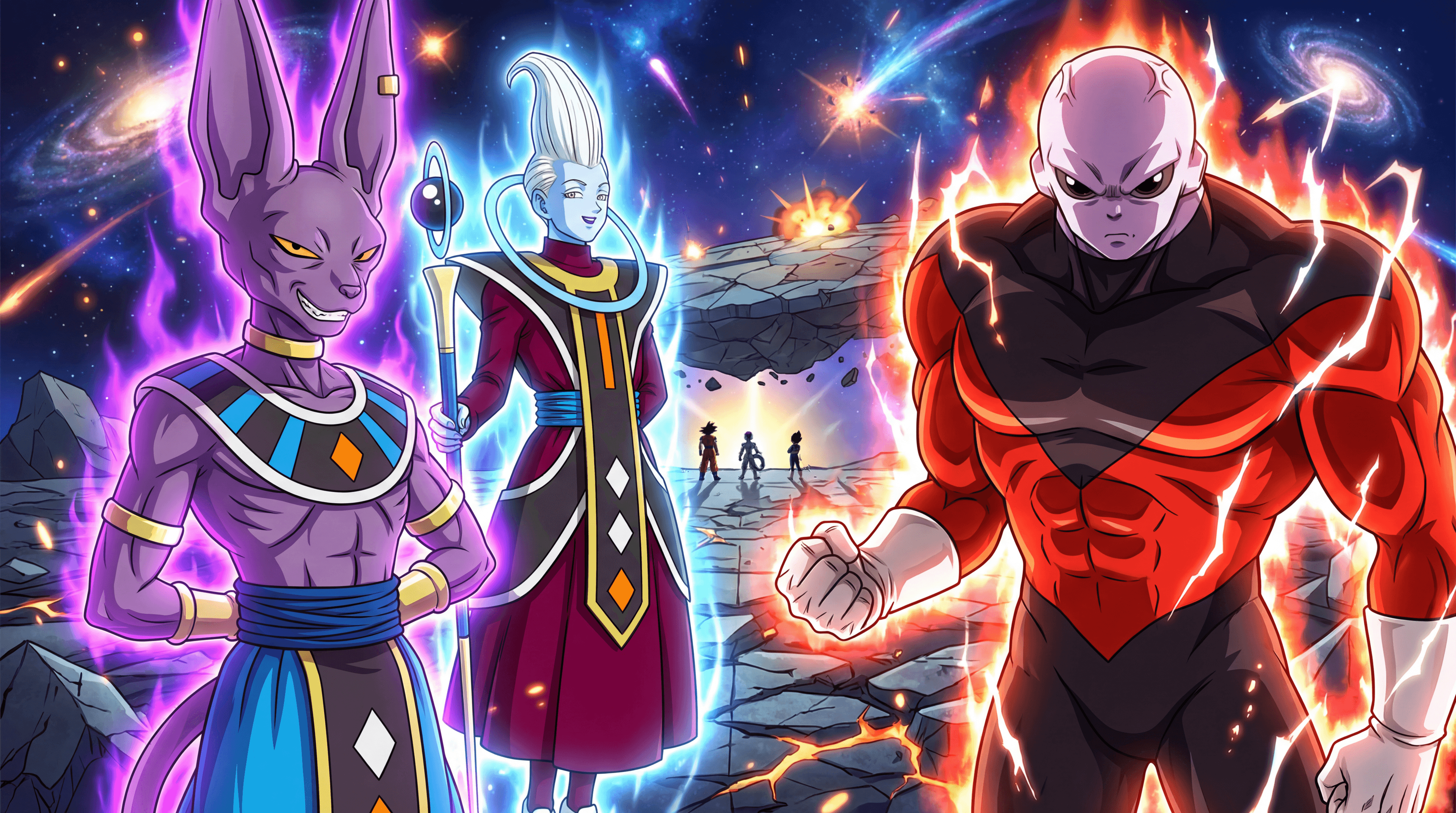
Son-Goku und Vegeta fusionieren zu Vegeto Blue, um gegen den fusionierten Zamasu zu kämpfen, defusionieren jedoch früh. Trunks aus der Zukunft bündelt die Energie jedes Überlebenden auf der Erde in einem Schwert der Hoffnung und spaltet den fusionierten Gott in zwei Hälften, womit der Kampf endet.
Vegito Returns, Trunks Finishes
Goku's God Kamehameha tears away half of Fused Zamasu's face, revealing that his fusion is imperfect. Because Goku Black's body is mortal while Future Zamasu's is immortal, the merged form lacks stability. The right side of Fused Zamasu's body begins mutating into a grotesque purple mass. Despite losing the use of both arms from the strain, Goku uses Kaio-ken to land a final kick before collapsing. Gowasu identifies the weakness: the conflict between mortal and immortal halves creates openings, but exploiting them requires enormous power.
Goku proposes Potara fusion. Vegeta resists the idea but recognizes they have no alternatives. Gowasu explains that non-Supreme Kai fusions last only one hour. After eating their last Senzu Beans, Goku and Vegeta don the earrings, and Vegito emerges for the first time since the battle against Super Buu. He immediately transforms into Super Saiyan Blue, dubbing himself "Vegito Blue." The fused warrior dominates Fused Zamasu, stabbing him with a Spirit Sword and pointing out that fusing with a mortal body means Zamasu is no longer truly immortal.
But the fusion burns through energy at a catastrophic rate. Vegito fires a devastating God Final Kamehameha, and just as he teleports in for a finishing blow, he defuses, far short of the one-hour limit. Goku and Vegeta crash to the ground helpless. As Fused Zamasu prepares to end them, Future Trunks arrives wielding a sword of pure ki energy. Powered by the collective energy of every surviving person on Earth, channeled through a Spirit Bomb-like sphere of light, Future Trunks's blade grows into a massive cleaver of energy. He drives it through Fused Zamasu and slices him completely in half, ending the battle in one climactic stroke.

Imperfect Immortality
Fused Zamasu's mutation is the saga's cruelest irony. The being who sought perfection through godhood is undone by the very mortal body he stole. His deterioration reflects the fundamental contradiction in his philosophy: he despises mortals yet relies on a mortal's body for his power. Vegito's return is fan service done right, providing a spectacular but ultimately incomplete solution that passes the baton to Future Trunks. The early defusion makes narrative sense since the power required to fight as Vegito Blue exceeded the fusion's energy budget, preventing the climax from being resolved by a borrowed power-up.
Verwandte Artikel
Alle anzeigen
Namek hat keine Frauen, und Piccolo klärt trotzdem
Es gibt keine Frauen auf Namek. Das ist kein Versehen, das ist die Biologie. Warum wir Piccolo die eine Sache gegeben haben, die seine eigene Spezies völlig ausschließt, und warum es Trap Soul sein musste....
1000 Mal: Für wen singt John Dragon Ball das?
Dragon Ball hat uns einen Protagonisten ohne Vorgeschichte vor die Füße geworfen und das Internet hat ihn John Dragon Ball getauft. Also haben wir ihm jemanden zum Quatschen gebastelt....
The People's Sword
Future Trunks's victory with the Sword of Hope draws on the Spirit Bomb's legacy while making it deeply personal. The energy comes not from a planet full of strangers but from the specific survivors he has been protecting throughout the saga: the soldiers, the children Haru and Maki, Future Yajirobe, Future Mai, and even Bulma. Goku and Vegeta contribute their remaining energy willingly, completing a transfer of responsibility to the saga's true protagonist. Future Trunks does not win because he is the strongest. He wins because he carries the hope of everyone who refused to give up.
Häufig gestellte Fragen
Was passiert in "Showdown! The Miraculous Power of Unyielding Warriors"?
Goku und Vegeta verschmelzen zu Vegito Blue, um gegen Fusions-Zamasu zu kämpfen, lösen sich aber früh wieder auf. Future Trunks bündelt die Energie aller Überlebenden der Erde in einem Schwert der Hoffnung und spaltet den verschmolzenen Gott in zwei Hälften, womit der Kampf endet.
Aus welcher Dragon-Ball-Serie stammt "Showdown! The Miraculous Power of Unyielding Warriors"?
"Showdown! The Miraculous Power of Unyielding Warriors" ist Folge 66 von Dragon Ball Super. Goku und Vegeta verschmelzen zu Vegito Blue, um gegen Fusions-Zamasu zu kämpfen, lösen sich aber früh wieder auf.
Wie beginnt "Showdown! The Miraculous Power of Unyielding Warriors"?
Gokus Gott-Kamehameha reißt eine Hälfte des Gesichts von Fusions-Zamasu weg und enthüllt, dass seine Fusion unvollkommen ist. Da Goku Blacks Körper sterblich, der von Future Zamasu jedoch unsterblich ist, fehlt der verschmolzenen Form die Stabilität. Die rechte Seite des Körpers von Fusions-Zamasu beginnt zu einer grotesken violetten Masse zu mutieren.
Was ist der Mittelteil von "Showdown! The Miraculous Power of Unyielding Warriors"?
Die Mutation von Fusions-Zamasu ist die grausamste Ironie der Saga. Das Wesen, das durch Göttlichkeit nach Perfektion strebte, scheitert ausgerechnet an dem sterblichen Körper, den es gestohlen hat. Sein Verfall spiegelt den grundlegenden Widerspruch seiner Philosophie wider: Er verachtet Sterbliche und ist für seine Kraft doch auf den Körper eines Sterblichen angewiesen.
Wie endet "Showdown! The Miraculous Power of Unyielding Warriors"?
Goku und Vegeta steuern bereitwillig ihre verbleibende Energie bei und vollziehen damit eine Übertragung der Verantwortung an den eigentlichen Protagonisten der Saga. Future Trunks gewinnt nicht, weil er der Stärkste ist. Er gewinnt, weil er die Hoffnung all jener trägt, die sich weigerten aufzugeben.
Quellen & Informationen
Mehr zu Der Entscheidungskampf! Die wunderbare Kraft der Unbeugsamen! gesucht? Die Dragon Ball Wiki auf Fandom hat eine eigene Seite mit Community-Hinweisen.
Auf Fandom ansehenDieser Inhalt ist ein Originaltext von Daddy Jim Headquarters, basierend auf der Dragon Ball Animeserie, dem Manga und offiziellen Materialien. Episoden- und Kapitelreferenzen werden bei Bedarf angegeben.
Rechteinhaber
- Erschaffen vonAkira Toriyama
- Veröffentlicht vonShueisha
- Animiert vonToei Animation
Alle Rechte liegen bei den jeweiligen Rechteinhabern.
Charakter- und Szenenbilder auf dieser Seite sind Originalkunstwerke von Daddy Jim Headquarters, keine Screenshots oder lizenzierten Bilder. Offizielle Cover-Artworks werden auf drei Seitentypen für redaktionellen Kommentar verwendet:
- Filmseiten: Kinoplakate und Key Visuals, mit Verweis auf Toei Animation und Shueisha.
- Spielseiten: Offizielles Box-Artwork, mit Verweis auf Bandai Namco, Atari und andere Verlage.
- Manga-Kapitelseiten: Jump Comics Bandcover, mit Verweis auf Shueisha und Akira Toriyama.
Unsere Episodenführer:
Offizielle Ressourcen:
Hilf uns, dieses Wiki aktuell zu halten
Daddy Jim Headquarters pflegt diese Enzyklopädie. Wenn du einen Fehler, ein Übersetzungsproblem oder etwas Merkwürdiges entdeckst, gib uns Bescheid.